0
0

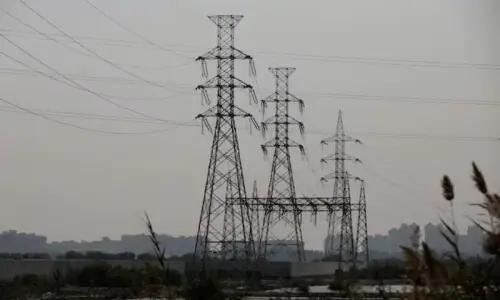
ISLAMABAD, July 3: Wapda has blamed the ministry of water and power and National Electric Power Regulatory Authority (Nepra) for the power crisis and said they had consistently been delaying its plan to set up new power plants for the past few years.
A Wapda official said that the shortfall in power production would cross 5,000 megawatts by 2010.
In a background briefing, the official said that Wapda had been cautioning about the potential power shortfall since early 2002 and had been trying to persuade the government to either allow it to instal thermal stations either on its own or with the involvement of private sector.
“Our proposals were not given any weight,” he said, adding that the government did not even accept Wapda’s consumption growth estimates. He, however, conceded that Wapda too could not be absolved of its failure to set up new hydroelectric power stations.
He claimed that the Wapda chairman had said at a recent meeting that he would not insist on Wapda setting up thermal stations but if asked he could issue tenders within three days and start construction within three to four months because the project structure had already been prepared.
He said the ministry of water and power, the Private Power and Infrastructure Board and Nepra had wasted well over a year in a tug-of-war over procedures for tariff determination for new power projects.
As proof, the official produced a number of documents, including a letter by Wapda chairman to the secretary of water and power dated March 22, 2002. The letter indicated the actual demand and supply situation over three years. The Wapda chairman wrote that the shortfall in power supply during winter of the following year (2003) was anticipated to range between 300 and 600 megawatts.
“There is, therefore, (an) immediate need of planning additional thermal power generation. It is apprehended that if immediate measures are not initiated, we may fall into a situation similar to that of 90s when load-shedding forced us to accept high tariff of IPPs,” wrote the Wapda chairman.
Wapda chairman also said that there was a serious need to set up thermal stations of about 600MW in mid-country. “However, the current government policy does not support installation of thermal stations in public sector.”
As such, the government was asked to allow the Wapda to establish two combined cycle projects of 450MW, one in Faisalabad and the other in Multan, as the authority already had land and infrastructure available. “Alternatively, we may be allowed to go for IPPs through international competitive bidding for the establishment of two 300MW and 450MW stations, one each in Faisalabad and Multan, (respectively).”
Subsequently, Wapda was allowed by President General Pervez Musharraf about two years ago to set up thermal power stations in Faisalabad, Nandipur and Chichuki Malyan with a combined generation capacity of about 1,350MW. But, the decision was withdrawn by the prime minister’s secretariat and the ministry of water and power with the prime minister citing the government’s covenants with the World Bank that restricted Wapda’s power wing from installing thermal stations.
On the other hand, the government did not offer the projects to private sector. However, Wapda’s Generation Company-III was recently allowed to instal a 450MW thermal power plant in Chichuki Malyan in the public sector on an emergency basis. Tenders for the project have already appeared in newspapers.
Referring to the government’s claim that it had provided the power utility a subsidy of Rs80 billion over the past few years, the official termed it a jugglery of figures. He said one reason for not allowing Wapda to set up plants was that the total cost of setting up a power plant was about $700,000 per megawatt against the private sector’s stated cost of over a million dollar per megawatt. It could have exposed some government officials, he said. The official said that Wapda had increased its power supply to the KESC to overcome the law and order situation in the Sindh megapolis but at the cost of its own consumers.
No immediate relief
By Our Staff Reporter
KARACHI: The top brass of the Karachi Electric Supply Corporation on Monday expressed helplessness in providing immediate relief to the irritated citizens but promised that the power supply situation would improve in two to three years.
At a joint press conference here, the chief executive officer of the KESC and the managing director of Siemens said that the frequent breakdowns in transmission network were caused by some elements in the power utility in connivance with external elements.