SC directs IHC to decide Imaan, Hadi's pleas against sentence within two weeks



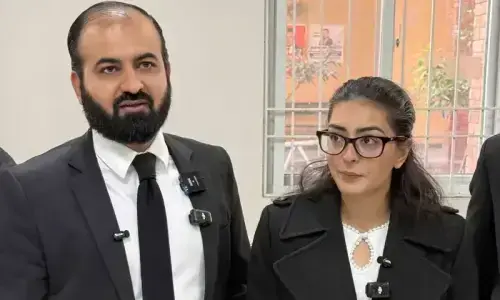
ISLAMABAD: The Supreme Court on Tuesday asked the Islamabad High Court (IHC) to decide within two weeks the pleas of human rights lawyer Imaan Zainab Mazari-Hazir and her husband, Hadi Ali Chattha, seeking the suspension of their sentence in the controversial social media posts case.
Until the IHC decides upon the petitions, the matter will remain pending before the apex court, a three-judge SC bench, consisting of Justice Shahid Waheed, Justice Naeem Akhtar Afghan and Justice Shafi Siddiqui, ordered.
During the hearing, the couple’s lawyer, Faisal Siddiqi H, argued that the legal requirements were not met in the trial against his clients. He asserted that they did not get the opportunity to be cross-examined and statements under Section 342 of the Criminal Procedure Code were also not recorded.
He presented his arguments as the SC took up the couple’s plea seeking to set aside an IHC order denying interim relief to them in the case.
The lawyer said that the IHC had kept his clients’ pleas for the suspension of their sentences pending despite the passage of two months.
“Which court should the accused go to if the high court denies relief or if the SC chooses not to go into the merits of the case,” the counsel argued.
At this, Justice Siddiqui wondered how the SC could interfere in a matter which fell under the jurisdiction of the high court.
The lawyer contended that the SC could hear applications seeking the suspension of a sentence without the high court’s final decision. He said that if the court asked him to, he could explain the circumstances his clients were facing.
Justice Waheed, however, observed that the SC was aware of the circumstances the appellants were facing, since they had mentioned the details in their applications.
“Now there are two options: one is to direct the high court to decide the matter and the second is to give instructions to the high court and keep this application pending in the SC,” Justice Waheed suggested.
The lawyer suggested keeping the matter pending before the SC while issuing instructions to the IHC. In this way, the shadow of the SC will remain upon the high court, the counsel argued.
“Not only the shadow of the Supreme Court, but also of the Federal Constitutional Court (FCC),” Justice Naeem Akhtar Afghan observed. The judge also reminded that the IHC did not dismiss the request for the suspension of the sentences.
Justice Afghan explained that if a high court rejected the request for suspension of sentence, then the SC could go into the merits of the case.
“To me, the SC is the only superior court in the country,” the couple’s lawyer responded.
“Don’t say this. The FCC has been established under the Constitution and all lawyers appear before it regularly,” Justice Afghan responded, adding that bringing amendments to the Constitution was Parliament’s prerogative.
The counsel, however, contended that the SC was the highest court to decide appeals in criminal matters. He contended that Imaan was like a sister to him and, above all, a daughter of this country.
The case
Imaan and Hadi have been in jail since their arrest in January in a case registered against the two for protesting outside the IHC and allegedly manhandling the IHC Bar Association (IHCBA) president. While the arrest prompted criticism by rights bodies, politicians, and journalists, who stressed the couple’s right to a fair trial, a sessions court sentenced them to 17 years in prison in the social media posts case just a day after the development.
The controversy at the centre of the case stems from a complaint filed on August 12, 2025, by the assistant director (investigating officer) at the National Cybercrime Investigation Agency Islamabad, before the Cybercrime Reporting Centre, FIA, under the Prevention of Electronic Crimes Act, 2016 (Peca).
The complaint accused Imaan of disseminating and “propagating narratives that align with hostile terrorist groups and proscribed organisations,” while her husband was implicated for reposting some of her posts.
In January, the sessions court sentenced the duo 10 years’ imprisonment under Section 10 (cyber terrorism), five years’ imprisonment under Section 9 (glorification of an offence) and two years’ imprisonment under Section 26-A (false and fake information) of Peca.
In December 2025, the couple moved the SC to overturn the IHC’s decision refusing interim relief in the case. The appeal was filed against a December 1 IHC order that denied ad-interim relief of staying the trial without a just legal cause.
In her appeal, Imaan argued that the high court had “erroneously and illegally refused” to exercise the discretion to grant ad-interim relief to the petitioners to stay the criminal trial, as recording of evidence before the trial court in their absence was not only a violation of Section 353 CrPC, but also their due process and fair trial rights under Article 10A of the Constitution.
On Monday, their counsel submitted additional documents to the SC in relevance to the appeal, consisting of the charge sheets of different dates against the petitioners, their statements before the trial court and the orders issued by the court.
The petitioners pleaded before the SC to allow bringing these documents on record in the interest of justice since they were “essential and relevant for adjudication of the present case”.
They explained that the said documents were not available at the time of filing the appeal, since the paper books were not prepared by the office of the IHC; the trial record was obtained after filing the appeals.
On April 30, the duo had moved another appeal in the SC, seeking an early hearing of their pleas against their conviction.
Moved under Article 185(3) of the Constitution, the application requested the grant of leave to appeal against the Feb 19 IHC order. Through that order, the IHC had admitted the appeal against the trial court’s Jan 24 decision of handing down a 17-year sentence to the couple.
And while it had issued notices to the respondents on the application for the suspension of sentence, it had not suspended the sentence.
The petition contended that the appeals be accepted and the sentence awarded to the petitioners through the impugned trial court’s judgement be suspended till the disposal of the criminal appeal pending before the IHC.