• Inclusion is a ‘condition of survival’, not a favour, UN Women representative declares
• Vulnerable communities hailed as resilient responders, not merely victims
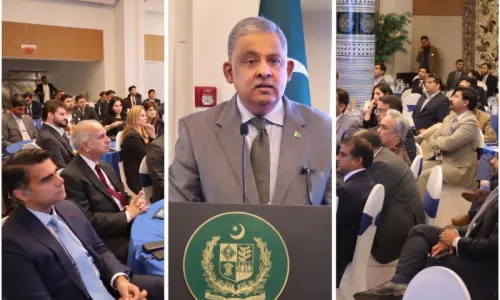
ISLAMABAD: Calling women and children the “frontline responders” to Pakistan’s recurring natural disasters, speakers at Breathe Pakistan on Tuesday urged that they be given a central role in policymaking to address the escalating environmental crisis.
The demand came during the 11th session of the international climate change conference “Unequal Burdens, Shared Futures: Reframing Climate Action Through Equity”.
Panelists argued that those most vulnerable to climate shocks are not just victims but are actively adapting with remarkable resilience and possess critical knowledge for future planning.
Addressing the session, PPP lawmaker Sharmila Faruqui highlighted the lack of official direction, noting the climate crisis isn’t fully integrated into crucial sectors like health, education, housing, and social safety networks.
She also noted there was a lack of data regarding the most vulnerable populations that live the realities of climate change.“Vulnerable communities women and children were the ones who are the least represented at the decision-making tables,” Ms Faruqui said.
She added that climate change was not just a humanitarian crisis but also an equity crisis and recalled the 2022 and 2025 floods that increased the inequalities for women after the water receded in affected areas.
The all-female panel discussion was moderated by Pernille Ironside of Unicef Pakistan, who commented that climate shocks were increasing, straining health systems and disrupting learning for
children.
Fahmida Khan, deputy country representative for UN Women Pakistan, delivered a fiery speech and said that the women and girls of Pakistan carry the heaviest load of a fire they did not ignite.
She called for the “right systems” to be built to include women and girls within the processes of making and implementing policy documents.
“It will take a political heart and a will to really engage women and girls at every step, no matter whether it was the PSDP, ADP, or PC-1,” she declared.
“Stop treating women, girls and youth’s inclusion as a favour and start treating that as a condition of survival.”
The conference’s youngest speaker and youth advocate Fatima Faraz urged for youth-led climate initiatives and platforms for young voices.
She called on youth to identify and address local climate issues using indigenous knowledge, underlining their crucial role as climate change directly impacts their future.
“Youth have greater responsibility to fight the climate change as it was directly impacting our future,” she stressed.
Zeba Sathar, director for the Pakistan Population Council, stressed the importance of data for solutions and shared worries about the country’s insufficient accurate data, echoing earlier concerns by Faruqui.
A stark warning from the World Health Organisation was presented, with estimates projecting 5 million deaths globally between 2030 and 2050 due to climate-driven malnutrition, heat stress and other related factors.
Ellen Mpangananji Thom, the deputy representative for WHO Pakistan, emphasised the importance of improving hygiene and waste disposal, including hospital waste and called for climate-resilient designs and enhanced surveillance for climate-sensitive diseases, like increased dengue and malaria post-floods.
She highlighted individual responsibility in health protection through being informed and simple measures like wearing masks during pollution, reducing heat exposure, and avoiding mosquito bites.
Uzma Yousuf, Cambridge’s country director, emphasised providing children universally with quality educational material and research on environmental challenges.
Meanwhile, Shehzad Roy, founder of Zindagi Trust, criticised the lack of political will to address climate change.
He pointed out that 400-600 million gallons of waste are dumped into water bodies and urged government action to regulate industrial and domestic waste, emphasising wastewater treatment.
Mr Roy questioned why effective climate solutions remain unimplemented, noting the isolation and non-inclusivity of policies.
Published in Dawn, May 8th, 2026