• Justice Afridi holds both are coordinate courts with distinct jurisdictions
• Writ cases to shift to FCC
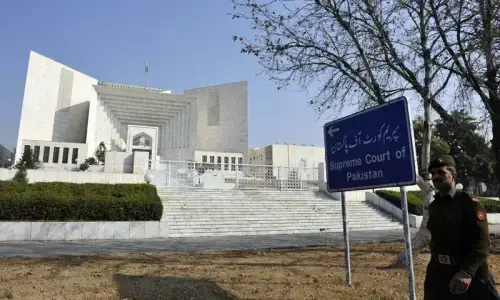
ISLAMABAD: Elucidating the post-27th Constitutional Amendment judicial framework, the Supreme Court has ruled that the constitutional scheme does not position either of the two apex courts — the Federal Constitutional Court (FCC) and the Supreme Court — as an appellate forum over the other.
Rather, it treats both as coordinate courts exercising clearly demarcated jurisdictions over distinct classes of matters, emphasised Chief Justice of Pakistan (CJP) Yahya Afridi in a 13-page judgement he authored.
The text of Article 189(1) of the Constitution must be read in conjunction with the overall post-27th Amendment framework, which deliberately distributes jurisdiction between the SC and the FCC across distinct domains.
Any broader interpretation of Article 189(1) would have the effect of subordinating one apex court to the other in matters constitutionally assigned to its jurisdiction — a result for which there is no warrant in the constitutional text, the CJP emphasised.
“The Supreme Court order appears to respond to the Dec 18, 2025, judgement of the FCC, which held that after the 27th Amendment, an exception had been created requiring all courts, including the SC, to adhere to its judgements,” a senior counsel commented on condition of anonymity.
A two-member bench comprising Chief Justice Yahya Afridi and Justice Shahid Bilal Hassan issued the order in a set of petitions arising from a Feb 17, 2020, Peshawar High Court consolidated judgement.
During the hearing, the Supreme Court’s attention was drawn to jurisdictional issues in the current constitutional dispensation following the 27th Amendment — including the proper routing of writ and non-writ proceedings that had been clubbed or proceeded in parallel before high courts, and the treatment of contempt proceedings arising from SC orders.
In his judgement, the CJP explained that the two apex courts are coordinate bodies exercising clearly demarcated jurisdictions, not arranged in a vertical hierarchy. Article 189 ensures consistency in legal principles but does not subordinate one court to the other, he said.
This arrangement assigns each court exclusive competence over different categories of proceedings rather than establishing a hierarchical relationship. In this context, Article 189(1), while ensuring consistency in the exposition of legal principles, does not displace the independent jurisdiction of either court.
Article 175F(2), read with Article 175F(1), expressly grants the FCC jurisdiction over appeals from high court judgements made under Article 199. All such matters pending before the SC stand transferred to the FCC, which has exclusive jurisdiction to hear and decide them.
By contrast, the SC’s appellate jurisdiction is defined under Article 185, which allows it to hear appeals from judgements, decrees, final orders or sentences of high courts in cases not falling within Article 175F.
Thus, the constitutional scheme is clear: all writ proceedings (except those relating to rent and family matters) fall within the FCC’s jurisdiction, while regular proceedings fall within the SC’s domain. Accordingly, all matters within the FCC’s appellate jurisdiction stand transferred to it, while regular proceedings remain with the SC.
Published in Dawn, May 7th, 2026