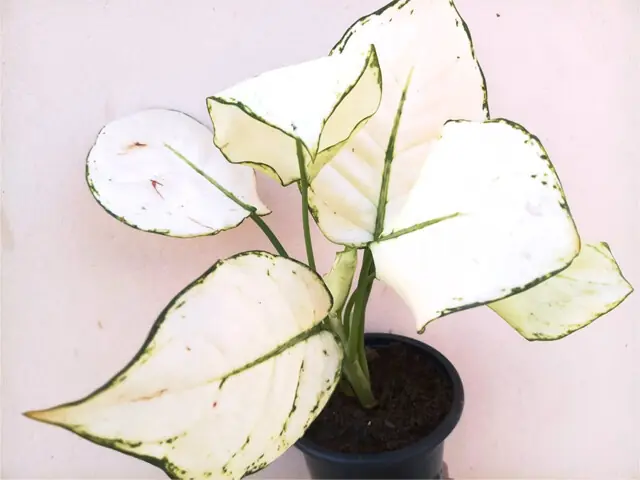
When the goal is to beautify the home via gardening, the local go-to solution is to grow as many varieties of colourful flowers as possible. The likes of pothos, dieffenbachia (locally known as diphens), cacti and aglaonemas rarely find favour with the masses.
They are often typecast as filler plants — without offering flowers or harvests — to be used only to add volume to empty corners and spaces inside the house and in the garden. However, growing these ornamental plants well is a more rewarding challenge than it might first appear.
What makes the aglaonema ‘Super White’ stand out is obvious from its name — the absence of greens or any solid colour on their leaves. The unique combination of pale-yellowish to white leaves, bordered with thin, dark-green edges makes them unique and visually striking. Being one of the rare varieties of the Chinese evergreens, this standout plant belongs to the family Araceae.
The Super White is also easy to grow and doesn’t demand too much time from the gardener. However, gardening fundamentals have to be observed to ensure optimal growth. The plant is propagated through its pups — small offshoots that emerge from the base of the mother plant and which can be carefully separated and potted individually. As this cultivar of the aglaonema is imported, it is expensive and only available at nurseries that sell exotic plants.
The aglaonema Super White is rare, imported and unlike almost any other houseplant in its colouring. It also happens to be manageable for a careful beginner…
Several online platforms also offer this variety. When the online purchase is from a different city, potted Super Whites — with at least five to eight leaves — are delivered wrapped in a soft cardboard or newspaper.
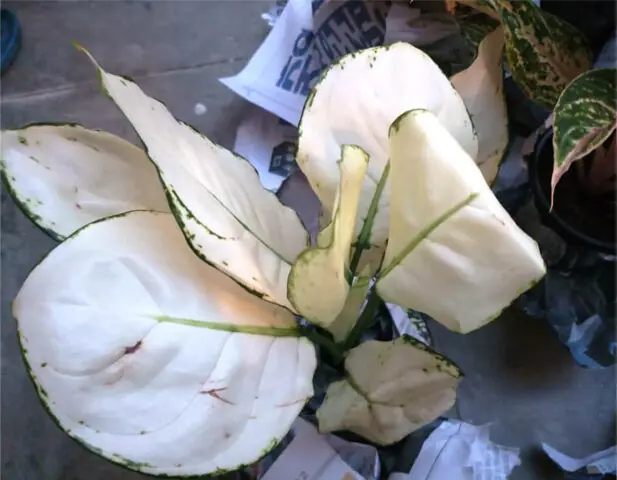
Upon receiving the delivery, the plant should immediately be kept with other plants. Without this environment — proximity to other plants — the Super White can experience stress. The other plants also humidify the surrounding area, which is one of the key requirements of the Super White, particularly at this stage of its life cycle.
The plants purchased via online sellers are usually well-watered beforehand to ensure their health over the next few days of transit. In any case, after receiving and potting it, water the Super White plants thoroughly until water runs freely from the drainage hole.
After that initial watering, follow a routine in which the upper two to three inches of soil dries out between two waterings. Watering has to be reduced further during the rainy season and, especially, during winters.
Being a sensitive plant, the Super White requires relatively more careful attention than most houseplants. It is highly sensitive to extreme temperatures. The plant cannot tolerate excessive heat or even direct sunlight exposure. Therefore, it should be kept in indirect, bright light.

Since the plant has significantly reduced chlorophyll — the pigment that gives plants their green colour and drives photosynthesis — it needs bright light to compensate for what its pale leaves cannot efficiently absorb.
The plant should be kept in the same potting mix in which it has been originally grown. It should not be removed or transplanted until it becomes stable in the pot. It is a slow-growing plant and can take between two to three years before requiring transplantation to a bigger area. After every month or two, especially during summer and spring, boost the soil with a balanced, slow-release fertiliser — an NPK formula works well — or a handful of compost.
Under typical indoor conditions, the Super White usually reaches around two feet in both height and spread, though this can vary. With its colour combination, size and minimal tending requirements, it is ideal for absolutely anyone to add something genuinely exotic to their space.
Place it in a corner with filtered afternoon light and the Super White does something no flowering plant can — it makes the room feel cooler, quieter and somehow more considered.
Please send your queries and emails to doctree101@hotmail.com. The writer is a physician and a host for the YouTube channel ‘DocTree Gardening’ promoting organic kitchen gardening
Published in Dawn, EOS, May 3rd, 2026