Artists are finely attuned to the shockwaves of violence that afflict humanity. One of the most iconic works of 20th century art remains Pablo Picasso’s monumental painting Guernica (1937), which mourned and commemorated the bombing of the town of Guernica in northern Spain by Germany and Italy in 1937.
Art depicting conflict can mediate between our revulsion of death and our need to comprehend pathos occurring on a vast scale. Brushstrokes, like words, have agency to create a liminal space of thoughtful retreat, where horror that is too grand for emotions to process may be mitigated. Such works provide a holding space for us to recalibrate our moral and psychological compass. Quddus Mirza’s recent solo show at Canvas Gallery is a case in point.
Under the simple title ‘New Works’ are gathered nine large oil paintings and three smaller sketches. ‘New’ could equally and ironically apply to the turmoil the world has been plunged into since the razing of Gaza and the start of the Iran war.
Mirza provides a pithy artist’s statement for his work: “A perception in paint of the world in and around us.” With the two prepositions “in” and “around”, he simultaneously connects our subjective emotions (the “in”) to the global landscape (the “around”). This method of imaginative documentation is substantially different from photographic and videographic realism.
Through deceptively simple forms, Quddus Mirza’s latest work bridges the inner emotional world and the global theatre of violence
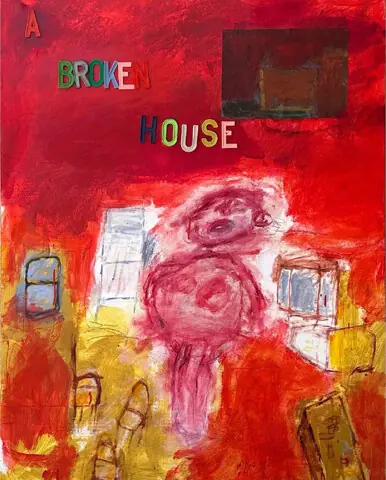
Mirza’s signature style of painting is contemporary naïve or faux naif [falsely naive]. This style deliberately chooses a child-like simplicity by eschewing refinement, three-dimensionality and classical proportionality in favour of simplified lines and flattened space. It is a style that acquires immense poignancy in the context of war, particularly the recent wars against Gaza and Iran, in which unimaginable numbers of children have been slaughtered. We enter the killing fields through saturated colour and scratchy lines that trigger emotional immediacy and intensity.
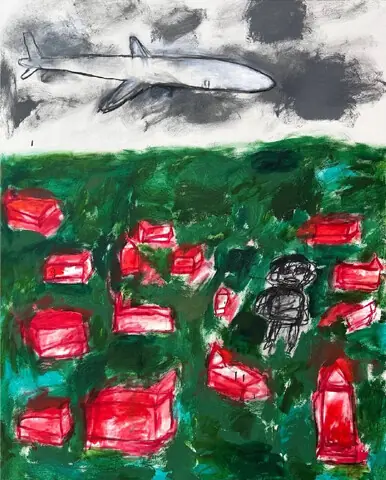
Underlying the stylistic disingenuity are complex manipulations, in which the rule of thirds is deployed by the artist to divide the picture plane, as is the use of emphatic contrast between black and white segments against fields of saturated and luminous colour. Both sky and ground are featured in the paintings, and the two realms create the narrative. The sky becomes the arena for the perpetrator to unleash terror, while the ground is the arena where the victims of downward-descending destruction face annihilation.
Airplanes, since their earliest use in 1911 for reconnaissance and subsequent aerial combat, have become a recurring feature of art about war. The British brothers Richard and Sydney Carline were the first artists to depict aerial landscapes during World War I. Airplanes feature prominently in several of Mirza’s paintings.
In A Stained Landscape, the upper one-third of the painting is dominated by a plane in black and white. The lower two-thirds of the painting is scattered with red graves on a viridian green background. A sketchy figure, unmistakably a child, lies between the graves.
The Ghost City shows an apocalyptic scene in which the accoutrements of regular life are dispersed across the canvas. This is rearrangement by bombardment. The scatter of items is unified by the underlying field of red paint.
The Book Still Burning is an enigmatic painting. The discourse turns on the mysterious identity of the book. Is the book a reference to a sacred document? Or is it a reference to the People of the Book who have conflicted with one another over centuries? The viewer can freely interpret the title, and this gives the painting many dynamic layers of meaning.
The painting Black Birds is overtly polemical. It uses the technique of collage. Images of various models of war planes are placed in the sky, while the cover of an old book is pasted between the heads of two figures. The title of the book reads “How States Are Governed.” This is sharp irony in a world in which the rules-based order has shattered.
The idea of governability connects politics and war as in the much referenced dictum by the Prussian military theorist Carl von Clausewitz: “War is merely the continuation of policy (or politics) by other means [On War, 1832].”
Mirza’s perceptions align with our heartbreak and inability to prevent death and injustice. His universalised depiction of war highlights its insanity.
‘New Works’ was on display at Canvas Gallery in Karachi from April 7-16, 2026
The writer is an independent researcher, writer, art critic and curator based in Karachi
Published in Dawn, EOS, May 3rd, 2026