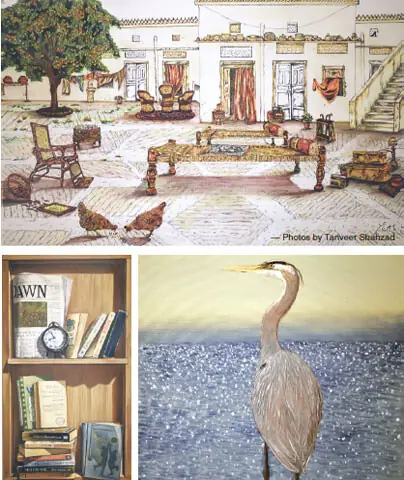
ISLAMABAD: A group exhibition featuring artworks by 14 emerging artists opened on Friday (1 May 2026) in Gallery6. Ranging from metaphysical light to ecological trees, from domestic narratives to surreal underwater worlds, the artworks highlight a diversity of creative cadences.
Curated by Dr Arjumand Faisel, the exhibition marks the second edition of a programme that traces the artistic journeys of the participants of the National Biennial Arjumand Painting Award 2025, moving beyond the competition itself to explore how diverse rhythms emerge from shared cultural and artistic roots. Each artist’s title serves as an anchor for their thematic exploration.
As Dr Faisel stated in the preview, “New Cadence II” is not a beginning, it is what a voice finds after moving through uncertainty, its own rhythm, its own resolution. The exhibition asks what happens when fourteen such voices, sharing a single point of departure, are given space to develop on their own terms.”
Aafia Ali Shah, a recipient of the three-way first prize at the contest, probes the ambiguous line at the intersection of spirituality and metaphysics. Her “Divine Love” is radiant imagery that conveys spiritual devotion, using light and color to symbolise transcendence and “Mystic Glow” is a continuation of her metaphysical exploration, evoking the aura of sacred presence.
A similar psychological intensity courses through Awais Nawaz’s neominiature figures appear calm, yet a subtle tension hints at “the conflict between desire and love.
Swarim Abid Hassan, also a first prize recipient, builds his surfaces through a process of accumulation and erosion, using silver leaf, oil paints, and oxidation to explore displacement. His figures “Collateral Grace”, “Breaching Point”, and “Playground of Empire”, are a visual analogue for the resilience required to inhabit spaces defined by displacement.
Sabahat Nisar and Buland Iqbal’s bold palette and gestural handling, especially in a large canvas like “Rangeela,” convey emotional charge. Sabahat’s oil paintings “Hidden Identity” and the “Invisible Lives” series are surrealist realism where masked or obscured faces question visibility and truth.
Other artists have highlighted the environments women navigate and on landscapes under threat. Sana Saeed has painted women from her immediate surroundings. Saeed’s oil paintings “Where do Sparrrows Go To Sleep” place women in foliage-filled domestic interiors, draped fabrics, and intimate postures.
Rooted in feminist ideology, her work examines how women shape and are shaped by the spaces they in habit. Faiza Taufique’s paintings are a powerful comment on ecological fragility. Her “The Essence of the Tree” and “Orchestra of Trees” display an almost devotional meticulousness, transforming foliage into visual meditation.
Shamsul Arfeen Hashmi engages with environmental decay, but through a radically personal method. He isolates fragments of the South Punjab landscape and expands them across canvases, like “Grove”, “Grey Heron” and “Jhilmill,” finding ecological and political weight in the apparently local.
Huria Naqvi’s underwater surrealism such as “Deep Sea Station” and “Daily Bread” submerges human figures to highlight a deep connection with water. The dreamlike stillness she captures offers a counterpoint to the exhibition’s social and ecological anxieties. Laiba Tanveer, Ahmed Alraai, and Rajeshwari Lohana demonstrate exceptional range.
Tanveer works intuitively, preserving the tension between what is seen and felt. “At the Cattle Farm” and “Little Boy In Red Cap” is a genuinely self-aware cadence. Alraai’s oil paintings “Pages that Remeber”, “Rust & Color” and “The Poetry Of The Unnoticed” trace shadow and reflection in quiet still lifes and overlooked beauty.
Lohana’s diptych “Stillness Speaks” uses acrylic washes and pastels, layering translucency to evoke calm; a more rigorous conceptual frame could strengthen its introspective abstraction.
A quieter cadence emerges from memory and domestic stillness. Yasmeen Zafar’s “Khamosh Sehan,” “Bikhri Hui Yaadein,” and “Lamha Jo Thehar Gaya” trace empty rooms and abandoned objects with a delicate touch; the Urdu poetic titles root nostalgia in cultural memory.
Zunaira Yousaf builds dense impasto surfaces through repetition. “Impasto Abstractions” and “Healing Geometry” turn thick, dot-like formations into a meditative, almost ritualistic experience of texture as meaning.
Published in Dawn, May 3rd, 2026