ENVIRONMENT: SWALLOWED BY THE SEA


 0
0
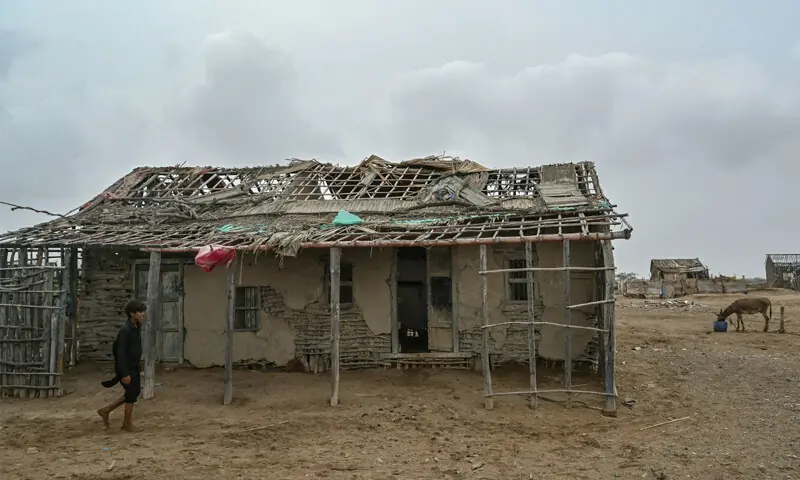

On most nights, octogenarian Ali Mallah lies down on a boat anchored at the jetty in Kharochhaan, one of the tail-end settlements in the Indus delta in Sindh’s Thatta district. He has his cigarette, the water and memories of his days at Sukhi Bandar.
Ali’s gaze wanders not into the depths of the sea but across its surface, seeking something that he cannot find: a once prosperous harbour that hosted fairs and wrestling matches, bull races and kite-flying competitions. He vividly remembers walking through the markets of Sukhi Bandar — which literally translates to ‘prosperous harbour’ — that has since been swallowed by the Arabian Sea.
GOLD MARKET AND GOURDS
The memory of that harbour town is still etched in the lines of Ali’s face. As he recalls those memories, tears roll down his cheeks and disappear, just as Sukhi Bandar has, into the sea.
“Sukhi Bandar was a major commercial hub,” Ali tells Eos. “There was a thriving gold market in Sukhi Bandar, along with trade in textiles, grain and gourds,” he continues. The area was full of crops, says Ali, including those of rice, pea, chickpea, sesame and barley. “Coconut, date and olive orchards were abundant,” Ali adds.
Once a thriving harbour town, Sukhi Bandar now lies beneath the Arabian Sea. Its disappearance tells a larger story — of a delta starved of freshwater, collapsing ecosystems and communities forced to retreat
Ali doesn’t know exactly how or when Sukhi Bandar was swallowed by the sea. He is unaware of the complex web of upstream dams and shifting climate patterns that starved the delta, resulting not only in the loss of Sukhi Bandar but also the disruption of his livelihood and way of life.
“After the partition of India, I saw this city start to collapse,” says Ali. His view carries weight — Pakistani coins found among the ruins suggest the decline accelerated after Independence, even if its roots go further back.
THE UPSTREAM DECISION
Standing at the Kharochhaan jetty, it is difficult to imagine that what stretches before you — flat, saline, encroaching — was once fed by one of the great river systems of the world. The Indus delta did not surrender to the sea overnight. It was given away, slowly, upstream.
According to the late Tahir Qureshi, an environmentalist associated with the International Union for Conservation of Nature (IUCN), the Indus delta actually started shrinking in the 1920s, with the construction of the Sukkur Barrage in 1923. “Before that, 150-million-acre feet of water reached the delta every year,” he told environmental webzine Dialogue Earth in 2019.
The downstream flow of water into the delta has decreased by 80 percent since the 1950s, as a result of irrigation canals, hydropower dams and the effects of climate change on glacial and snow melt, according to a 2018 study by the US-Pakistan Centre for Advanced Studies in Water at the Mehran University of Engineering and Technology in Jamshoro.

“It all happened because freshwater stopped reaching the delta,” says environmentalist Nasir Panhwar.
While sea-level rise plays a role globally, experts argue that, in the Indus delta, reduced freshwater flow has been the dominant factor. “The issue of sea-level rise doesn’t apply here,” Panhwar tells Eos. “The lack of freshwater is why the sea has swallowed up millions of acres of land.”
Ali has watched this happen in real time. “The fish moved further out, then the land started going, then the people,” he says, pausing to light another cigarette. “Now, there is only water where there used to be everything.”
THE MANGROVE FACTOR
There is one partial reprieve in an otherwise bleak picture. Mangrove cover across Sindh and Balochistan has increased by roughly 300 percent in under three decades, according to an IUCN report presented at COP29 — the United Nations Climate Conference — in Baku in November 2024.
But environmentalists caution that planted mangroves cannot fully compensate for the loss of freshwater and sediment that once sustained the delta naturally and kept saline seawater at bay.
Shoukat Soomro runs the Hyderabad-based Hamdam Foundation that works on mangrove plantation in the Thatta-Sujawal-Badin coastal belt. His organisation has planted around 200,000 mangrove saplings along the coastal belt of Thatta, Badin and Sujawal as part of a project with the United Nations Development Programme (UNDP). “We will plant an additional 100,000 mangroves along the Badin coast in June this year,” he tells Eos.
But Soomro is clear-eyed about the limits of what replanting can achieve. “We can’t restore the former glory of this harbour, but our efforts can secure the future of the currently inhabited islands, including Kharochhaan.”
VILLAGES SUBMERGED
Kharochhaan once comprised about 40 villages, but most have disappeared under rising seawater. According to revenue records reviewed in 2025, in Kharochhaan alone, around 400,000 acres out of 595,091 acres — or 67 percent — are under water.
The situation is similar in nearby areas, including Shah Bunder — with 518,895 acres out of 735,706 acres having been lost. Jati taluka [administrative division] in neighbouring Sujawal district fares no better: 405,000 acres out of 879,373 acres (46 percent of its land, spread across 13 of 133 dehs) now lie beneath seawater.
It has resulted in mass displacement. More than 1.2 million people have been displaced from the overall Indus delta region in the last two decades, according to a study published in March 2025 by the Islamabad-based Jinnah Institute, a think tank led by former climate change minister Sherry Rehman.
Ali does not know the figure of those displaced but he knows many of the faces from his immediate surroundings. “Everyone I grew up with has left,” he says. “Some went to Karachi. Some just went.”
WHAT REMAINS
If you start a boat journey from Kharochhaan Jetty — past the Redho and Baghaan towns in the coastal belt of Thatta district — you’ll see ruins of an island after about three hours. There, broken flags, smashed utensils, graves and crumbling walls mark what remains.
Back at the jetty in Kharochhaan, Ali Mallah finishes his cigarette and lies back on the boat. Above him, the sky is wide and indifferent. Somewhere beneath the water ahead, a market is still standing.
The writer is a researcher focusing on climate change, green economy and energy. He can be contacted at santoraisbc@aol.com
Additional input and editing by Hussain Dada
Published in Dawn, EOS, April 19th, 2026