Pakistan seeks early approval of next IMF tranche

WASHINGTON: Finance Minister Muhammad Aurangzeb said on Friday that while he has discussed with International Monetary Fund (IMF) officials the impact of the Iran conflict on Pakistan’s economy, “our focus is on getting an early approval for the next tranche” of the IMF package and that a team of the global lender will visit Pakistan next month for consultations on the upcoming review.
Talking to Dawn after his news conference at the Pakistan Embassy, the minister reiterated that the reopening of the Strait of Hormuz was “a very good development”, which would ease pressure on global oil supplies, bring down oil prices everywhere and benefit Pakistan as well.
Had the conflict persisted, it would have adversely affected everything “from economic growth to inflation”, he said, adding: “We hope the situation will improve, but hope is not a strategy, and that’s why we had planned for everything.”
Aurangzeb said he also discussed the possible consequences of the Iran crisis with the IMF, which has established facilities to support countries affected by global economic shocks, but emphasised that “our focus is on the next tranche and on getting an early approval of the IMF board”.
Cites global relief from reopening of Hormuz
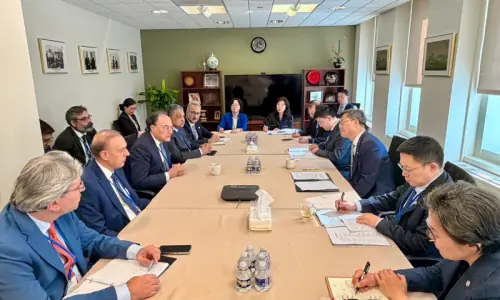
Speaking at his news conference at the Pakistan embassy, the finance minister also briefed Pakistani media representatives on the country’s broader economic outlook, progress on reforms, and outcomes of his engagements during the World Bank-IMF Spring Meetings 2026, which were also attended by the State Bank governor and Pakistan’s ambassador to the United States.
The minister said his meetings with global stakeholders, including counterparts from China, the US, the UK and other partners, focused increasingly on expanding cooperation in trade, investment and key sectors such as information technology, minerals and energy.
On the external sector, he highlighted what he described as strong performance indicators, including a current account surplus of over $1 billion in March, remittance inflows of $3.8bn during the same month, and record inflows of $261 million under the Roshan Digital Account, with expectations of further growth.
He also said the Pakistani diaspora was playing an increasingly important role in supporting external sector stability through formal financial channels.
On financial sector reforms, Aurangzeb said efforts were under way to strengthen regulatory oversight and formalise exchange company operations through coordinated action between the finance ministry, the State Bank of Pakistan and law enforcement agencies.
He said preparations for the upcoming budget were continuing through consultations with chambers of commerce and business councils, adding that tax policy formulation was being led by the finance ministry with a focus on broadening the tax base and incorporating stakeholder feedback before final approval by the cabinet and parliament.
The minister said improving the ease of doing business remained a priority, particularly by reducing administrative bottlenecks and outdated regulatory procedures.
He stressed the importance of policy continuity, including in initiatives such as the Roshan Digital Account, saying predictable policies were essential for attracting both domestic and foreign investment.
On energy and climate policy, he highlighted the need to shift towards renewable energy while addressing structural issues in the power sector, and said Pakistan’s experience with recent climate shocks had underscored the importance of stronger fiscal buffers and preparedness.
Aurangzeb also said responsible borrowing remained central to government policy, adding that international financial platforms should be used for knowledge-sharing and peer learning rather than debt relief advocacy, and reaffirmed Pakistan’s commitment to meeting all financial obligations on time.
He further noted increased transshipment activity through Pakistani ports and improvements in logistics management as emerging positive signs for economic activity.
Concluding his briefing, the finance minister reaffirmed the government’s commitment to macroeconomic stability, structural reforms and a disciplined policy framework aimed at supporting long-term, inclusive growth.
Published in Dawn, April 18th, 2026