0
0
LAHORE: Speakers at a forum stressed that Islamic economic principles offer a path toward welfare, transparency, and sustainable growth and there is a need to move away from interest-based systems, empower youth and promote fairness in global financial structures.
University of Management and Technology (UMT) Khurshid Ahmad Institute of Islamic Economics and Finance (KAIIEF) organised the 6th International Forum on Islamic Economics, Finance and Banking on Friday.
Speaking at the event, Federal Minister for Religious Affairs Sardar Muhammad Yousaf, as the chief guest, said Islamic economics provided a strong foundation for stability and prosperity.
He reiterated his opposition to interest-based systems and highlighted his efforts to eliminate it, adding that capable and ethical youth were vital for Pakistan’s future.
UMT Chairman and President Ibrahim Hasan Murad noted that debt repayments consumed a significant portion of Pakistan’s economy, stalling progress.
He pointed out that nearly half of the world’s wealth was concentrated in the hands of just one percent of the population, reflecting severe imbalance.
Mr Murad argued that Islamic finance could help eliminate corruption and injustice, urging policymakers to adopt reforms that would transform the global financial landscape.
In a virtual address, Malaysian Prime Minister Anwar Ibrahim paid tribute to Dr Khurshid Ahmad’s contributions to Islamic economics and called for collective action to tackle the economic challenges of the Muslim world.
FPCCI President Zaki Ijaz emphasised that Islamic finance could reduce poverty, advocating for interest-free loans to young entrepreneurs.
State Bank of Pakistan Executive Director Ghulam Muhammad Abbasi added that Islamic banking promotes social justice and transparency. Securities and Exchange Commission of Pakistan (SECP) Commissioner Imtiaz Haider and other experts joined discussions on transitioning from conventional to Islamic banking.
The forum brought together national and international policymakers, business leaders, and students, who engaged in comprehensive debates on challenges and opportunities in Islamic finance.
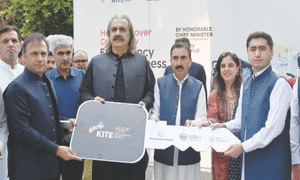
INAUGURATION: University of Engineering and Technology (UET) inaugurated the National Centre for Quantum Computing (NCQC) and the National Centre for Manufacturing (NCM) at its Narowal Campus on Friday.
Federal Minister for Planning, Development and Special Initiatives Ahsan Iqbal attended as the chief guest, alongside Vice Chancellor Prof Dr Shahid Munir.
Dr Munir described the centres as a milestone in building national capacity in advanced technologies. Established under the Hub and Spoke model, the centre brought leading institutions, including UET Lahore, UET Peshawar, GIKI, LUMS, UET Taxila, NUST, and NAVTTC, together.
He said the initiative would strengthen research and innovation while positioning Pakistan prominently in the global technological landscape.
Published in Dawn, April 18th, 2026