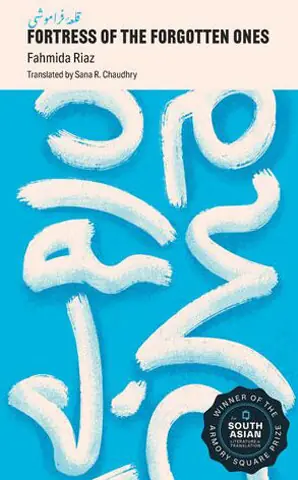
Fortress of the Forgotten Ones
Translation of Qila-i-Faramoshi by Fahmida Riaz
Translated by Sana R. Chaudhry
Open Letter Books
ISBN: 978-1-960385-51-2
216pp.
Sana R. Chaudhry’s recent translation of Fahmida Riaz’s novel Qila-i-Faramoshi, titled Fortress of the Forgotten Ones, has won the 2026 Armoury Square Prize for Literary Translation.
To render the specificities of a work that qualifies as historical fiction is difficult enough; to do so across a linguistic divide is no mean feat. To understand the translator’s triumph, one must contend with the architecture of the novel itself.
The concise book opens with a poignant dedication to the Parsi community from Riaz, the original author, which serves as a prelude for the reader to begin a story set in fifth-century ancient Persia, during the Sassanid Empire. The narrative follows the life of the central character Mazdak, a historical figure whose story is artfully fictionalised in this work.
The narrative unfolds within the rigid geometry of systemic inequality, a landscape where the earliest echoes of human history are defined less by progress than by a siege. Its origins can be traced back to a foundational sin of the Neolithic era: the moment when granaries became the stronghold of a few. The priests and the well-born do not merely govern; they curate a surplus and preside over a hoard of resources, whereas the labouring classes are relegated to the thin, frantic margins of scarcity.
The English translation of late Fahmida Riaz’s novel Qila-i-Faramoshi offers the Anglophone world a window into ancient Persian history through an Urdu lens
By centring the story on the centralised control of the storehouse, the author exposes the machinery of the myth: the priests and nobles exist in a realm of perpetual excess, while the rest of humanity is defined by lack.
Amidst this picture of systemic inequality, the capital city of Ctesiphon is shown in the grip of a devastating famine. While traditionalists view the catastrophe as a divine curse, Mazdak interprets the crisis as a man-made failure of distribution. The ensuing revolt, the core of the narrative, originates from within Mazdak’s internal moral struggle. Driven by the core Zoroastrian tenet that “all are equal”, Mazdak transforms his private convictions into a public uprising and leads the labouring classes against the Sassanid elite.
A diverse cast of characters, which includes King Qobad, his high-ranking military officials, and his influential wife, is drawn into the unfolding struggle. Their involvement highlights the complexity of the revolution. As the uprising begins to permeate the highest levels of Sassanid power, it forces the ruling elite to confront Mazdak’s radical vision.
Riaz’s profound and rare command of Zoroastrian history offers readers a nuanced glimpse into the culture, social structures and linguistic dynamics of the Sassanid era. This scholarly depth firmly roots the work in the genre of historical fiction, a sophisticated amalgam of historical fact and creative imagination.
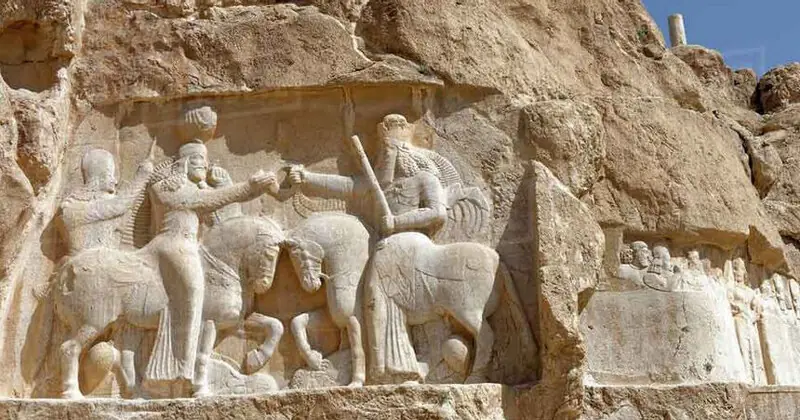
As the narrative progresses, Mazdak transitions from being a priest to a prophet. Drawing from his interpretation of Zoroastrianism, he introduces radical social and religious codes. Of particular interest is his emphasis on dietary abstinence, specifically the propagation of a strictly vegetarian diet. Furthermore, the author refuses to sanitise the more ‘scandalous’ tenets of ancient Persian society: its rejection of private lineage in favour of a communal sharing of wives and offspring. By refusing to look away from these ancient social ruptures, the novel achieves a rare kind of historical honesty.
While the narrative centres on the ignition of a revolution and the resulting palace intrigues, its true depth lies in Riaz’s exploration of historical symbolism. She masterfully traces the origins of the hammer and the chisel by conjuring the tale of a legendary blacksmith who once rose against a tyrant king. Similarly, the swastika is reclaimed as an ancient symbol of Aryan courage; its perpendicular arms represent the revolving sun and the ‘Wheel of Mithra.’
Crucially, if history is the ultimate litmus test for a writer of historical fiction, translating such a work is a bigger challenge. One must consider how this Urdu-to-English translation secured the prestigious Armoury Square Prize: the answer lies in Sana R. Chaudhry’s masterful execution.
Chaudhry’s translation is consistent and evocative. The translation undoubtedly reflects a sophisticated hermeneutical approach. In simple words, given the vast syntactical differences between Urdu and English, the translated version comprises remarkably clear and coherent prose. By avoiding over-saturation, she ensures the text remains fluid and accessible, all the while allowing the historical weight of the narrative to shine through without the interference of clunky phrasing. For readers who appreciate sensory detail, the novel offers exquisitely translated descriptions that breathe life into the Sassanid world, such as in the passage:
“The vast doors had been flung open. Inside, hand-woven rugs were lined with bolster pillows, while decorative pots and vases adorned tables of various sizes. In one corner, a large carpet held a low table set with a chessboard. Inside a lapis lazuli box lay chess pieces carved from black and white marble, and a glazed blue tray filled with dried fruits rested on a central table.”
We read historical fiction not to escape the present but to understand the ghosts that continue to haunt our current political and social landscapes. For the translator, the task is a delicate sort of dual demand that requires the creation of a language that revitalises the forgotten past while resisting archival coldness. Chaudhry achieves this without relying on unnecessary footnotes or endnotes, which can often be jarring for the reader.
It is through the use of italics that a seamless transition between the character’s inner monologue and the outer setting is achieved, an aspect of the text that doesn’t feel out of place. Most significantly, she successfully captures a range of distinct voices of varied characters that bring about different levels of consciousness. These characters span the social spectrum of the Sassanid Empire — from the resilient wives of common labourers to the politically astute Queen and the formidable, warrior-like fighters.
Each character possesses a unique personality and is given a voice that varies between poised and aggressive. This reflects different cross-sections of the Sassanid society, which includes farmers, miners, craftsmen, nobility and kings. True to the late author’s feminist legacy, the novel ensures that women are afforded equal voice and representation. By centring these diverse perspectives, Riaz elevates the narrative from a traditional historical chronicle to a vibrant exploration of female agency within a revolutionary struggle.
Published by Open Letter Books, the English translation of Qila-i-Faramoshi brings Fahmida Riaz’s vision to a global Anglophone audience. The Armoury Square Prize for Literary Translation has carved out a vital space for under-represented South Asian languages, by offering the Anglophone world a window into ancient Persian history through an Urdu lens.
Beyond its introduction of Zoroastrian customs and the “first socialist revolution”, the novel expands its canvas in the 40th chapter by linking the Sassanid era to the mysterious Ranikot Fort. Though its true origins remain shrouded in history, Riaz imaginatively suggests a Sassanid foundation — a connection that feels remarkably grounded and plausible within the narrative.
The novel’s structure is accessible and engaging, though its chapter divisions are notably irregular. Some chapters, such as the fourth, are as brief as a single paragraph, a stylistic choice that lends a sharp, cinematic vividness to the storytelling. While the narrative’s sweeping historical breadth leaves little room for exhaustive character studies, its compelling novelistic quality ensures a gripping experience.
Readers will find it deeply rewarding to trace the hero Mazdak’s journey through his trials, triumphs and eventual failures. Ultimately, the pulse of the novel is the timeless desire for equality, captured in the radical decree: “All the wealth of the rich must be seized and distributed equally among all people.”
And finally, it is in the deafening background thunder of the ongoing US war with Iran that the novel becomes all the more discernible and necessary.
The reviewer is a PhD scholar working on Punjabi poets.
She can be contacted at ayesharamzan83@gmail.com
Published in Dawn, Books & Authors, April 19th, 2026