1
1


PAKISTAN’S role in brokering the first direct US-Iran talks since 1979 has generated immense global goodwill. Can Islamabad strategically deploy this diplomatic credibility? Peace between the nuclear-armed Pakistan and India in South Asia is no less vital than Middle East stability and hinges on reviving cooperation on the Indus Waters Treaty (IWT). Such initiatives translate Pakistan’s diplomatic capital into structural stability — foundational to regional security and our shared capacity to manage the accelerating climate risks to the subcontinent. By focusing on water, a domain of acute shared vulnerability, Islamabad can address areas where the cost of non-cooperation hits ordinary populations hardest, and where political barriers to progress are lower than in traditional security matters.
The treaty’s effective suspension, driven by India’s withdrawal from treaty mechanisms after the April 2025 Pahalgam attack and Pakistan’s unilateral filing at the Permanent Court of Arbitration, has paralysed the Indus basin’s institutional machinery. This breakdown has occurred at the worst possible moment, leaving both nations without a functional framework to manage the increased frequency of transboundary climatic events and disasters.
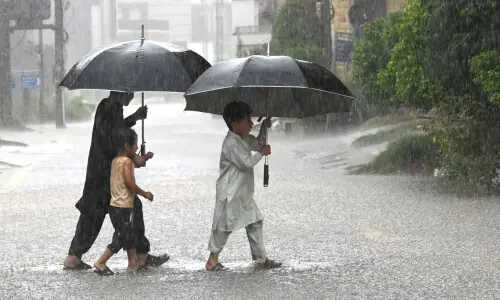
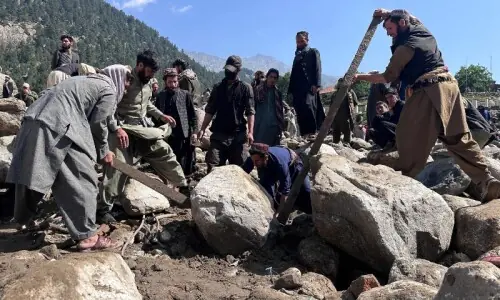
The 2025 floods were a compound event. Record heatwaves first saturated the glaciers and atmosphere, then an early and intense monsoon hit river systems already at capacity. The transboundary dimension is the sharpest new argument. India’s opening of dam gates after reservoirs reached full capacity caused sudden downstream surges. Crucially, this happened after the IWT’s unilateral suspension. Instead of using the Permanent Indus Commission as stipulated in the IWT, India informed Pakistan of the floods through diplomatic channels — meaning the very mechanism designed to prevent this kind of uncoordinated release was gone. All three major rivers (Ravi, Chenab, and Sutlej) overflowed simultaneously for the first time in the country’s history.
The Himalayan glaciers feeding the Indus are melting rapidly, a trajectory that will intensify flood events in the near term and produce structural water scarcity by mid-century. These risks are shared equally by Pakistan and India’s northern states of Himachal Pradesh, Uttarakhand and occupied Jammu & Kashmir, which draw from the same glacier systems, in addition to downstream Punjab and Haryana, making water security a vulnerability that transcends political divides.
The IWT’s technical framework remains legally valid and needs only political will to activate.
The IWT’s technical framework remains legally valid and needs no new negotiation to activate — only political will. The World Bank as treaty broker, and UN climate and disaster-risk bodies to which both countries are signatories, offer multilateral entry points for re-engagement on technical grounds without either side bearing the domestic cost of appearing to concede. Water data is not a concession. It is information that protects populations on both sides of the border.
The case for reviving the treaty’s technical mechanisms is, therefore, as much a disaster-risk management argument as a political one. Coordinated data-sharing on river flows, early warning systems for flood events, joint reservoir management, and agreed protocols for upstream infrastructure development are technically available under the treaty framework. Their absence means that downstream populations in Pakistan are more exposed to upstream decisions made without consultation, and that early warning of floods in both countries is less effective than it could be.
The World Bank has a historical role in pressing both governments back towards technical engagement. Pakistan should actively seek Washinton’s nod for that intervention. India halted treaty participation over alleged cross-border terrorism and resists engagement that might appear to vindicate Pakistan without reciprocal action. But there is a distinction between political normalisation and technical cooperation that both governments have, at various times, recognised.
Water cooperation is security by another name. A Pakistan that proposes the revival of technical-level treaty mechanisms as a climate and disaster-risk initiative, rather than as a political negotiation, creates space for India to engage without visible concession. The framing is not cosmetic. It changes the domestic political calculus in New Delhi by allowing the BJP government to present engagement as responsible stewardship rather than as accommodating Islamabad.
A deeper reason distinguishes this moment from past attempts to revive Indus cooperation. Since the 1972 Shimla Agreement, Pakistan has engaged India from a position of structural disadvantage, defined by a smaller economy and a downstream riparian status that cast it as a ‘supplicant’ in negotiations. For half a century, Pakistan’s calls for functional water management were dismissed as political manoeuvring rather than shared-risk arguments. By invoking Shimla’s bilateralism principle to resist international arbitration, India maintained a comfortable status quo of delay, leaving Pakistan without effective multilateral leverage.
The Islamabad talks have altered this geometry. For once, Pakistan is not approaching the table with a grievance or a request. Instead, it arrives having delivered a global public good — the first direct US-Iran contact in five decades, at considerable diplomatic cost for no bilateral gain. This represents a structural shift from any position Pakistan has occupied since Shimla. The resulting goodwill is operational, not sentimental; it shows a capacity for disciplined, multilaterally anchored diplomacy. This shift changes how a Pakistani proposal on water will be received by both India and the global institutions and capitals that matter most.
This window will not stay open indefinitely. The domestic political conditions allowing for re-engagement are products of a transient moment. The winds shifting across the region have created, briefly, a political climate in New Delhi where technical cooperation can be received as regional statesmanship rather than diplomatic retreat. By moving quickly to propose the revival of the Permanent Indus Commission’s technical mechanisms and framing it as a climate and disaster-risk initiative, Pakistan offers New Delhi a path to cooperate without appearing to concede. This opportunity is measured in months, not years.
Crucially, this proposal involves no retreats: Pakistan is not withdrawing its arbitration filing, abandoning its legal position or demanding political normalisation as a precondition. Instead, it seeks to revive a technical mechanism: originally co-designed and still legally valid, whose absence is now measurably costing lives on both sides of the border. Framing the initiative in these precise, operational terms is not a concession. Pakistan has not held this hand since 1972. It should play it now.
The writer is a climate change and sustainable development expert.
Published in Dawn, April 16th, 2026