KARACHI: Press freedom in Pakistan is under sustained pressure as censorship, economic constraints and direct restrictions shrink the space for independent journalism. The authorities’ tolerance for dissenting voices has reduced to a level which was not witnessed even during martial law periods.
This was the concerted view expressed in a panel discussion during the “Ahfaz-ur-Rehman Awards for Courage of Expression and Freedom of the Press” held at the Arts Council of Pakistan on Thursday.
Moderated by academic and writer Dr Naazir Mahmood, the session began with an introduction to the purpose of the awards. He explained that the Ahfaz-ur-Rehman Awards recognise journalists and writers who have contributed to the cause of freedom of expression in Pakistan. The awards are named after Ahfaz-ur-Rehman, who is remembered for his struggle for press freedom, the rights of media workers and his resistance to censorship and authoritarianism.
This year’s award was conferred upon veteran journalist Ali Ahmed Khan for his struggle for freedom of expression.
Veteran journalist Ali Ahmed Khan awarded this year’s Ahfaz-ur-Rehman Award
Dr Mahmood said Ali Ahmed Khan worked as a journalist in East Pakistan (now Bangladesh) till 1971 before returning to the country after the Dhaka Fall. He played an important role during the military regime of Gen Ziaul Haq and resisted the attempts to curb press freedom. He later joined BBC and continued his struggle for freedom of expression.
A documentary on Ahfaz-ur-Rehman’s life and work was also screened on the occasion. It highlighted his principled stance against oppression, particularly during the period of Zia-ul-Haq.
Thereafter, a panel discussion titled “The Struggle for Freedom of Expression in A Restrictive Environment” was held.
It was moderated by journalist Wusatullah Khan, who initiated the discussion by saying that democratic values are weakened and resistance declines when censorship, pressure and threats increase, which is happening in Pakistan.
He observed that Pakistan is among the countries where journalists face significant risks and there is limited institutional protection available to them.
Journalist Mazhar Abbas spoke in detail about the changing environment for media professionals. He said that “the news is something that those in power do not want published” and added that this has become harder to uphold in the present situation as there are now several issues that media organisations cannot report on openly.
He was of the view that the current level of pressure is unprecedented. “I have never experienced such interference and censorship in my life,” he said, adding that even small elements such as the wording of news tickers now require careful consideration. He then referred to recent incidents, including the denial of permission for a press conference of the Baloch Yakjehti Committee at the Karachi Press Club (KPC) and an attack on the Quetta Press Club.
Mr Abbas said that student organisations have largely weakened over time, political parties have become compromised, and divisions within society have deepened. He stressed that these issues need to be addressed in order to strengthen resistance and democratic engagement, and emphasised the importance of reconnecting with young people.
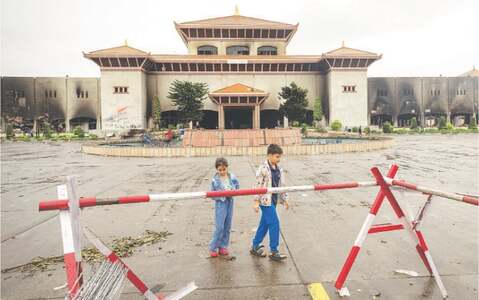
At this point, Wusatullah Khan also added something. He referred to the 2025 ‘Gen Z protests’ in Kathmandu. He said there were restrictions in Pakistan on coverage of that international conflict, which had no connection with Pakistan. Journalists were instructed on what could be reported. Media outlets were asked just to report the events and not to show footage or do an analysis of the uprising. Mr Khan said this reflects the current level of control over the press.
Journalist Amber Shamsi said that while resistance in Pakistani journalism continues, it needs to be grounded in principles rather than personalities. She added that many young journalists remain uncertain about what content can or cannot be published. At the same time, she said that there is still some space available, particularly in digital platforms, which can be filled through creative approaches.
She also pointed out that younger audiences are more aware and can easily distinguish between truth and misinformation. “You cannot fool them now. They instantly recognise propaganda and sincerity.”
Speaking on the occasion, KPC President Fazil Jamili said that in the past, issues related to journalists and press activities were often “addressed through ISPR” but now direct restrictions are imposed.
He said that instructions are given regarding what protests and press conferences can be allowed, and at times, physical barriers such as containers are also used to restrict movement and limit activities.
He added that such measures not only create difficulties for journalists but also portray a negative image of those imposing them. Despite these challenges, he said that the press club will continue its efforts. “We are resisting and will continue to do so,” he stated.
Writer and journalist Iqbal Khursheed also spoke.
Published in Dawn, April 10th, 2026