Artemis II crew snaps historic ‘Earthset’ photo on way home
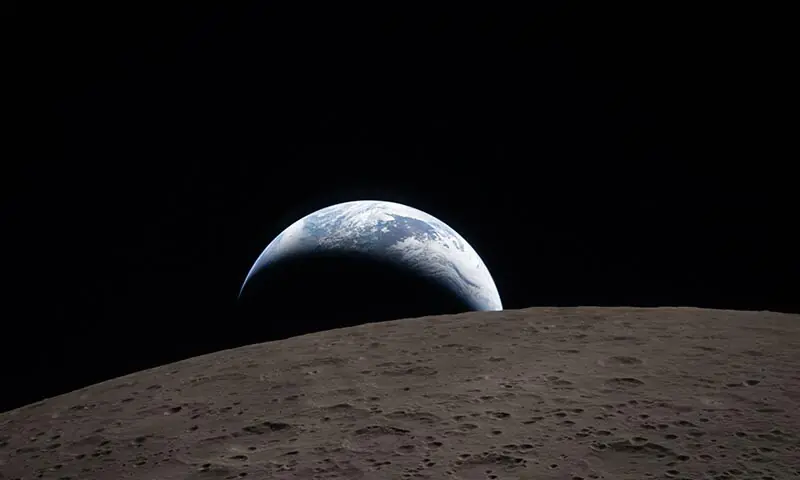
The Artemis II astronauts snapped a stunning shot of an ‘Earthset’ — the moment when the Earth dips below the Moon’s horizon — on their long journey back home Tuesday after wrapping up a historic lunar flyby.
Nasa released the photo of Earth dropping below the rugged lunar edge in a deliberate nod to the iconic Earthrise image taken by an Apollo 8 astronaut in 1968.
That shot from 57 years ago helped capture the public’s imagination when it was taken by US astronaut Bill Anders during the first space mission to carry humans around the Moon.
The modern version pairs the delicate, watery planet Earth with the harsh, huge curve of the Moon, separated by black space.
“First photo from the far side of the Moon,” the White House said, reposting the image.
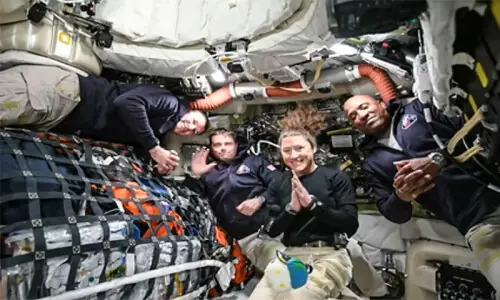
The crew of four — US astronauts Reid Wiseman, Christina Koch, and Victor Glover, teamed with Canadian Jeremy Hansen — are on a historic mission to loop around Earth’s natural satellite as part of a broader programme paving the way for a Moon landing in 2028.
After completing their lunar flyby — breaking the record for distance from Earth — they were bound for home, with splashdown due in the Pacific off the coast of California late Friday.
‘Hard to describe’
The crew reported in vivid detail features of the lunar surface and later witnessed a solar eclipse, when the Moon passed in front of the Sun. They also described flashes of light — meteor strikes — on the Moon’s surface.
“Humans probably have not evolved to see what we’re seeing,” said Victor Glover. “It is truly hard to describe. It is amazing.”
Late Monday, the crew got a congratulatory call from Nasa administrator Jared Isaacman and US President Donald Trump, who, at 79, is old enough to remember the Apollo programme.
“You’ve really inspired the entire world,” Trump said, calling them “modern-day pioneers” who have “a lot of courage”.
He probed the astronauts about their favourite moments and asked what it was like to lose connection with Earth for some 40 minutes during an expected communications blackout.
Trump experienced a signal glitch of his own while calling into space.
“Might have gotten cut off,” Trump said as he waited a full minute for the signal to return. “It is a long distance.”
Historic trip
The Artemis II team broke the distance record set by the 1970 Apollo 13 mission, which they surpassed by more than 6,000 kilometres when they reached the journey’s furthest distance from Earth.
Astronaut Jeremy Hansen said the moment should “challenge this generation and the next, to make sure this record is not long-lived”.
Glover was the first person of colour to fly around the Moon, Koch was the first woman, and Canadian Hansen the first non-American.
The Orion capsule carrying the astronauts will now travel back to Earth in a so-called free-return trajectory before coming down in the ocean. They’ll be leaving something behind: names for two previously unnamed Moon craters.
They requested to name the first in honour of their spacecraft’s nickname, “Integrity”.
They offered a second name, “Carroll,” for another crater, which they asked be named after the late wife of mission commander Wiseman, who died of cancer.
“It’s a bright spot on the Moon,” said Hansen, his voice breaking with emotion. “And we would like to call it Carroll.”
Nasa said it will formally submit the name proposals to the International Astronomical Union, the body charged with naming celestial bodies and surface features.