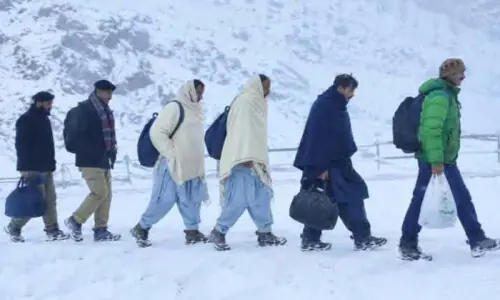
Pakistan’s vulnerability to climate change has come into sharp focus at the start of 2026, with alarming signals emerging from its northern highlands.
Data from the Pakistan Meteorological Department (PMD) indicates an unusually warm winter in Gilgit-Baltistan. During the first 22 days of February, daytime temperatures were 3–5°C above normal, while nighttime temperatures remained 1–3.5°C above the 1981–2010 average.
Persistent warmth, low snowfall, and clear skies have sped up snowmelt and glacier retreat at mid- to lower altitudes. Less overnight refreezing has increased meltwater runoff. This raises the risk of glacial lake expansion and possible Glacial Lake Outburst Floods (Glofs) in Gilgit, Ghizar, Hunza, and Astore.
The trend continued into March, adding to concerns about ongoing thermal anomalies. Although precipitation from westerly systems was light, temperatures remained above historical norms. The PMD has repeated warnings about higher Glof and flash flood risks as warming disrupts fragile mountain hydrology.
Long-term assessments confirm intensifying extremes with serious flooding and drought-like conditions possible throughout the country in the coming times
Experts note that snowfall patterns are shifting, arriving later in the season and reducing ice compaction. A Dawn report quoted Khadim Hussain, Director General of the Gilgit-Baltistan Environmental Protection Agency, as saying late snowfall “can melt rapidly when the summer season starts, increasing flood risks downstream”.
These concerns are echoed by the International Centre for Integrated Mountain Development, which warns that the Hindu Kush Himalaya region faces a “crisis unfolding in real time,” with ice loss rates having doubled this century.
Data presented to the National Assembly in 2025 identified over 3,044 glacial lakes in northern Pakistan, of which 33 were classified as highly dangerous. These lakes threaten an estimated 7.1m people downstream. With above-normal temperatures likely to persist until April 2026, the risk of sudden floods remains elevated in areas such as Hunza, Chilas and Astore.
Pakistan’s broader climate trajectory is also being reshaped by extremes. The Economic Survey 2024–25 ranked 2024 as the ninth-hottest year on record, with temperatures 0.71°C above the long-term norm. It was also the seventh-wettest year since 1961, with rainfall 31 per cent above average.
However, averages conceal volatility. April 2024 alone recorded rainfall 164pc above normal, followed by sharp deficits, highlighting an emerging pattern of climatic instability.
Long-term assessments confirm intensifying extremes. A study in Theoretical and Applied Climatology (1991–2023) found rising drought conditions in Punjab, with February and August rainfall declining by 44.7pc and 63.5pc, while mean February temperatures rose by 2.7°C.
This interplay of floods and droughts is eroding food security as well, with estimated crop losses of 30–40pc in parts of Pakistan in recent years, according to the Integrated Food Security Phase Classification (IPC).
Farmers are increasingly abandoning traditional practices as water cycles become erratic and glacial sources retreat. Research presented to the European Geosciences Union and reported by GlacierHub links glacier retreat in the Karakoram to water scarcity and farmland abandonment since the 1950s.
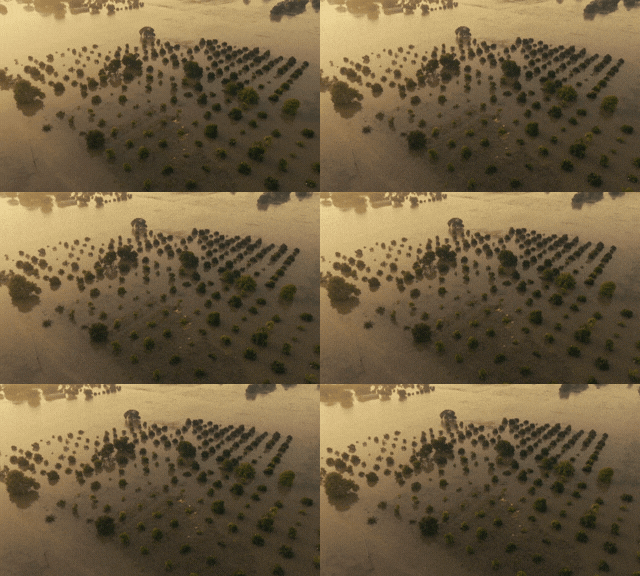
The human and economic costs are mounting. Floods and mountain hazards in 2025, including Glof events, destroyed homes and damaged infrastructure, which affected. Poorly planned development has amplified these impacts, exposing vulnerabilities across rural and urban areas.
The financial toll is equally significant. Pakistan is losing nearly 1pc of GDP annually to climate shocks, including heatwaves, floods and glacial melt. Urban centres are also at risk; Peshawar has seen a 16pc deterioration in climate conditions over the past 15 years, alongside more frequent heatwaves exceeding 45°C.
In response, the government is moving from policy intent to action. Initiatives such as the Glof-II project have introduced early warning systems and weather stations in 24 high-risk valleys, alongside efforts to develop a national Glacier Conservation Strategy. Financial innovation is being explored through instruments such as the proposed Green Panda Bond, though challenges persist, including reliance on fossil fuels and institutional constraints.
Recognising the urgency, the government has adopted a time-bound action plan to prepare for increasingly intense monsoon cycles. Approved in late 2025, it includes a 200–250-day emergency phase to repair embankments and drainage systems, a one- to three-year plan to expand urban drainage, and a three- to five-year strategy focused on resilient infrastructure, including river training works.
These measures are driven by projections that the 2026 monsoon could be up to 26pc more intense than in 2025.
Financing remains a central challenge. The National Climate Finance Strategy aims to mobilise international and private capital, supported by climate-linked subsidies and environmental taxation in the FY27 budget, and the integration of resilience into development planning.
Major programmes include the $3.5 billion “Glaciers to Farms” initiative and the $1.3bn Resilient Water Infrastructure Facility. Moreover, international partnerships are expanding, including collaboration with Sweden’s SEB bank and the CVF-V20 group to develop a Climate Prosperity Plan.
Complementing these efforts is a $2.7 million Japanese grant to rehabilitate flood-damaged schools in Khyber Pakhtunkhwa, with a focus on resilience and gender-sensitive facilities. Pakistan has also received $210m in climate financing from the International Monetary Fund under the Resilience and Sustainability Facility (RSF). The RSF totals $1.4bn and supports climate resilience, disaster management and water governance reforms.
Our climate challenge is no longer distant. While policy responses are evolving, their success will depend on sustained implementation, institutional coordination and timely financing.
Published in Dawn, The Business and Finance Weekly, March 30th, 2026