Whale filmed giving birth, with a little help from her friends
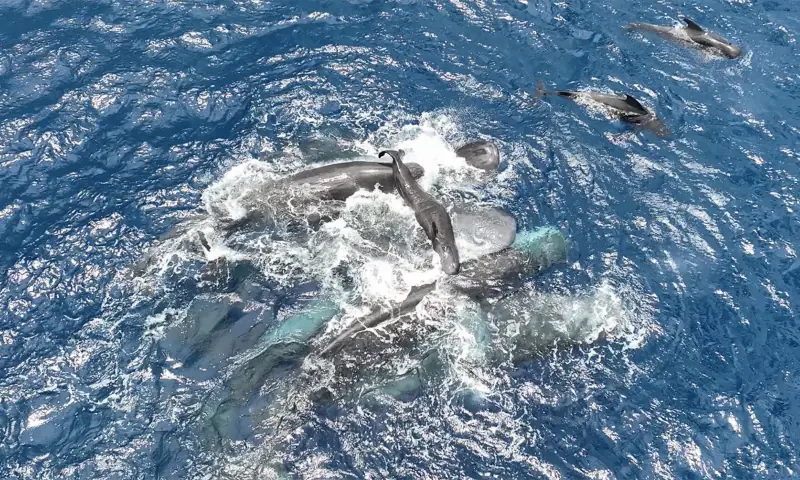
PARIS: Scientists have managed to film a spectacular event rarely witnessed by humans: a sperm whale giving birth while other females worked together to support the mother and her newborn.
A team from Project CETI, an international effort seeking to understand how whales communicate, were in a boat near a pod of 11 whales off the coast of the Caribbean island of Dominica on July 8, 2023.
Rounder, a 19-year-old female, was surrounded by family members and others as she was about to give birth to her second calf.
Over nearly five and a half hours, the scientists documented the group’s behaviour, watching them from the boat, filming them with drones and recording the sounds underneath the waves.
The data they collected, which was published in the journals Scientific Reports and Science on Thursday, represent an exceptional rarity in the history of science.
Out of 93 species of cetaceans — a group that includes whales, dolphins and porpoises — only nine have ever been observed giving birth in the wild.
Rarer still was that whales not related to the mother were helping out.
“This is the first evidence of birth assistance in non-primates,” Project CETI team member Shane Gero told the New Scientist.
“It is fascinating to see the intergenerational support from the grandmother to her labouring daughter, and the support from the other, unrelated females.”
Lifting up the newborn
The birth lasted 34 minutes, from their tails emerging from the water to the calf being born.
During labour, other adult females dove under Rounder’s dorsal fin, often on their backs with the heads facing her genital slit.
Immediately after the birth, the pod’s behaviour “rapidly changed” as every member became active, according to the study in Scientific Reports.
All the adults were “squeezing the newborn’s body between theirs, touching it with their heads”, the researchers wrote.
The whales pointed their noses towards the newborn, “pushing it around, under the water, and onto and across their bodies above the surface”.
The remarkable behaviour dates back more than 36 million years and is believed to be due to the unique history of cetaceans.
After their distant ancestors left the water and adapted to life on land, cetaceans are the only mammals that returned to the ocean.
This dive back into the water required some evolutionary tricks to prevent newborns from drowning.
Published in Dawn, March 28th, 2026