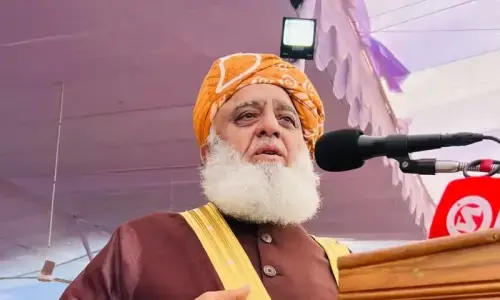
Fazl stresses caution in foreign policy decision-making
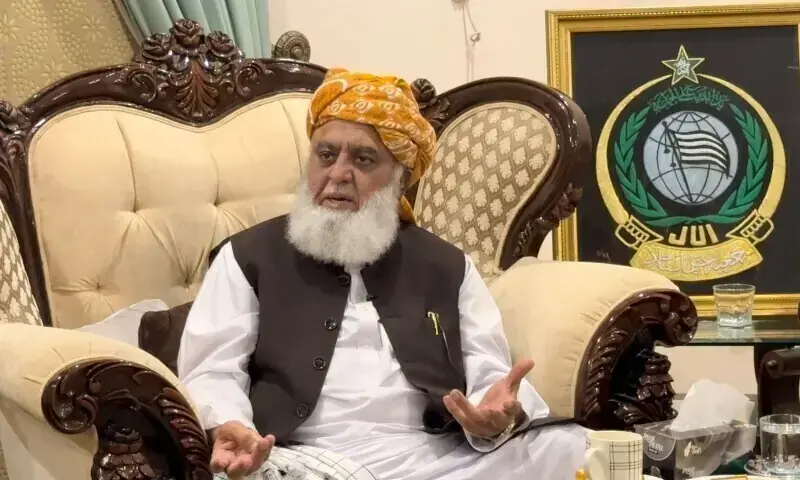

Dera Ismail Khan: JUI-F chief Maulana Fazlur Rehman on Thursday night expressed concern over Pakistan’s position in an increasingly complex regional and global environment, warning that the country faces mounting pressure on both its eastern and western fronts, while lacking a clear and coherent foreign policy.
Addressing a press conference, he said Pakistan’s relations with key countries, including China, the United States, Iran and Afghanistan were facing strain, adding that the country must clearly define its stance on major international issues related to India, Palestine and Israel. He remarked that uncertainty in foreign policy was contributing to ambiguity in Pakistan’s global standing.
Referring to broader developments in the Muslim world, the JUI-F chief criticised decades-long reliance of many Islamic countries on western powers for security and economic support, arguing that such policies had led to instability in countries like Afghanistan, Iraq and Libya, while tensions involving Iran continued to escalate. He called for greater political, economic and defence cooperation among Muslim countries, suggesting the formation of a more cohesive bloc to safeguard shared interests.
Criticises Muslim world’s decades-long dependence on West
Fazlur Rehman also questioned the role of global powers, particularly the United States, stating that shifting geopolitical dynamics indicated a transition towards a new global order. He stressed that Pakistan should adopt a cautious and self-reliant approach in its foreign policy decisions.
Turning to domestic issues, he highlighted the deteriorating law and order situation in parts of Khyber Pakhtunkhwa including Tank, Waziristan, Dera Ismail Khan, Lakki Marwat and Bannu where, he said, residents were being forced to migrate due to insecurity. He criticised the government’s inability to establish its writ in the affected areas.
He maintained that the prevailing challenges were national in nature rather than the responsibility of any single political party, and called for an in-camera session of parliament to brief lawmakers on the country’s internal and external situation and to evolve a unified strategy.
On Afghanistan, Mr Rehman said Pakistan should support a stable, sovereign and independent neighbour, urging a reassessment of past policies. He noted that despite decades of engagement, diplomatic efforts had not yielded the desired outcomes and emphasised the need to strengthen ties with the Afghan people alongside state-level relations.
Published in Dawn, March 28th, 2026