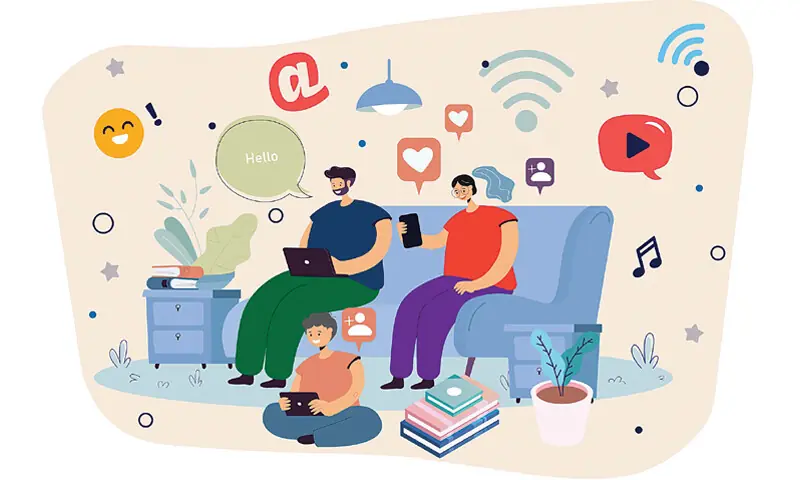
The relentless pace of the modern world leaves parents with so much to juggle. Many find smartphones useful for keeping their children busy, playing and even learning.
It is not uncommon to see a toddler swiping through cartoon videos or a child sitting quietly with a phone in one hand at dinner time. Sadly, along this modern path, something has quietly changed. Questions like “Why is the sky so blue today?” or “Why do birds fly in flocks?” have started to fade.
In this age of instant gratification and endless scrolling, children ask fewer questions — not because they know more, but because they are not used to wondering. Smartphones have replaced critical thinking with instant answers, leaving no room for exploration.
The emotional cost
Depression and anxiety are on the rise. This is not anyone’s fault; it is simply a result of overstimulation. Children often struggle to handle their feelings and may have a lower emotional quotient (EQ). Their emotional growth can be stunted due to a lack of in-person communication.
When watching something on a screen, people often express an emotion with a simple “like” or an emoji before they have actually felt it deeply. Children do not learn to read facial expressions or understand different tones of voice. Smartphones can rob them of these crucial life skills that are best picked up during face-to-face interaction.
We live in an age of instant answers and endless scrolling. While technology helps us learn, there is a hidden cost of being always connected
Growing dependence
Ask yourself: “Have I ever created something new?” “Have I thought about the real world?” “Do I know how to handle my emotions?”
A child who opens YouTube the moment they feel bored doesn’t do any of those things. They get so much dopamine from the screen that everything else seems boring. They don’t learn to handle frustration or quiet time.
Smartphones cannot teach us resilience or self-regulation.
Is social intelligence being ignored?
How can we expect a child to have a conversation when the only thing they know is texting? Empathy and cooperation are important social skills that get lost in impersonal social media chats.
Many teenagers struggle with eye contact, listening and patience in real-time conversations. In the past, face-to-face interactions helped people pick up social cues and learn how to behave in different settings.
Shrinking attention spans
Short videos, such as Reels and TikToks, train our brains to crave quick hits of excitement. Students surrounded by this content find it hard to focus, read long texts or even write long messages.
This is why “short forms” are so common now. Using terms like “W8” or “TLDR” (Too Long Didn’t Read) is proof of a rising sense of impatience.
Lead by example
The dopamine boost affects adults too. After a long day at work, parents often turn to screens for relaxation. Children mimic this behaviour, scrolling through dinner or checking phones during conversations.
This can lead to “emotional absence,” where parents are physically in the room, but not truly present. This can hurt the parent-child relationship.
Outsourcing our memory
Using Google Maps to find a friend’s house, a calculator for simple maths or a digital calendar for everything is now normal. But while it seems harmless, it can be a problem. When the brain is not used, it forms weaker connections.
While our own memory fades, the smartphone becomes our only memory bank.
Delayed development
Studies show that too much screen time can delay language development and impulse control. Even if educational apps are used, children may lose the ability to think for themselves.
Self-worth and social media
Comparing yourself to others on social media can damage self-esteem and body image. Many teenagers develop a fragile sense of identity based on “likes” and comments. This leads to mental health issues and affects how they get along with others.
The irony: smart devices, duller minds?
Smartphones are advertised as tools for connecting, but using them too much can produce a generation that is distracted and less social.
Smartphones are powerful tools, but only when we stay in control. It is time to draw a line between using them and depending on them. Let’s remind ourselves that the greatest connection doesn’t need Wi-Fi; it needs us to be present.
Published in Dawn, Young World, March 28th, 2026