Women protest sentencing of Kashmiri activists in Muzaffarabad
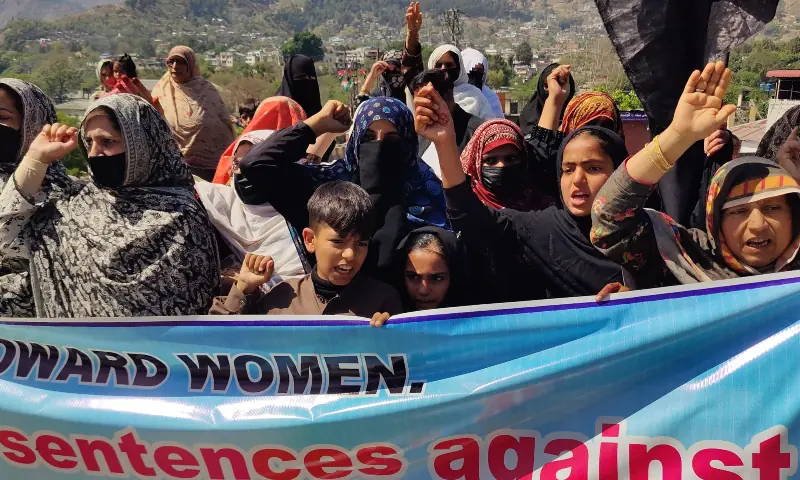

MUZAFFARABAD:A large number of women on Wednesday staged a protest demonstration against the ‘wrongful’ sentencing of three Kashmiri women activists imprisoned in India, urging the United Nations and international human rights organisations to press New Delhi for the immediate release of Kashmiri political detainees.
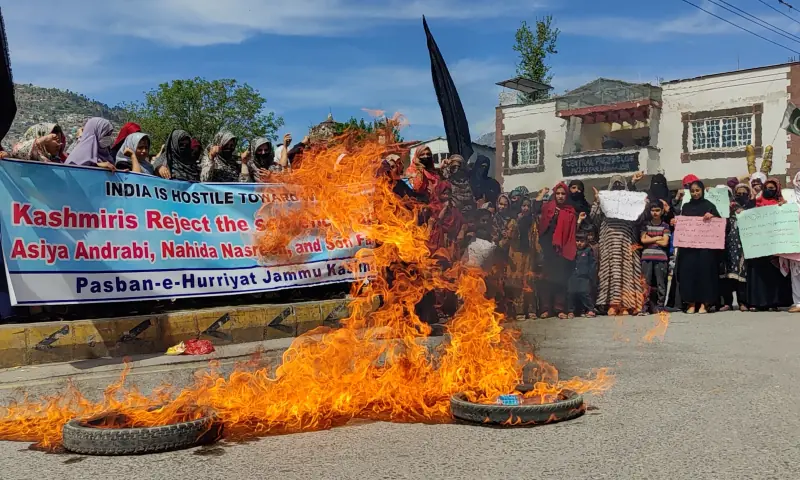
The demonstration was organised by the women’s wing of Pasban-i-Hurriyat Jammu Kashmir (PHJK), an organisation representing post-1989 migrants from Indian-occupied Jammu and Kashmir, at a bustling roundabout in the capital of Azad Jammu and Kashmir (AJK).
Carrying banners, placards and black flags, the protesters marched along the main road, where they also burnt tyres to register their anger. Slogans inscribed on placards read: “Kashmiris do not accept oppressive laws,” “Kashmiris do not accept unjust rules,” and “Kashmiris do not accept India’s decisions.”
Addressing the gathering, PHJK women’s wing head Mahnaz Qureshi charged Indian Prime Minister Narendra Modi with “weaponising the judiciary to victimise the Kashmiri leadership,” and said the sentencing of women activists reflected “a systematic attempt to silence dissent through coercion and intimidation.”
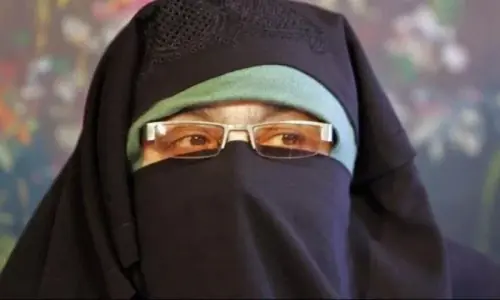
She described the double life imprisonment awarded to Syeda Aasiya Andrabi — detained in Tihar Jail for the past eight years — and the 30-year sentences handed to Nahida Nasreen and Sofi Fehmeeda as “an extreme form of political revenge and a blatant manifestation of anti-Kashmir bias.”
Ms Qureshi pointed out that Indian courts had consistently delivered “biased and politically motivated verdicts” on Kashmir-related cases, and termed the latest sentences “yet another link in a chain of retributive justice aimed at crushing legitimate political aspirations.”
“In a country where an innocent person is sent to the gallows to satisfy the ‘collective conscience’ of society, miscarriage of justice has become the new normal for Kashmiris,” she said, referring to the Indian Supreme Court’s verdict in the Afzal Guru case.
Other speakers, including Riffat Farooq, Zainab Ghazali, Sajida Usman, Idreesa Butt and Tahira Qureshi, paid tribute to the resilience and courage of Kashmiri women leaders and detained activists of the All Parties Hurriyat Conference.
They maintained that India had “institutionalised repression” in the occupied territory through arbitrary arrests under “draconian laws,” prolonged detentions without fair trial, and “inhumane treatment of detainees in prisons.”
“Thousands of Kashmiris, including women and youth, are languishing in jails under fabricated charges, denied due process and basic human rights,” said Idreesa Butt, a teacher in a refugee camp. “Such tactics expose the hollowness of India’s claims of democracy and rule of law,” she added.
The speakers said that violence, intimidation and even sexual abuse had been used as “tools of war” to suppress the Kashmir freedom movement, but had failed to break the resolve of the people.
“India’s state-sponsored terror cannot extinguish the spirit of a people determined to secure their fundamental rights, particularly the inalienable right to self-determination. Our struggle will continue until justice is served,” said Tahira Qureshi, also a teacher, emotionally.
Urging global attention, the speakers called on international human rights bodies to intervene and press India to end the inhumane treatment of Kashmiri detainees — including women, youth and the elderly — and instead ensure their early release.
Published in Dawn, March 26th, 2026