IHC orders formation of medical board to evaluate Imran’s health
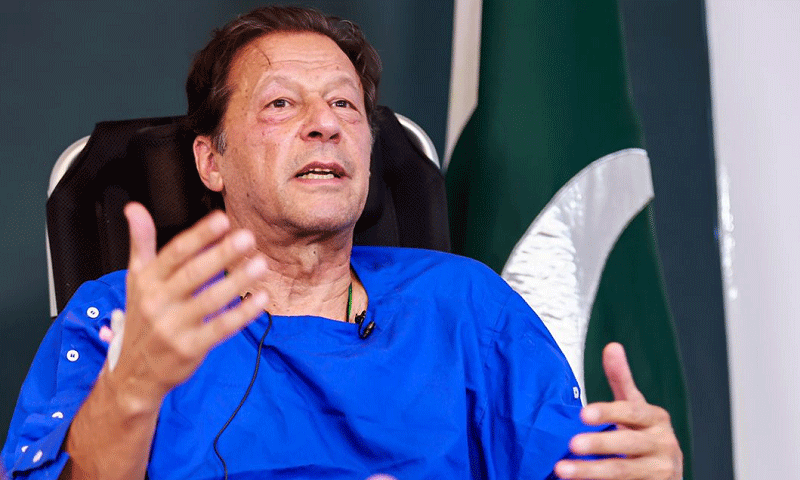


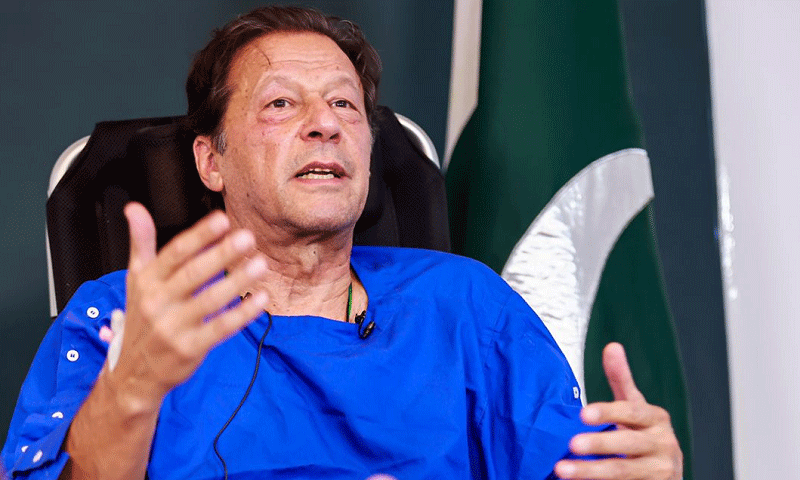
ISLAMABAD: The Islamabad High Court (IHC) on Thursday directed the formation of a medical board in its verdict on a plea seeking the transfer of PTI founder Imran Khan to Shifa International Hospital for medical treatment.
A division bench, comprising Justice Arbab Muhammad Tahir and Justice Khadim Hussain Soomro, presided over the hearing.
IHC directed Islamabad Chief Commissioner Muhammad Ali Randhawa to constitute a medical board and ordered that Dr Muhammad Arif and Dr Nadeem Qureshi be included.
Dr Qureshi, who is a retina specialist from Rawalpindi’s Al-Shifa Trust Eye Hospital, is also part of the medical board constituted on the orders of the Supreme Court. Dr Arif is the head of the ophthalmology department at the Pakistan Institute of Medical Sciences (PIMS) in Islamabad.
In its order, the court also directed the authorities to ensure Imran’s meetings with his lawyers and family. Dr Qureshi was instructed to remain in contact with Imran’s family over his medical treatment.
The written verdict, a copy of which is available with Dawn, stated that the plea has been disposed of.
It ordered that the medical board “shall furnish its recommendations” to the Islamabad chief commissioner at the earliest.
“The latter, in the light of such recommendations, shall take appropriate decision, in accordance with law and the relevant prison rules, as to whether the appellant is required to be shifted to any hospital outside the prison premises or otherwise,” it added.
The IHC ruling noted that under Rule 795 of the Pakistan Prison Rules, the prison authorities were “obligated to inform the relatives of a convicted prisoner when the prisoner develops a serious medical condition”.
The court ordered the prison authorities to act strictly in accordance with the rules.
It explained that under Rule 197 of the Prison Rules, the “power to remove a convicted prisoner for special treatment outside the prison premises vests in the government”.
Therefore, the IHC ruled, its jurisdiction under Section 561-A (saving of inherent power of high court) of the Code of Criminal Procedure “cannot be invoked to interfere with or substitute the power vested in the executive”.
The IHC observed that the report furnished by the Adiala jail superintendent “shows that substantial steps have been taken to ensure proper treatment of the appellant”.
“As per the report, the appellant (Imran) has shown further improvement from the previous visits. The medical board, to be constituted pursuant to his order, shall be in addition to the measures already taken so far,” the order noted.
The hearing
The proceedings on Thursday saw heated exchanges between the defence, the state’s legal team, and family members of the incarcerated former prime minister.
Representing the PTI founder, senior counsel Sardar Latif Khosa informed the court that his client had been complaining of a retinal issue since October.
“The Adiala jail doctors treated the matter as routine, while the government kept his deteriorating condition a secret for five days before the information minister finally admitted he was moved to PIMS,” Khosa argued.
He further claimed that the founder’s eyesight is now critically impaired, with only 15pc vision remaining.
Khosa drew parallels with the case of former prime minister Nawaz Sharif, noting that the current administration had previously allowed a convict to travel abroad on a Rs50 stamp paper for medical reasons.
On the other side, Islamabad Advocate General (AG) Ayyaz Shaukat and Additional Attorney General Rashid Hafeez defended the government’s position.
The AG recalled that a medical board, including top retina specialist Dr Qureshi, had been constituted following the SC’s observations.
A similar plea was submitted in the SC on February 25, after Imran underwent a government-facilitated follow-up treatment for his eye ailment.
The bench questioned the AG on the necessity of satisfying the prisoner regarding his treatment.
Justice Arbab asked the AG, “If something happens tomorrow, will you take full responsibility?”
AG Shaukat responded affirmatively, stating, “We will take responsibility.”
Justice Soomro then asked: “Should we place this commitment on the judicial record?”
At this, the AG argued that under jail rules, the satisfaction of the medical officer, not the prisoner, was the legal requirement for determining the venue of treatment.
Imran’s sister, Aleema Khan, briefly addressed the court as well. She expressed deep distrust in the jail’s medical facilities.
“We have doctors in our family; why are his personal physicians being denied access to his medical reports?” Aleema asked.
The court observed that while rules are dated, the right to life remains supreme.
Justice Arbab noted that the court had been hearing the case on a day-to-day basis due to the sensitivity of the matter, adding, “Life is the top priority; any loss would be irreparable.”
Khosa cited previous rulings by former IHC chief justices Athar Minallah and Aamer Farooq regarding prisoners’ fundamental rights.
The defence demanded that the founder be examined by his own doctors at Shifa International Hospital, even if only for a few hours.
After hearing detailed arguments from both sides, the bench reserved its judgment and later ordered the formation of a medical board.
PTI to challenge verdict in SC
The PTI, however, decided to challenge the verdict in the Supreme Court (SC), the party said in a statement.
It termed the verdict “extremely regrettable”, particularly in connection with Imran’s health and his fundamental human and legal rights.
The party said the rejection of all three pleas made on Imran’s behalf — permission to transfer him to Shifa International Hospital, allowing regular meetings with his family and including his personal physicians in the medical board — was “deeply alarming”.
Furthermore, the party decried that Imran had not been provided direct access to his doctors.
“All of these actions amount to grave injustice toward a person who is not only a former prime minister of the country but also the elected leader of millions of people,” the party stated.
Demanding that Imran’s family and personal physicians should be provided access to him, the PTI announced its decision to challenge the IHC verdict in the SC.
Imran’s health woes
The incarcerated ex-prime minister’s family and party have been raising concerns about his health since his eye ailment — right central retinal vein occlusion (CRVO) — came to light in late January.
Concerns mounted after partial vision loss in the right eye was reported via a lawyer who met Imran upon the SC’s intervention. Doctors later confirmed that, with glasses, the PTI founder had 6/9 partial vision in the right eye.
It should be noted that Imran’s family and personal doctors have increasingly pushed for the former premier’s admission to Shifa International Hospital in Islamabad.
On March 2, PTI moved IHC with a plea seeking the immediate transfer of the incarcerated PTI founder to Shifa International Hospital for specialised eye treatment.
The plea — filed under Section 561-A Criminal Procedure Code (CrPC) by senior counsel Khosa — alleged that jail authorities have been conducting medical examinations in complete secrecy and demanded that Imran’s personal physicians be granted access to him.
The petition further claimed that Imran — now 73 years old and incarcerated since August 2023 — has been left with only approximately 15pc vision in his right eye.
The application cites a report submitted to the SC by amicus curiae Barrister Salman Safdar, which confirmed that despite the petitioner’s repeated complaints of “blurred and hazardous vision”, no timely or adequate medical intervention was undertaken by jail authorities, ultimately resulting in complete loss of vision in one eye.
On March 3, the Pakistan Institute of Medical Sciences (Pims), where Imran was being treated, said that the PTI founder was examined at Adiala jail for the follow-up treatment of his eye ailment, which showed that his vision had “improved remarkably”.
Additional input from Ikram Junaidi