Meltdown on PSX: index loses 11,015 points on oil surge


 0
0
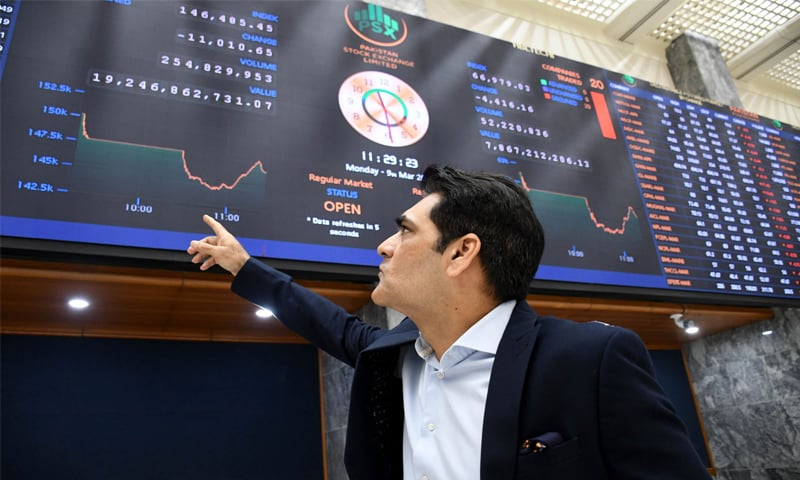

KARACHI: Within a few minutes of opening trading, Pakistan’s equities experienced an exceptional meltdown, causing the benchmark index to drop nearly 6pc and prompting a market halt as surging oil prices triggered panic selling amid a rout on global markets, directly linked to the ongoing Middle East crisis. However, crude prices later fell off their highs but were still up over 10pc from the previous close.
The panic-driven sell-offs pushed the benchmark KSE-100 index below 145,000 to 144,119.44 intraday. The KSE-100 index closed the session at 146,480 points, marking a decline of 11,015 points or 6.99 per cent — the second-largest single-day drop in the index’s history, costing investors over Rs1.09 trillion.
Since the all-time peak on Jan 23, the index has fallen by 42,686.68 points, or nearly 22.56 per cent, resulting in a total loss of over Rs4.618 trillion, or 21.76 per cent, in market capitalisation. On March 2, after the US-Israel illegal attack on Iran, the KSE-100 index plummeted and experienced its largest single-day decline of 16,089 points, or 9.57 per cent, to close at 151,973 points.
Topline Securities Ltd stated that trading on the PSX was temporarily halted for an hour after the benchmark KSE-30 index fell more than 5 per cent from the previous day’s close, triggering a market-wide circuit breaker.
Benchmark falls below 145,000; equity investors lost over Rs4.6tr since January 23 peak
However, market sentiment remained fragile as global crude oil prices surged above $110 per barrel after Iran moved to close the strategically vital Strait of Hormuz, a key route for global energy shipments. The development triggered strong reactions across international energy and financial markets, further impacting investor confidence.
The ongoing Middle East crisis, which has disrupted oil supplies as major shipping companies halted operations to and from the Gulf, has caused energy prices to rise and prompted the government to adopt contingency measures. These include weekly reviews of petroleum prices to pass on increased costs to consumers, petrol rationing, and Covid-like measures such as working from home and switching to online classes to conserve oil stocks.
Index-heavy constituents, including Fauji Fertiliser, United Bank, Engro Holdings, Hub Power UBC, and Lucky Cement, emerged as major laggards, collectively dragging the index down by 4,497 points during the session.
Amid a bearish market, trading volume surged 71.18pc to 621 million shares, suggesting that equity investors rushed to sell off their holdings. The traded value also increased by 60.62pc to Rs37 billion. K-Electric topped the volume board, with trading exceeding 127 million shares.
Ali Najib, deputy head of trading at Arif Habib Ltd (AHL), stated that the PSX opened under considerable pressure following an overnight increase of nearly 25pc in global oil prices. Within the first five minutes of trading, the KSE-30 index dropped more than 5pc, triggering a market-wide circuit breaker in accordance with PSX regulations and temporarily halting trading activity.
After trading resumed an hour later, selling pressure persisted as investor sentiment remained fragile. Concerns over rising fuel prices, high global crude oil rates, and the potential increase in business and production costs weighed heavily on the market, resulting in widespread selling across multiple sectors.
Looking ahead, global markets appear to be reaching a point where much of the current uncertainty has already been taken into account. Any positive developments in the Middle East could help boost investor confidence and potentially lead to a substantial recovery across financial markets.
In line with market expectations, the State Bank of Pakistan decided to keep the benchmark policy rate steady at 10.5pc, with the next Monetary Policy Committee meeting scheduled for 27 April.
Published in Dawn, March 10th, 2026