ARE we living in a post-literate era? In today’s world, where digital media has taken over much of readers’ time and attention, and reading is not deemed as important a way of consuming information as it used to be, the term post-literate is gaining currency.
In many countries, book sales are faltering, newspapers and magazines are closing down for good and reading habits have taken a heartbreaking nosedive as reading printed materials for pleasure or information is slowly but surely being replaced by screens.
But all is not lost, not in France, at least. An article by Alexander Hurst, published last week in The Gurdian, tells a story that may lift the spirits of the elderly, such as this writer, who reminisce about “the good old days before cell phones”. While “worried voices prophesy the death of reading, dawn of a post-literate society and even a generational drop in intelligence”, says Hurst, print culture is thriving in France as French publishing industry has refused to let printed matter die. Book sales in France are booming and even the sales of literary magazines are surprisingly high, as newspaper kiosks, too, sell literary magazines in quite good numbers, writes Hurst.
But in this part of the world, picture is not that rosy. In Karachi, for instance, most of the newspaper kiosks that we had been seeing for quite long are disappearing quietly and are now sparsely seen. The bike-riding paperboys we used to see in the pre-dawn hours, going from door to door to deliver a copy of a newspaper, are a rare sight these days. A sign of the times, perhaps! But the older cohort is addicted to reading the printed-on-paper, ink-smelling newspaper. This ‘scent of the morning’, as some affectionately call it, may soon become a thing of the past. The same goes for voluntary reading for enjoyment or knowledge.
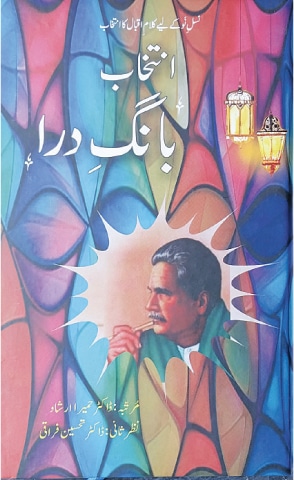
But there are some restless souls like Prof Dr Tehseen Firaqi who refuse to give in and insist on printing books that may inculcate a love of reading and love of literature in youngsters. To lure back the young readers drifted away to digital media, Dr Firaqi, as director of Lahore’s Bazm-i-Iqbal, has launched a series. Titled Nasl-i-Nau Ke Liye Kalam-i-Iqbal Ka Intikhab, or the selections from Iqbal’s poetry for new generation, the series has just begun with the first book: Intikhab-i-Baang-i-Dara. Four scholars, namely Humaira Irshad, Arshad Mahmood Nashad, Sajid Siddiq Nizami and Zahid Muneer Aamir, helped select the verses and Humaira Irshad has compiled the work, informs Firaqi in his intro to the book.
Selections from Iqbal’s poetry for children or young adults is not something new and, as mentioned by Dr Rafiuddin Hashmi in his Kitabiyaat-i-Iqbal, there have been 50-odd such selections both in India and Pakistan before and after the Independence. But what makes this new selection a special one is that extreme care has been taken not only in selecting but also in composing. Diacritic marks are meticulously put on the words, making it easier for the young readers to read and pronounce them correctly. A glossary at the foot of every page briefly explains the difficult words and expressions. The selection is intended for secondary, higher secondary and undergraduate classes, says Firaqi, and every care has been taken to make it as objective and representative of Iqbal’s art and thought as possible.
Allama Iqbal did not write many poems exclusively for children and in the first part of his Baang-i-Dara there are only seven poems whose titles precede the wording ‘bachchon ke liye’, or for children. These seven poems are naturally made a part of the book. But then there are two more poems in Baang-i-Dara’s first part whose titles do not mention that they are specifically written for children, but they sound like intended for children. These are: ‘Tarana-i-Hindi’ and Hindustani ‘Bachchon Ka Qaumi Geet;. These two poems have not been made part of the book for apparent reasons.
Still, there are some more verses by Iqbal that sing of childhood days, as put by Abdul Qavi Desanvi in his article published in Nuqoosh’s Iqbal Number (vol 2, 1977). Some of Iqbal’s poems written for children aim to convey wisdom and love of freedom as well as nature, adds Desanvi. Such poems, too, have made it to this selection, showing the conscientious approach.
Dr Humara Irshad in her foreword has mentioned that the selection includes verses from all three parts of Baang-i-Dara, representing three eras of Iqbal’s poetry. Humaira Irshad holds a PhD in Urdu literature and serves Lahore’s Government Graduate College for Women as principal.
Published in Dawn, March 9th, 2026