US President Donald Trump has told the Iranian people that “the hour of your freedom is at hand” and the government would be “yours to take when the United States was finished with its mission.”
However, the problem here is that history has shown that the removal of Saddam Hussein from Iraq or Gaddafi from Libya did not lead to nation building or national reconstruction in either state. Both economies were seriously damaged by war, with the common man worst hit.
Moreover, The New York Times has highlighted that new optimism in Venezuela based on hopes for oil wealth is marked by fragile progress.
In Iran’s case, “The sanctions have not so much weakened the regime as entrenched it further,” wrote Iranian American writer and journalist Amir Ahmadi Arian in an article for The New York Times.
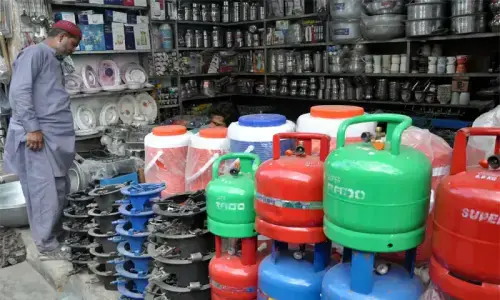
Analysts say Pakistan’s trade is likely to face delays and higher freight and insurance costs given the state of the US-Israel conflict with Iran
He wrote, “Lifting them would at least help alleviate the destructive effects of this new war on ordinary Iranians, who will inevitably bear the brunt of.” It may be noted that Mr Arian is not opposed to US intervention in Iran.
He further stressed, “We need a new form of internationalism: grass-roots activism focused on transnational coordination. Ordinary people must have more of a say in global affairs. Iran is as good a place as any to start.” That said, an overwhelming majority of the American citizens, according to a survey, are opposed to the US armed attack against Iran.
Another profound shock lies ahead for the global economy if the war is prolonged, says an American analyst. The fallout of the war in the region on Pakistan can be gauged from the fact that the Pakistan Stock Exchange witnessed a record single-day plunge which inflicted unprecedented losses of Rs1.7 trillion leading panicky investors to exit following the assassination of Iran’s Supreme leader Ayatollah Ali Khamenei.
While ensuring uninterrupted energy supplies is critical, Pakistan is more vulnerable to a sharp surge in global energy prices. “For every $10 rise in oil prices, the current account deficit increases by roughly $1.5–$2 billion,” explains former chief executive officer of the Pakistan Business Council, Ehsan Malik.
To quote Sakib Sherani, “While Pakistan is to be blamed for where it is, the IMF bears culpability via acts of commission as well as omission, for keeping it there.”
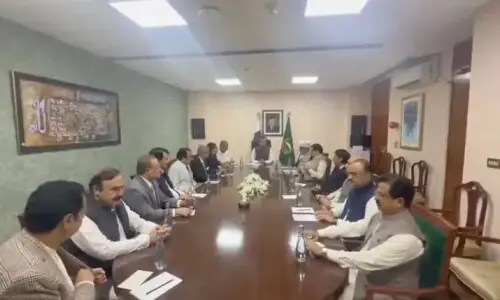
Pakistan has been assured by Saudi Arabia that it will get energy supplies through the Red sea and it expects the United Arab Emirates to follow suit. Prime Minister Shehbaz Sharif, on March 2, constituted an 18-member high-level committee to assess the impact of rising international prices on the country’s economy, particularly in response to the upward trend in global oil prices.
Furthermore, the committee was tasked with conducting a thorough analysis of the fiscal impact in the event of an extended conflict and evaluating the economic consequences for Pakistan. As a Dawn editorial notes, “Energy import dependence, a narrow export base, and reliance on remittances leave the economy exposed to shocks originating far beyond country’s borders; exports to the Middle East will also be badly hit.”
With Finance Minister Muhammad Aurangzeb as convenor, the prime minister-appointed committee is expected to suggest measurers for conserving energy like ‘work from home’ policy. Other reported proposals include weekly review of petroleum prices, compensation to oil companies for elevated insurance costs, import premiums and freight charges.
The federal government is now preparing an indigenisation plan (2026–35) focused on strategic indigenisation of electric power equipment to reduce import dependence. It has also awarded to Pakistani companies 11 onshore oil and gas exploration blocks located across eight tracts in Balochistan, two in Sindh and one in Punjab with an investment of Rs8.66bn.
Multiple major international shipping lines have suspended all new cargo bookings for the closed Hormuz straits and Eastern Mediterranean ports. The suspension covers a sweeping range of Gulf nations including the United Arab Emirates, Saudi Arabia, Iraq, Kuwait, Oman and Qatar.
Some firms have indicated the imposition of war-risks and contingency surcharges on cargo. Analysts say Pakistan’s trade is likely to face delays and higher freight and insurance costs. Insurance companies are also cancelling war risk coverage.
An extended conflict, as feared widely, cannot be ruled out. “Relying on the US military as a primary tool of foreign policy — rather than as the ultimate option — is dangerous,” wrote US security expert W.J. Hennigan in the NYT. Trumps’ “constantly shifting instance on the invasion of Iran” indicates what a US analyst says “a leap into the unknown.”
Published in Dawn, The Business and Finance Weekly, March 8th, 2026