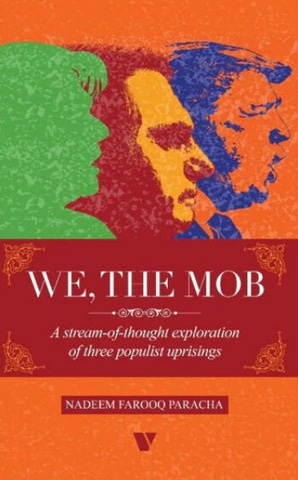
We, the Mob: A Stream-of-Thought Exploration of Three Populist Uprisings
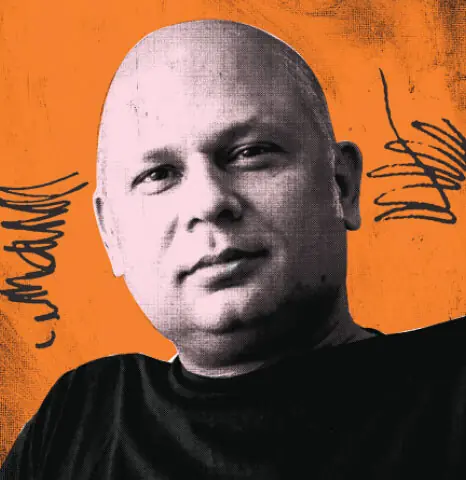
By Nadeem Farooq Paracha
Vanguard Books
ISBN: 978-969-402-705-0
153pp.
Nadeem F. Paracha’s We the Mob: A Stream-of-Thought Exploration of Three Populist Uprisings takes a refreshing step out of the comfort zone of our familiar and repetitious local debates and discourses on politics to situate the dynamic of populism in Pakistan within what is evidently a global phenomenon.
As an experienced journalist and cultural critic who has travelled widely and closely observed political events, upheavals and transitions over the past two decades, Paracha brings into conversation three very different contexts — the United States, Brazil and Pakistan — to share his insights on the common threads of contemporary populism.
We the Mob is a reflective monograph on this comparative theme, stringing together observations from politics, culture and history. Its crisp and accessible style of writing makes it an interesting read for anyone curious about how we can think of Pakistan beyond an isolated, parochial lens.
The book is structured in an instructive case study format. In the introduction, the author explains his comparative focus on the three ‘populist uprisings’ or ‘insurrections’ surrounding the political careers of Donald Trump, Jair Bolsonaro and Imran Khan, and explores the similarities in the political ideas and styles that inform their populist practice and rhetoric, despite varied contexts.
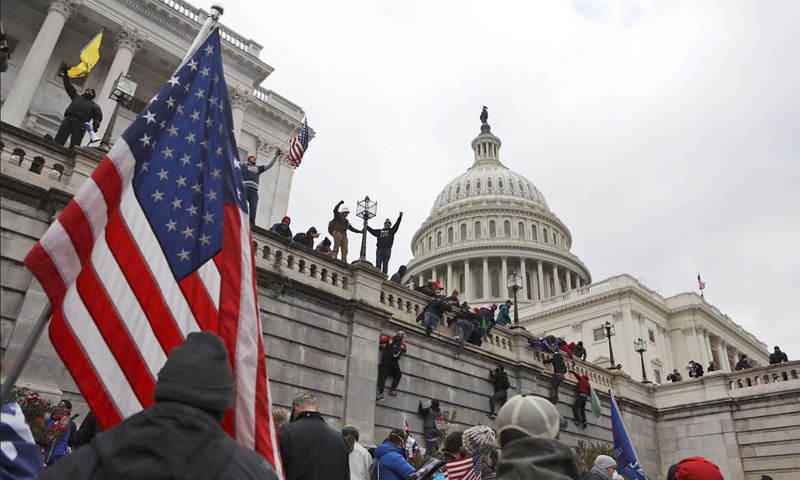
The three substantive chapters are devoted to each case study, outlining in detail the trajectories that lead up to the violent uprisings in an uncannily similar way and with strikingly similar antics. These relate to the mob attack on the US Capitol in early 2021 by Trump supporters after he lost the presidential re-election in 2020; the riots at the National Congress Palace in late 2022 by Bolsonaro supporters after he lost the presidential re-election that year; and the storming and ransacking of military property by Khan supporters in mid-2023 after he was arrested for corruption during his tenure as prime minister.
Nadeem F. Paracha’s latest book explores contemporary populism by comparing three modern-day populist uprisings in the global North and South and situates Pakistan within a global phenomenon
The concluding chapter of the book distils from these case studies the core elements of contemporary populism that may manifest in different forms but are rooted in increasingly homogeneous structures of political thinking in many parts of the world.
So, what is common to these cases apart from the circumstances of the uprisings, and what is contemporary populist politics made of? The author identifies three important elements and belief systems that populists and their supporters mutually reinforce.
The first idea that populists peddle is “anti-elitism”, the belief that “pure people” are pitted against a “corrupt elite.” This is a powerful emotive tool that plays on the frustration, anger and fear of people who feel sidelined from the benefits accrued by an entrenched political class. But there are ironies here. The populist claiming to be ‘anti-elite’ also hails from the same elite class but a different or newer faction, and his supporters are very likely to come not from the ‘masses’ but from the middle classes, including urban, educated professionals. The author repositions this idea of anti-elitism as an intra-class or intra-elite conflict, in which a new elite is allied with middle classes aiming to bolster their economic power.
A second idea that populists play on is a “Manichaean” vision of good and evil, a binary that perpetuates “tribalism” or a tendency to garner support by fomenting and demonising an “out-group.”
Finally, populists use a “politics of faith” to celebrate a “mythic and idealised past.” From Trump’s slogan of “Make America Great Again”, to Bolsonaro’s nostalgia for military rule, to Khan’s evocation of “Riyasat-i-Madina”, these imaginaries add to the intensity of people’s emotions against the status quo. Neither does populism have any connection to ideology. In fact, an essential part of a populist’s toolkit is to agglomerate from other ideologies, so that old distinctions between left and right become obfuscated.
The emotional dimension is thus especially potent in populist politics, fuelling a “cult of personality” and displacing any real focus on governance. The author suggests that it is for this reason that, when populists anticipate failure or ouster by the ‘old elite’, they are able to incite their supporters to violence on the pretext of “event-based conspiracies”, such as electoral fraud, in order to retain or return to power.
The uprisings in all three cases point to the widespread belief among their supporters that they were on the verge of a popular coup. The role of the military is also important here: all three populists attempted to instigate a coup within the military in a bid to restore their position, seriously underestimating military discipline.
Ultimately, the question arises, what are the historical and socio-political roots of contemporary populism? The author offers some broad possibilities: the culture wars of the past few decades that gradually hollowed out the politics of the left; the rise of neoliberalism and the backlash to the neoliberal agenda of globalisation in the form of ultranationalism, xenophobia, racism and politicised religion; and the disruption and disintegration of party structures and old power brokers.
As a reader, this is perhaps where my curiosity was left unsatiated. I wanted to know more about the culture wars and the impact of the rewiring of the left-right political spectrum on the Global South. I also wondered if something could be said more broadly about the gradual erosion of democratic institutions by corporate, military and other non-democratic institutional interests.
In fairness, the author points to what he views as the inherent potential of democracy to seed from within itself anti-democratic impulses. He says, for instance, that in all three cases under scrutiny, the populists are not dictators in the traditional sense but “authoritarian-minded politicians”, who entered the political arena through apparently democratic institutions. But under what kinds of institutional conditions is this a real possibility, apart from the observable global trajectories of neoliberalism?
Last but not least, I found myself making comparisons of contemporary populism with populist politics of the past. Some differentiation of the two would surely add more nuance to our understanding of the continuities and changes that underpin this new wave of politics.
All in all, We the Mob is a thought-provoking work that helps us view Pakistan within a global frame.
The reviewer is a Socio-Legal Scholar on South Asia and Research Fellow at the Institute of Development and Economic Alternatives (IDEAS), Lahore
Published in Dawn, Books & Authors, March 1st, 2026