GARDENING: HARVESTING THE CHARD
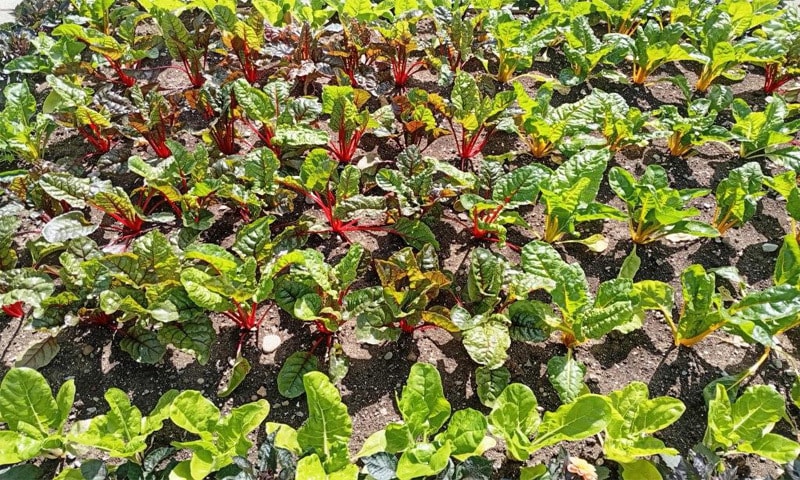
Swiss chard is a leafy vegetable and a staple of Swiss cuisine. It is one of the key ingredients in their local cuisine and a must in capuns, a traditional Swiss dish consisting of spätzle dough mixed with dried meat, herbs and onions, wrapped in Swiss chard leaves. The Swiss also consume the leaves in a number of other local dishes, side dishes and as a garnish. The leaves offer a mild, earthy flavour, while the stems remain crisp, making it well-suited to eating raw.
In many cuisines, young Swiss chard leaves are usually preferred uncooked in salads. Young leaves are believed to taste better while older leaves, especially the ones from older, more mature leaves, are relatively bitter in taste. Versatile in the kitchen, Swiss chard can be sautéed, steam boiled and stir fried for consumption. Prolonged cooking can reduce its nutritional content.
Getting the most out of Swiss chard, whether raw or cooked, depends on knowing precisely when and how to pick it. The timing of the harvest depends on the way it is likely to be consumed. For instance, if the leaves are to be consumed raw or in salads, then the gardener would harvest baby leaves. Such baby Swiss chard leaves are usually around four inches. From the day of sprouting, it takes around one and a half months to harvest the first few of the baby Swiss chard leaves.
In most parts of South Asia, the full-sized larger leaves are more often consumed with the main course and are usually cooked like many other leafy greens. These leaves are almost double in size as compared to baby leaves and range from about eight to 10 inches in length. The size also depends on whether the plant is being grown in pots or open ground land, with a larger leaf size expected of the latter. The optimum size for the first harvest of a full-size leaf is usually attained around 70 to 90 days after the sprouting of the seeds.
Getting the most out of Swiss chard, whether raw or cooked, depends on knowing precisely when and how to pick it
There are a few recommendations while making the harvest. For instance, the harvest should be performed early in the morning, when leaves are at their most hydrated and flavourful. Regular harvesting stimulates continued leaf production. If the leaves are growing normally throughout the maturity phase, the harvests can be performed after every 10 to 15 days.
Swiss chard is harvested much like spinach, with two main approaches. One approach is to simply cut off the plant from the base when it is ready. This provides the gardener with a bunch of ready leaves instantly. However, it reduces the life of the plant and the quantity of leaves produced by the plant significantly.
The other, more commonly used, method is of harvesting fully-grown leaves individually. The leaves are usually harvested by working around the plant in a circular motion, cutting outer leaves a few centimetres above the soil. By adopting this outside-in harvesting technique, the leaves on the outside are harvested while the central core part is left untouched. Within a few weeks, new leaves begin to sprout and another harvest is ready for harvest. Depending upon conditions and the variety of Swiss chard, the leaves can be harvested for about six months or so.
There is a strong belief among Swiss chard lovers that the plant should not be grown past its second season. After a season ends, or in unfavourable conditions resulting in early bolting of the plant, the taste of the leaves becomes bitter, making them unpalatable. Many gardeners remove the plant, which can then be used to prepare leaf-based fertilisers, leaf compost and even fodder for poultry.

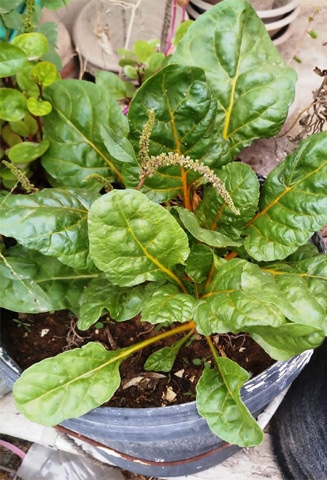
Typically, at the end of the plant life cycle, a long stalk grows from the plant, marking the beginning of the bolting phase. This phase usually occurs at the end of two years but, sometimes, it may occur earlier as well. The taste of the leaves gradually changes, which makes them unpalatable.
Flowers grow on the top of this stalk. These flowers later produce seeds that start out as green; once they turn brown, they can be harvested and kept in a cool, dry place for the following season.
To further increase the life of the plant and slow down the bolting phase, gardeners pinch off the buds growing on the long stalk, extending the harvest of Swiss chard leaves by a few more weeks.
Please send your queries and emails to doctree101@hotmail.com. The writer is a physician and a host for the YouTube channel ‘DocTree Gardening’ promoting organic kitchen gardening
Published in Dawn, EOS, March 1st, 2026