THE ICON INTERVIEW: THE FUTURE’S ALWAYS BRIGHT FOR HIM


 0
0
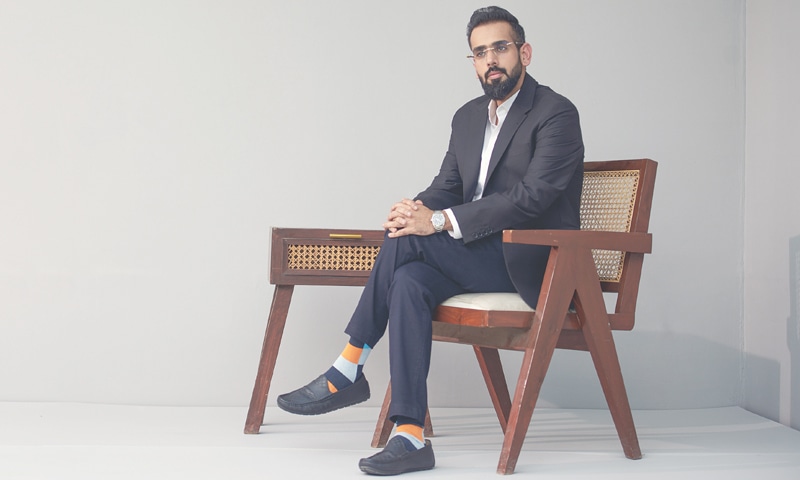

2026 is going to be exciting,” Abdullah Seja tells me.
You said the same about 2025, I remind him.
“I am going to tell you the same in 2027,” he grins.
He isn’t just saying this because it sounds good. Abdullah Seja really means it. He is one of the youngest producers in the Pakistani TV drama landscape — and a very successful one — and he talks about every drama that he has produced, under the iDream Entertainment banner, with great passion.
He’ll discuss the nuances of crafting together a story, certain scenes that he has liked, actors who have stood out in different projects, and trying out new ways of storytelling. You can tell that he loves what he does. It is this passion that has very quickly spiralled him upwards into the top ranks of Pakistani TV drama production.
“I always wanted to make TV dramas,” he tells Icon. “I think that, since sixth grade, I had decided that I would become a producer. I love developing content and creating stories. And when I tell a story, I don’t want to wrap it up in two hours. I want to take 10 to 12 hours, build up the various aspects of it, in order to tell it right.”
Abdullah Seja is one of the youngest producers in the Pakistani TV drama landscape. But with a slew of hits behind him, he’s also one of the most successful. Does he instinctively know what will be a hit? Why does he hate experimenting with storylines? And how does he deal with problematic actors?
It’s interesting talking to Abdullah Seja. In entertainment, often the focus is on actors, but the producers are the architects working behind the scenes, connecting the dots, making things happen. Abdullah’s particular brand of ‘architecture’ flits from one structure to another, completely different one — or rather, from one genre of drama to another.
“When I started working at iDream, I was told that it was important to create a bouquet of stories,” he says. “Every story needs to be different from the previous one, while also connecting with the audience.”
Abdullah’s metaphorical bouquet has been enticing the audience very well. iDream churned out a slew of solid hits last year — with Naumaan Ijaz playing the philandering middle-aged man in Bismil, Danish Taimoor breaking records as the titular Sher, and an exceptional ensemble cast forming the backbone of the neighbourhood drama Sharpasand. There are many other iDream dramas that have been memorable over the years; among them, the top-rated soaps Baby Baji and Baby Baji Ki Bahuwain and dramas Fraud, Ghisi Piti Mohabbat and Kaisi Teri Khudgharzi.
I recall meeting Abdullah at an event last year where he had animatedly shown me the promotional teaser for his drama Sher, which was then yet to air on TV. Flames lit up a battleground where an angry mob fought with each other while the two leads, played by actors Danish Taimoor and Sarah Khan, pointed guns at each other. It had all looked very cinematic, like a snippet from a movie rather than from a desi drama.
Some weeks later, he had invited me to a studio where Sher’s title track was being filmed as a full-blown music video. Musician Faisal Kapadia lip-synced to the parts that he had sung, with Arif Lohar’s vocals ringing out in between — perhaps his part had already been shot. Pairing two popular musicians with such disparate vocals was a great idea and it worked very well, with the drama’s director Aehsun Talish plugging in the song every time the drama took a tense turn.
“A drama OST [original soundtrack] is very important and we invest a lot of time into developing it,” says Abdullah. “Also, I never develop just one track for a drama. There need to be at least two tracks, so that different songs can fit into different situations over a drama that will span 30 episodes or more.”
Later last year, I was let in on the secret that the upcoming drama, Sharpasand, was going to feature a title track sung by Rahat Fateh Ali Khan and his son Shahzaman Ali Khan — another coup in the realm of drama OSTs. Once Sharpasand aired, I was invited to visit the set: a street created especially to emulate the mohalla where the plot would unfold.
“I am going to show you my next drama, Mirza Ki Heer’s trailer soon,” Abdullah promises me now.
From one drama to the other, his enthusiasm never wanes. Can you tell when a script is going to be a hit, I ask him. “No, there is no given formula for success,” he says. “I sincerely think that our productions have worked because God has held our hand throughout. We rely a lot on research, seeing what clicks with the audience and following the channel’s suggestions on what tropes should be added into the story.
“I don’t experiment — I don’t even like the word. I don’t want to try producing something that will alienate a large chunk of my core audience. Instead, I try to tell stories from new angles. Stories, around the world, are more or less the same. The way they are told keeps evolving. We are always trying to innovate and learn from our mistakes and, somehow, it’s been working well for us.”
When I started working at iDream, I was told that it was important to create a bouquet of stories,” he says. “Every story needs to be different from the previous one, while also connecting with the audience.”
With an increasing global audience gravitating towards Pakistani dramas, has the content that he is producing changed? “The content development is the same, but the production quality has improved, not just in my case but across the board for every channel and production house. When a drama rakes in two to three million views in a few hours — like Sher did — it means that it has a loyal international audience. To keep this audience hooked, we try to make the quality better, work on better locations and styling and introduce new technologies.”
Speaking of Sher, does he think that the mass popularity of the lead hero, Danish Taimoor, had a role to play in the drama’s success? “Danish is one of our biggest superstars and I definitely knew that half our work was done when we signed him and Sarah Khan for the drama. They are both extremely popular with the masses,” says Abdullah. “But based on the story, also, I knew that the drama would create a buzz. The director Aehsun Talish was also excited. We just didn’t know that it would be that big a hit.”
However, Danish Taimoor also occasionally becomes the target of social media criticism because of his controversial comments in interviews, and his predilection for playing the toxic hero on TV. From a more general perspective, is an actors’ popularity with the masses entirely unaffected by social media controversy?
“I think it does translate somewhere or the other,” Abdullah muses. “Social media discussions cannot be written off entirely, because they also affect the eyeballs that we get internationally. If an actor says something wrong, you will see effects of it in people’s reactions, and also in conversations that are taking place. Ratings, though, are more likely to suffer if an actor has said something wrong in his or her personal capacity. On the other hand, if an actor is playing a toxic character and people are criticising him or her [because of it], then that just means that the actor is doing a great job at convincing them.”
Some time ago, iDream Entertainment also produced one of their biggest hits, following the toxic stalker trope: 2022’s Kaisi Teri Khudgharzi. If he were to produce the drama today, would he still opt to do so?
“Absolutely,” he says. “I own up to having produced that drama and the basic premise of the story, focusing on stalking, is still a reality around us. However, today, I might tell the story from a different angle. The audience’s perception has changed and so have our own thought processes. Every time period teaches you something and there was a certain kind of content that was working back then and other content which is working today. The story probably cannot be told the same way today.”
The drama’s female lead, actress Durefishan Saleem, had once said in an interview that she would not want to work in such a drama again. What is Abdullah’s take on this? “It is her own opinion and her own journey. And you never know, she might say this today and, two years later, she might be acting in something similar.”
He continues, “She has a certain point of view and I respect that. What can also not be denied is that the project gave her career a boost, which allowed her to go on and do the kind of work that she wanted to do. She has accepted this fact in multiple places that, while she may not work in such a drama again, it did help her in her career.”
Kaisi Teri Khudgharzi, incidentally, was another iDream hit starring the eternally popular Danish Taimoor. “He was already a big star when he came on board but, for Dure, the drama was definitely a career boost. She is a brilliant actress and I had a great time working with her. We have been trying to coordinate for more projects together but the dates haven’t worked out. She is one of the most educated individuals that we have in the industry.”
Another actress who can credit iDream for one of her best-loved hits is Ramsha Khan, in the critically acclaimed Ghisi Piti Mohabbat from 2020. “It’s one of my favourite projects and four actresses backed out from playing the lead character because it was a very difficult one, with four different looks, four family set-ups and no constant hero. Fasih Bari wrote the script and Ahmed Bhatti did a great job directing the drama but, acting-wise, the project was solely relying on Ramsha’s shoulders. No one could have played the role as well as she did.”
Lately, iDream projects are being directed by Aehsun Talish — is the director now an official part of the production house? “Yes, Aehsun bhai is now exclusively working with us. At iDream, we like to build teams, with everyone working together, making improvements and learning from mistakes. If something goes wrong, we never place the blame on the director, actor, or producer. We all messed up, as a team, and we will learn from it and not make the same mistake again.”
Referring to Aehsun Talish’s recent work in the drama Sharpasand, Abdullah says, “Credit for telling the story so well truly goes to him, as well as the writer. There were scenes that Aehsun bhai shot so well that I was taken aback. It is a story navigating an entire neighbourhood and we haven’t dragged it at all, with every story track reaching its eventual conclusion.”
I comment that Abdullah’s various dramas negate the prevalent notion that Pakistani dramas are dominated by saas-bahu storylines. “I think the people that say this don’t actually see Pakistani dramas,” he rightly points out. “Mothers-in-law, mothers, sons and daughters are part of the Pakistani family structure and they may be part of the overall story. However, most dramas have additional plots and subplots with the family simply providing the basic framework.”
We’ve talked about some of his favourite experiences as a producer but he must have had bad experiences too. Does he, like his contemporaries in the field, have to deal sometimes with actors who suddenly disappear from the set, delaying production?
“Yes, that happens,” he accepts. “We try to avoid such problems by figuring out which actor might be troublesome, usually based on our past experiences. However, an actor who might have been very easy to work with in one project, may give us trouble in the next. Ultimately, we are all human. We make mistakes and so do actors. An actor may be going through a phase. That doesn’t mean that what they are doing is right but, at our end, we just have to figure out what to do.
“If my set is up and nine out of 10 actors have turned up, I can’t halt production because one actor isn’t there. And while we don’t believe in banning anyone, we might avoid working with a difficult actor for some time, at least.”
And do you sometimes ‘cheat’, trying to make it appear that the actor is there when he or she is not? “Yes, sometimes we have to do that.”
Have you tried using AI (Artificial Intelligence) to make it look like an actor is there, I ask. “We have tried it, but the technology isn’t as believable yet. Maybe by next year, we will be doing so easily.”
Actors, similarly, have their issues with producers, particularly with regards to late payments. What is his take on the situation?
“They aren’t lying. We do get late sometimes,” he says. “The problem is that we do not have a proper structure. An actor may make mistakes and create problems for the production house and vice versa, a production house may end up paying two to three weeks late. We are trying to fix this problem and, hopefully, over the next two to three years, contracts will get fulfilled from the producers’ as well as the actors’ end.”
What’s next for him, in the ‘exciting’ year ahead? “There’s Mirza Ki Heer, starring Ali Raza and Hina Afridi. They are a fresh new pair, very talented and we’ve also taken on a new challenge while filming the drama which I hope will work out,” he says mysteriously.
“There’s also Hey Fam, which has a very current script, with the story delving into issues that are faced by younger people. There is also another, really different project that we will be starting off later in the year. We’re trying to do a lot of things: build bankable new stars and trying out new concepts.
“And we already have our storylines locked in for the next year too.”
Abdullah Seja is right. There’s indeed a lot of excitement up ahead.
The writer is a fashion and entertainment journalist with over two decades of experience. She can be reached at maliharehman1@gmail.com
Published in Dawn, ICON, March 1st, 2026