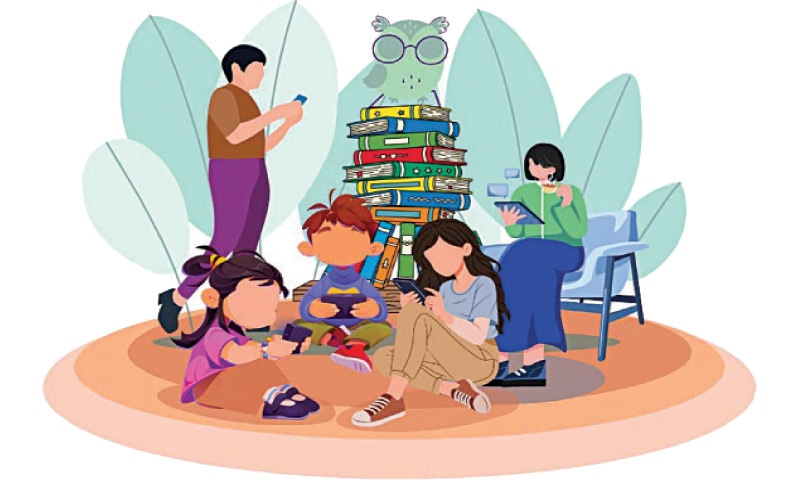
We are scrolling ourselves into intellectual silence, and it’s time to turn the page.
I can’t remember the last time I saw someone browse through a bookstore just for fun. That quiet ritual of running your fingers along the shelves, flipping through pages and discovering a story you never knew you needed, feels almost nostalgic now. We scroll instead of strolling. We swipe through reels, memes and captions faster than we ever turned a page. The joy of reading, once a deeply personal act, is fading behind the blue glow of our screens.
It’s not that we’ve stopped reading altogether. If anything, we read constantly — captions, tweets and comment sections — but what we’re consuming has lost its depth and length. Our attention spans have been sliced thin by algorithms that reward speed over thought. We are reading more words than ever, yet understanding fewer of them.
A recent report found that the average teenager spends nearly eight hours a day on screens, not counting schoolwork. In Pakistan, where digital access is expanding rapidly, this habit is only rising. But amid all that scrolling, how much of what we “read” actually stays with us? When was the last time we finished a book cover to cover without checking our phones every few minutes?
Screens have made reading faster, shorter and shallower. What they’ve taken away is the depth of learning that books once gave us
Book culture is disappearing. Bookstores were once sanctuaries, quiet spaces where ideas lived. Now, they’re becoming rare sightings. In Karachi, a city of more than 20 million, you can count the surviving bookstores on one hand: Liberty Books, Paramount, maybe one or two tucked away in Saddar. Lahore and Islamabad have Readings and Books n Beans, but even those rely on a small circle of loyal visitors and, dare I say, privileged ones too.
For most young people, books have become luxuries. They are expensive, hard to find and less entertaining than a screen. Libraries tell a similar story. Walk into any school or university library today and you’ll find students scrolling under the table rather than flipping through reference books. The smell of paper isn’t there anymore.
But the real loss isn’t just the disappearance of bookstores; it’s the erosion of curiosity. Reading for pleasure is now seen as old-fashioned, something our parents did when there wasn’t “anything better to do.” Yet reading is what shapes how we think, how we empathise and how we question. Books give us context, something our social media bubbles rarely do.
Why bookstores matter
Bookstores aren’t just shops; they’re cultural breathing spaces. They hold entire worlds within them. They offer the kind of silence that allows ideas to grow.
Sadly, places where bookstores still exist often cater to the privileged few. Affordable reading spaces are rare, and public libraries remain underfunded and forgotten. It’s little wonder that Pakistan’s reading culture is slowly fading.
More often than not, we blame technology, but maybe the real issue isn’t that alone — it’s that we no longer value stillness, reflection and culture. Reading requires us to stop everything and sit with a single thought for a while. It demands focus, a quality our digital world quietly erodes.
Yet hope isn’t lost. Perhaps what Pakistan needs isn’t just more bookstores, but a shift in how we see reading itself.
Because in a world drowning in noise, the simple act of reading might just be our last refuge of depth.
Published in Dawn, Young World, February 21st, 2026