PAKISTAN’S exports are heavily reliant on the textile and apparel sector, which account for about 55 per cent of total exports and a quarter of industrial value-added exports. They provides roughly 40pc of industrial employment and 46pc of the manufacturing base.
The country is the eighth-largest textile exporter in Asia and the fourth-largest cotton producer globally. However, our export profile remains concentrated in low-value-added textile segments. Pakistan exported textile worth $17.5 billion in 2024, with nearly half directed to the EU showing a high dependency on one market.
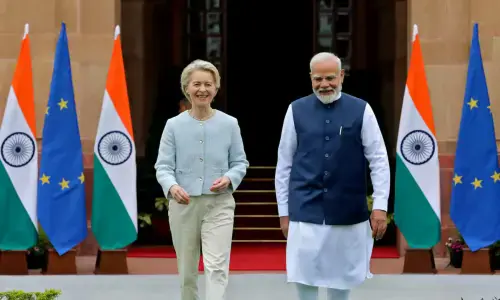
Based on the aforementioned statistics, the recent EU–India Free Trade Agreement (FTA) will have a profound impact on Pakistan’s textile competitiveness and export prospects. This agreement between the two economic giants is a milestone in international trade diplomacy and is being referred to as the “mother of all deals”. It has the potential to open new avenues for economic cooperation and investment, transforming the trade dynamics of both partners.
As such, it raises questions about the agreement’s impact on Pakistan’s trade strategies and competitiveness in the European market. Islamabad needs to rethink its strategies immediately as its exports to the EU are both sizeable and concentrated. Such rethinking is no longer optional but imperative.
The EU-India FTA serves as a reminder to Pakistan that preferential treatment cannot substitute competitiveness
According to the UN Comtrade 2024 data, Pakistan’s exports to the European market were approximately $8.95bn, accounting for 27.6pc of its total exports. Out of the total, 76.6pc accounted only for clothing and textile, constituting three-quarters of the total exports to the bloc.
In addition to export basket concentration, the export destinations are narrow as well, with only six countries out of 27 as the main destinations.
The lion’s share of exports go to Germany (19.2pc), followed by the Netherlands (17.9pc), Spain (16.4pc), Italy (12.7pc), Belgium (7.8pc), and France (5.8pc).
This high share in the textile and apparel sector is partly due to the preferential market access under the Generalised Scheme of Preferences Plus (GSP+) status, which provides duty-free entry on a substantial share of tariff lines. Pakistan has been benefiting from this arrangement since 2014, subject to compliance with governance, labor, and environmental conventions. However, the recent EU-India FTA can flip the equation by altering the competitive outlook.
Under the new deal, India secures duty free access to most tariff lines, particularly in sectors where Pakistan has a competitive advantage. It includes labor-intensive sectors such as textiles, apparel, leather goods, and footwear. Prior to this agreement, India’s apparel exports faced around 9–12pc tariffs. This was the marginal advantage that Pakistan’s exporters were enjoying despite high domestic production costs.
According to the ITC trade map data of 2024, Pakistan exported textile and clothing worth $6.8bn, as compared to India ($7.7bn).
This was about 76.6pc of its total exports to the EU market, while for India, it accounted for only 11.2pc of its exports. In dollar terms, India exported about $1bn more than Pakistan despite India’s tariff disadvantage of around 12pc. With tariff parity now established, Pakistan’s textile exporters will be competing against Indian products that will be 10–12pc cheaper than before.
The competitive outcomes are now shaped by scale, productivity, logistics and compliance capacity. For example, India ranks 38th in the World Bank’s logistics performance indicators with an overall score of 3.4, while Pakistan ranks 122nd with a score of 2.4.
India outperforms Pakistan across all components, including customs efficiency, infrastructure quality, logistics competence and timeliness of shipments.
Likewise, the UN Survey on Digital and Sustainable Trade Facilitation shows India with an overall implementation rate of 93.6pc, compared to 71.0pc for Pakistan. This wide gap is due to cross-border paperless trade and procedural formalities. As tariff preferences converge after the deal these factors carry greater weight in time sensitive import decisions. A 2023 study found that if Pakistan’s GSP+ status is revoked, the country’s exports to the EU market would be reduced by around $3bn.
Export competitiveness is not limited to the amount of tariffs imposed; it is increasingly constrained by other non-tariff barriers, for instance, industrial electricity tariffs in Pakistan are about 36pc higher than in India.
Other barriers include reliance on imported intermediate goods, high financing costs and logistic issues. Once tariff preferences converge after the agreement, these non-tariff barriers will play a decisive role.
For Pakistan, the macroeconomic impacts also need attention. Data reveals that export performance has weakened in the recent quarter, with merchandise exports declining.
The country cannot afford a reduction of its EU market share. It will not only increase pressure on the balance of payments but also on employment in the labor-intensive export-oriented sector.
Therefore, the EU-India FTA serves as a reminder to Pakistan that preferential treatment cannot substitute competitiveness. The appropriate response is therefore not limited to preserving preferential access, but to strengthening underlying competitiveness.
The country needs to reduce input costs and comply with regulatory requirements across different markets. In this regard, the recent steps taken by the Prime Minister to reduce the electricity tariffs for industries and the export financing scheme rate are highly commendable. Pakistan needs to move from reliance on non-reciprocal GSP+ toward FTAs.
Moreover, export markets should be diversified, particularly toward the Middle East and Africa. It is the need of the hour for the country to develop niche sectors such as technical textiles and sustainable fashion. These measures will reduce export vulnerabilities, strengthen export resilience, and, as a result, long-term global competitiveness.
Dr Junaid Ahmed is the Chief of Research at PIDE.
Email: Junaid.ahmed@pide.org.pk Wajid Islam is a Research Economist at PIDE.
Email: wajidislam@pide.org.pk
Published in Dawn, The Business and Finance Weekly, February 16th, 2026