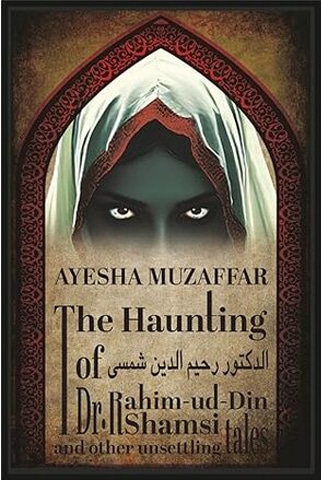
The Haunting of Dr Rahim-ud-Din Shamsi and Other Unsettling Tales
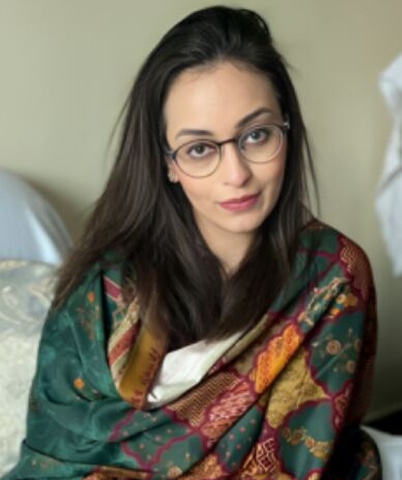
By Ayesha Muzaffar
Liberty Publishing
ISBN: 978-6277626716
337pp.
Ayesha Muzaffar, by means of two intriguing books preceding this one (Jinnistan and The Bhabhis of Lahore), has already established a sound name for herself in the realm of supernatural-themed fiction. Her latest foray into this entertaining, albeit dark, territory, The Haunting of Dr Rahim-ud-Din Shamsi and Other Unsettling Tales, strings together three novellas of the horror genre.
While the overarching subject involves jinns and the dangers of demonic possession, each novella is distinctly different from the others. The first contains a mild-mannered male protagonist, Rahim, while the central characters of the other two are women. All three pieces of writing, however, are united in noting how the world of the jinns can impact that of humans, often with consequences that are problematic, to say the least, and downright disastrous at worst.
Rahim Shamsi is perhaps my favourite character in the book. A taciturn child, he is initially treated coldly by a domineering father and stifled by a simple, gentle mother. His mother fears that he is prone to possession by jinn influences, simply because he has an extra finger on one hand. Polydactyly is a relatively harmless condition caused by a genetic mutation, but Rahim’s relatively uneducated mother can be excused for not knowing the scientific logic underlying the existence of multiple fingers on her child’s hand.
Although Rahim is shy and withdrawn, he shows absolutely no active signs of demonic possession during his childhood or in his taxing adolescence (which takes place at a cadet college devoted to strict discipline). His father is responsible for packing him off to the aforementioned school, so that Rahim can toughen up, become more manly, and abandon his dreams of becoming a veterinarian.
Ayesha Muzaffar’s latest offering strings together three novellas that will undoubtedly delight fans of the horror genre
One evening, Rahim and his friends exchange stories about jinns and demonic influences; this is fairly typical behaviour for young people thrown together on a stormy night. His close friend, Salman, believes that a scientific rationale underpins what many term jinn activity. This point becomes increasingly significant later in the novella.
Excelling at the study of biology, Rahim settles for becoming a dentist as opposed to a veterinarian, a decision that pleases his father, who acquires office space for him, where he can begin his clinical practice. Although Rahim works with skill and diligence, things begin to go awry quite soon.
He finds that there is ‘something not quite right’ about several of his patients. Some of them do not exhibit the bodily proportions of normal human beings, yet others have entire alternative universes within their mouths and, in a particularly jaw-dropping scene, all the family members of one of his patients drop their lower jaws to an utterly freaky extent!
My hat goes off to Rahim for remaining persistent about his career in the face of overwhelming (not to mention supernatural) odds. Rather unexpectedly, it is his hitherto cold and difficult father who comes to his help by attempting to figure out if the clinic is haunted in some tangible sense of the word. Less unexpectedly, his old school chum Salman also helps Rahim understand why he might be plagued by such unusual career hurdles.
The novella builds up its various characters admirably, and Ayesha Muzaffar is to be credited for attending to the development of both major and minor characters with an equal degree of care and skill. The novella is set in Lahore, and Muzaffar’s thorough knowledge of, and familiarity with, this historic city makes for an authentic and enjoyable backdrop.
The vibration climbed up his arms. The sweat from his brow trickled into his eyes. The cavity had no end. He changed bits. Increased speed. Switched angles. The cavity consumed it all. It was like digging into a black sun — nothing pushed back. His hands began to tremble. He glanced up once — just once — and the three of them were still staring. Still watching. Mouths dangling like broken ornaments. He nearly dropped the drill. — Excerpt from the novel
Muzaffar demonstrates even greater authorial prowess in the novella following this one, titled Finding Faraz. Also set in Lahore, although the latter part of this work is heavily reliant on supernatural themes, it is, in essence, a love story, carefully crafted by the writer.
Faraz and Farwah meet at college in Lahore, fall in love, and marry in spite of his family’s disapproval. Fate intervenes cruelly, and Faraz falls victim to a traffic accident a few years later. In a rather spooky turn of events, his body is never found, and hence Farwah receives no closure insofar as this major crisis is concerned. Although she eventually remarries and has children, she gradually becomes unhinged, imagining that she is seeing her late husband on various occasions.
Her kind but prosaic second husband, Basit, realises that something is seriously preying on Farwah’s peace of mind. Her frailty and increasing ill-health cause him to turn to religious sages and seers in order to ‘cure’ his wife. I will not spoil the story by giving away its denouement, but I can certainly state that those readers who are looking for thrills and chills related to possession by jinns will definitely not be disappointed.
My personal favourite of the three novellas, however, is the final (and shortest) one, The Possession of Bareera Khurram. In spite of the fact that this is set in Karachi, not Lahore, and is only a third of the length of the other two novellas, I don’t believe that my primary reason for liking it is because I am a Karachiite. Rather, it is its unexpected plot-twist at the end that makes it come across as a work of genius. I do not use the term ‘genius’ lightly, since it is well-established lore to assume that superior creative pieces are inspired by ‘genies’ (the word is etymologically related to ‘genius’) or ‘jinns’!
Bareera is an elite Karachi-based woman whose husband sends her to a therapist in order to help get to the root of her delusions and aberrant behaviour. Her therapist appears to be a shrewd and capable woman who is sincere about helping her patient. As the story unfolds, one finds, much to one’s horror, that the therapist is as much in danger of forces beyond her control as is Bareera herself!
By moving beyond the genre of the short story, Ayesha Muzaffar has expanded her vistas in a manner that will prove to be truly satisfying for her numerous fans. Her prose is simple and crisp, and I was impressed by how rapid and engrossing the pace of her writing was in this riveting collection of novellas. Perhaps the only criticism I can come up with is that jinns are not wholly evil beings (even the Quran indicates that some are devout Muslims), and therefore the book presents a somewhat skewed perspective on these paranormal entities.
However, it is possible that Muzaffar wishes, by means of her authorial agenda, to underscore that the world of the jinns should never be taken lightly. In this, she succeeds, since her tales are nothing if not cautionary. While the book will undoubtedly delight fans of the horror genre, the sobering fact that all three of these remarkable stories are loosely based on real events will cause many readers to think twice before dabbling in the occult.
And perhaps that’s not such a bad thing, in aggregate.
The reviewer is Associate Professor of Social Sciences and Liberal Arts at the Institute of Business Administration. She has authored two collections of short stories, Timeless College Tales and Perennial College Tales, and a play, The Political Chess King
Published in Dawn, Books & Authors, February 15th, 2026