0
0

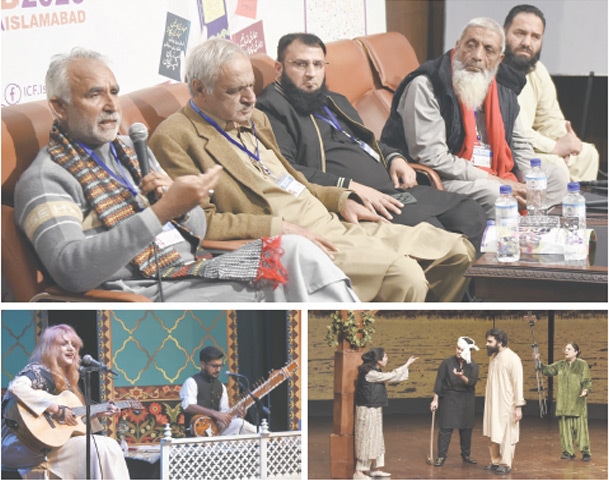
ISLAMABAD: On the second day of the Pakistan Mother Languages Literature Festival 2026, held on Saturday at the Pakistan National Council of the Arts (PNCA), celebrations of mother languages were accompanied by a sobering reflection: as languages become endangered, entire musical worlds risk falling silent.
The day unfolded across two major sessions, one honouring literary legends of mother languages and the other examining endangered arts and musical instruments, yet both were united by a shared concern about cultural survival.
The opening session, “Celebrating the Legends of the Languages,” brought together writers representing Brahui, Seraiki, Punjabi, Urdu, Balochi, Sindhi, Potohari and other traditions. Behind the tributes, however, lay a pressing question: who will inherit these languages?
The concern was echoed by panellists representing Gojri, Pahari, Hindko and Gawarbati, who stressed that recognition without institutional backing risks marginalising linguistic heritage.
Speakers call for preservation efforts that go beyond passion, individual endeavours
Brahui poet Tahira Ehsaas Jattak, widely recognised as one of the first prominent female poets in the language, recalled her struggle for education in Khuzdar.
“I was the only girl in my school at that time,” she said. “The first to pass matric and intermediate. Today, I see more girls studying, but I still ask, in which language are they dreaming — in English?”
She stressed that children in many parts of Balochistan and elsewhere are not being taught in their mother tongues. Although initiatives were launched in recent years to introduce local languages into curricula, the lack of trained teachers and institutional support has stalled meaningful progress.
Balochi scholar Abdul Saboor Baloch traced his journey from a schoolboy reading magazines to chairing the Department of Balochi at the University of Balochistan and later leading academic projects internationally. With over 18 books and numerous research publications to his credit, he remains cautiously optimistic.
“There is more material to read now, more students enrolling in Balochi studies,” he said. “But preservation cannot depend on passion alone; it needs policy.”
The second session, “Endangered Arts, Crafts and Instruments of Pakistan,” opened with a documentary by Unesco on the Boreendo, an ancient clay wind instrument from Sindh, setting the tone for a discussion on vanishing sonic traditions.
Filmmaker Jawad Sharif, whose documentary Indus Blues explores endangered instruments, shared examples of generational shifts. In Peshawar, he noted, a sarinda player’s son now prefers the saxophone.
Salman Tahir of Citizens Archive Pakistan argued that archiving must go beyond documentation.
“When we look at a craft, we must examine the technical knowledge behind it, the muscle memory, the migration history and the politics of the artist’s life,” he said. “If we remove these from context, we distort the heritage itself.”
He stressed economic sustainability as the real battleground for cultural survival. “We can talk about preservation in air-conditioned halls,” he said, “but if an artist sleeps hungry, what kind of preservation is that?”
Author Gulzar Gichki spoke passionately about the Suroz, a bowed instrument central to Balochi classical storytelling traditions. His book Suroz documents its history not merely as a musical instrument but as a vessel of epic poetry and even traditional healing.
“This instrument is not only for music; it also carries our stories and memories. In the past, it was even used for treatment. It is part of who we are,” he said.
Yet, like many indigenous instruments, the Suroz faces dwindling numbers of practitioners.
Youth activist Raaziq Faheem described efforts in Balochistan to train young men and women in folk instruments through structured programmes. Preservation, he argued, must extend beyond museum displays.
“You can preserve an instrument in glass,” he said, “but can you root it in contemporary life? Can it add value to the lives of young people?”
Across both sessions, a shared understanding emerged. Mother languages and musical traditions are not vanishing quietly; they are negotiating space within a rapidly modernising society.
Speakers agreed that innovation and adaptation are essential. Universities, archives, filmmakers and cultural organisations were recognised not merely as observers but as active custodians.
Published in Dawn, February 15th, 2026