
The prime minister’s recent incentives announcement has generated cautious optimism in a demoralised business community that has long watched peers in other countries outperform and outcompete them.
Corporate leaders attribute their weak global competitiveness to a flawed policy framework, arguing that compliant high-performing firms are often penalised by tax authorities through high tax rates imposed on a narrow tax base. Weary of chronic policy reversals, they say the state’s core challenge is to rebuild trust, not through personalised, short-term concessions, but by credibly reorienting the economy around a predictable, rule-based, and business-friendly framework.
The delay in unveiling a comprehensive industrial policy by the government has done little to dispel doubts about the government’s commitment to prioritising industrial activity over trading and speculation, or to building investors’ confidence. There is a perception that the existing policy framework has promoted imports and steadily eroded what remained of the country’s industrial base rather than strengthening it.
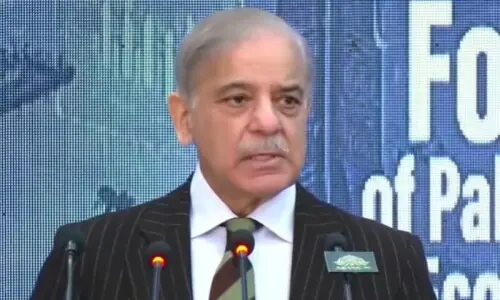
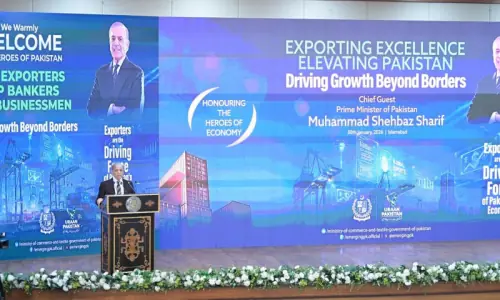
Widely interpreted as the first clear signal of a shift toward growth, since Shehbaz Sharif assumed office in 2022 after replacing former prime minister Imran Khan and continuing in power following the 2024 elections, the prime minister recently announced an incentive package for industry and exports.
‘Meaningful recovery will require reversing damaging policies and, more importantly, regaining exporters’ trust via credible long-term commitment’
The measures include a Rs4.04 per unit reduction in power tariffs, lower wheeling charges for industry, a three-percentage point cut in export refinance rates from 7.5 per cent to 4.5pc, and extension of the ‘blue passport’ (previously reserved for senior officials) to businessmen as a symbolic recognition of their economic contribution. For more than three years, the government’s overriding focus on stabilisation, while restoring macroeconomic order, has come at the cost of stifled growth.
Musadaq Zulqarnain, a leading exporter who serves on multiple corporate and official advisory forums, said the package would provide partial relief through lower energy costs, while the 18-month reduction in the Export Refinancing Facility would offer much-needed breathing space to exporters.
“However, far more is required to stimulate sustainable, long-term growth. With limited progress on broadening the tax base, the fiscal burden continues to fall disproportionately on salaried individuals and compliant corporates, an increasingly unsustainable outcome,” he noted.
Mr Zulqarnain also underscored the role of the State Bank, urging it to keep the real effective exchange rate within a stable 99-100 range to contain external imbalances and reduce balance-of-payments risks.
Majyd Aziz, President of the Employers Federation of Pakistan, offered a self-critical view, pointing to risk aversion within the business community itself. He noted that despite decades of incentives and subsidies, exports have grown slowly, suggesting weaknesses in productivity, efficiency, marketing, and over-reliance on external financing. Incentives alone, he argued, cannot compensate for gaps in the export ecosystem.
As for industrial policy, Mr Aziz said a credible framework must focus on sectors with genuine capability, indigenous resources, small and medium enterprises, Special Economic Zones, infrastructure, regulatory simplification, digitisation, logistic rationalisation, and lower taxes and inspections.
Younus Dagha, Chairman of the Policy Research and Advisory Council at Karachi Chamber of Commerce and Industry, supported the package, but considered it insufficient to restore export competitiveness. He argued that heavy, poorly designed taxation has already inflicted lasting damage on exports, including services.
“Meaningful recovery will require reversing damaging policies and, more importantly, regaining exporters’ trust via credible long-term commitment,” he said. That sort of recovery, Mr Dagha stressed, demands an integrated policy framework covering industrial, trade and investment policies.
Khurram Mukhtar, Patron-in-Chief of the Pakistan Textile Exports Association, welcomed the incentives but called them insufficient in scale or design to deliver targeted growth without a stable and credible ecosystem. Frequent policy shocks, he stressed, including retrospective super tax recoveries, abrupt provincial levies and shifting interpretations, continue to erode investor confidence.
He noted that public spending has not been meaningfully rationalised to create fiscal space for export-led growth, while provinces remain misaligned with competitiveness goals. “Short-term relief may lift utilisation, but investment and jobs require 12–24 months of policy stability. Countries that align policy with industry grow exports; those that debate narratives fall behind.”
Dr Khurram Tariq, former president of the Faisalabad Chamber of Commerce and Industry, argued that power tariff cuts and wheeling charges are essentially the same relief repackaged for optics. According to him, the industry already cross-subsidises the power sector. The recent tariff reduction, he said, merely returns a fraction of what is owed to industry under fair accounting.
While welcoming lower interest rates, he termed the move ‘too little, too late’. He also criticised the selective use of data that distorts interpretation and expressed scepticism about the forthcoming industrial policy, calling it heavy on optics but unlikely to restore competitiveness or spur industrialisation amid agile regional rivals.
Published in Dawn, The Business and Finance Weekly, February 9th, 2026