Hamas rejects disarmament, foreign rule in Gaza


 3
3

DOHA: A senior Hamas leader said on Sunday that the Palestinian movement would not surrender its weapons nor accept foreign intervention in Gaza, pushing back against US and Israeli demands.
“Criminalising the resistance, its weapons, and those who carried it out is something we should not accept,” Khaled Meshal said at a conference in Doha.
“As long as there is occupation, there is resistance. Resistance is a right of peoples under occupation … something nations take pride in,” said Meshal, who previously headed the group.
Hamas has waged an armed struggle against Israel’s occupation of the Palestinian territories. A US-brokered “ceasefire” in Gaza is in its second phase, which foresees demilitarisation of the territory — including the disarmament of Hamas — along with a gradual withdrawal of Israeli forces.
Top leader Meshal urges ‘Board of Peace’ to take ‘balanced approach’
Hamas has repeatedly said that disarmament is a red line, although it has indicated it could consider handing over its weapons to a future Palestinian governing authority.
Israeli officials claim that Hamas still has around 20,000 fighters and about 60,000 Kalashnikovs in Gaza.
A Palestinian technocratic committee has been set up with a goal of taking over the day-to-day governance in the battered Gaza Strip, but it remains unclear whether, or how, it will address the issue of demilitarisation.
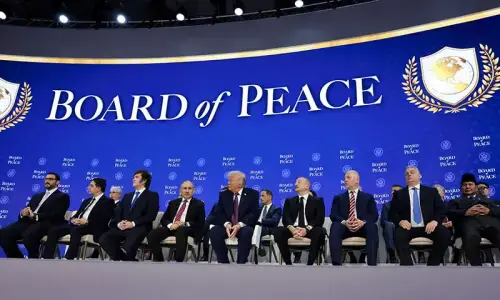
The committee operates under the so-called “Board of Peace”, an initiative launched by US President Donald Trump.
Originally conceived to oversee the Gaza truce and post-war reconstruction, the board’s mandate has since expanded, prompting concerns among critics that it could evolve into a rival to the United Nations.
Trump unveiled the board at the World Economic Forum in the Swiss ski resort of Davos last month, where leaders and officials from nearly two dozen countries joined him in signing its founding charter.
Alongside the “Board of Peace”, Trump also created a Gaza Executive Board — an advisory panel to the Palestinian technocratic committee — comprising international figures including US envoys Steve Witkoff and Jared Kushner, as well as controversial former British prime minister Tony Blair.
On Sunday, Meshal urged the “Board of Peace” to adopt what he called a “balanced approach” that would allow for Gaza’s reconstruction and the flow of aid to its roughly 2.2 million residents, while warning that Hamas would “not accept foreign rule” over Palestinian territory.
“We adhere to our national principles and reject the logic of guardianship, external intervention, or the return of a mandate in any form,” Meshal said.
“Palestinians are to govern Palestinians. Gaza belongs to the people of Gaza and to Palestine. We will not accept foreign rule,” he added.
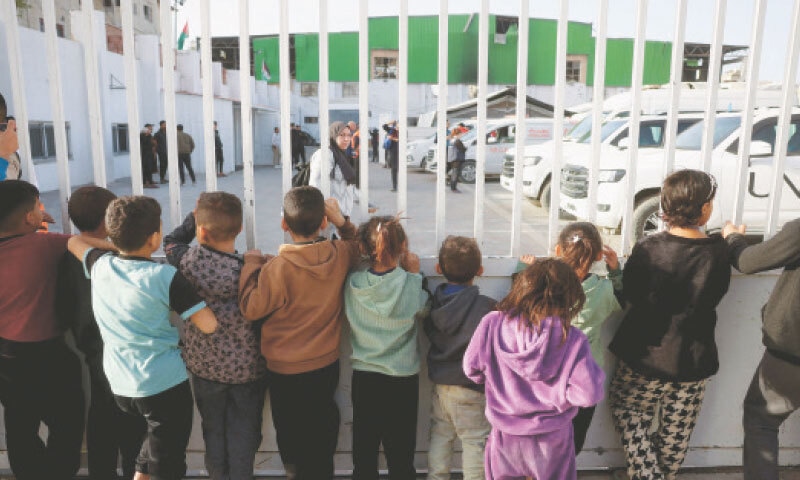
Meanwhile, around 180 Palestinians left the Gaza Strip since Feb 2 when the Rafah crossing with Egypt was partially reopened, according to officials in the territory.
The Rafah crossing is the only gateway left for Palestinians in Gaza to the outside world that does not pass through Israel.
Between Monday and Thursday, 135 people crossed into Egypt from Gaza through the crossing, mostly patients and their companions, according to Ismail al-Thawabteh, head of the Hamas-run media office in the Palestinian territory. He said the crossing was closed on Friday and Saturday.
The Palestinian Red Crescent Society confirmed that 135 residents of Gaza had left through the crossing between Feb 2 and 5. On Sunday, another 44 people, including 19 patients, left the Gaza Strip through the crossing to Egypt, Mohammed Abu Salmiya, director of the territory’s main Al-Shifa Hospital, said.
Published in Dawn, February 9th, 2026