Explainer: What is Trump’s ‘Board of Peace’ and what are its aims?
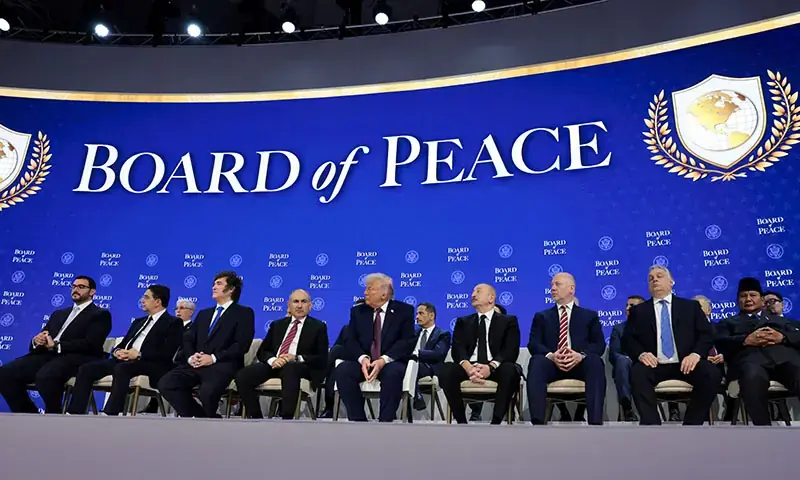


• States may only join if formally invited by US president
• France indicated it will not take part; Trump responded by threatening to impose steep tariffs on French wine
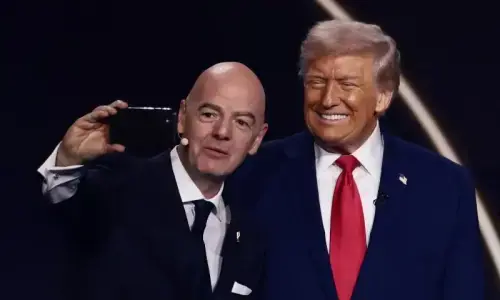
US President Donald Trump has invited countries to pay $1 billion in exchange for a permanent seat on a newly proposed initiative known as the “Board of Peace”.
The body was initially envisioned as a mechanism to address Israel’s war on Gaza, though its charter does not restrict its mandate solely to the occupied Palestinian territory.
Several states have been approached by the US to join the initiative.
On Wednesday, Prime Minister Shehbaz Sharif accepted the proposal to participate in the initiative with the aim of “achieving lasting peace in Gaza”.
Board leadership and aims
According to AFP, the Board of Peace will be led by Trump under the terms outlined in its founding charter.
Under the charter, Trump will serve as chairman while also acting as the first representative of the United States. “The chairman shall have exclusive authority to create, modify, or dissolve subsidiary entities as necessary or appropriate to fulfil the Board of Peace’s mission,” the document says.
Trump will appoint members of an executive board, described as “leaders of global stature”, who will serve two-year terms and can be removed by the chairman.
He may also, “acting on behalf of the Board of Peace”, “adopt resolutions or other directives”.
The chairman can only be replaced through “voluntary resignation or as a result of incapacity”.
The document describes the board as “an international organisation that seeks to promote stability, restore dependable and lawful governance, and secure enduring peace in areas affected or threatened by conflict”. It further states that the body will “undertake such peace-building functions in accordance with international law”.
Membership
States may only join if formally invited by the US president and will be represented by their head of state or government. Membership is limited to a maximum of three years, according to the charter. However, this restriction does not apply to countries that contribute more than $1bn in cash during the first year after the charter comes into force.
The board will hold voting sessions at least once a year, with each country allotted a single vote.
While decisions require a majority of members present and voting, they are also “subject to the approval of the chairman, who may also cast a vote in his capacity as chairman in the event of a tie”.
Executive board
According to the White House, the executive board will oversee the implementation of the organisation’s objectives. It will be chaired by Trump and comprise seven members:US Secretary of State Marco Rubio, Trump’s special negotiator Steve Witkoff, Trump’s son-in-lawJared Kushner, former British prime minister Tony Blair, US billionaire financier Marc Rowan, World Bank President Ajay Banga and Robert Gabriel, a close Trump associate serving on the US National Security Council.
Aside from Pakistan, dozens of governments and leaders have confirmed receiving invitations.
Among them are China, India, Russian President Vladimir Putin, Ukrainian President Volodymyr Zelensky and Canadian Prime Minister Mark Carney.
France, a longstanding US ally, has indicated it will not take part.
Trump responded by threatening to impose steep tariffs on French wine.
Invitations have also been confirmed by Egypt’s President Abdel Fattah al-Sisi and Argentina’s President Javier Milei.
Other countries to acknowledge invitations include Jordan, Brazil, Paraguay, Pakistan, as well as several states across Europe, Central Asia and the Middle East.
Who is expected to join?
Countries ranging from Albania to Vietnam have signalled interest in becoming members.
Hungarian Prime Minister Viktor Orbán, a strong supporter of Trump within the European Union, has also agreed to join.
Canada has said it will participate but has clearly ruled out paying the $1bn required for permanent membership.
It remains uncertain whether other interested states, including Armenia, Belarus, Kazakhstan, Morocco and Vietnam, would be willing to make the $1bn contribution for a permanent seat.
Ukrainian President Volodymyr Zelensky said it would be “very hard” to sit on a council alongside Russia, adding that diplomatic efforts were ongoing.
The charter states that it will come into force “upon expression of consent to be bound by three States”.
Published in Dawn, January 22nd, 2026