Equities end turbulent week on flattish note amid security jitters


 0
0
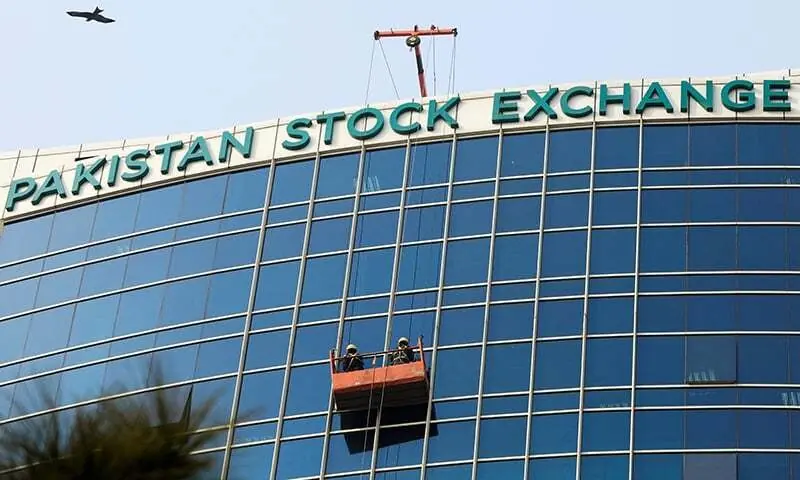

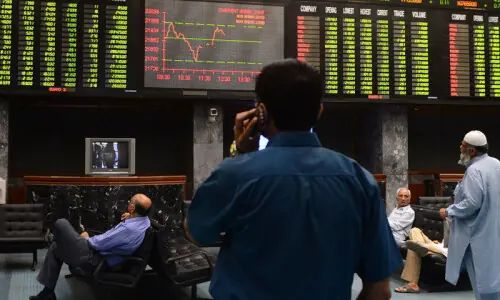
KARACHI: The Pakistan Stock Exchange (PSX) wrapped up a shortened trading week, owing to Kashmir Day national holiday, on a subdued note as the absence of positive triggers, coupled with mounting security and economic concerns, kept investors on the sidelines.
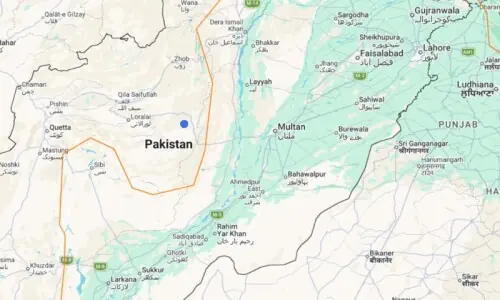
Sentiment took a hit on Friday after Barrick Gold indicated it would review its Reko Diq copper-gold project following a recent escalation in security incidents in Balochistan.
The situation was further aggravated by a bomb blast during Friday prayers in Islamabad, which heightened anxiety over the country’s internal security environment and weighed on risk appetite.
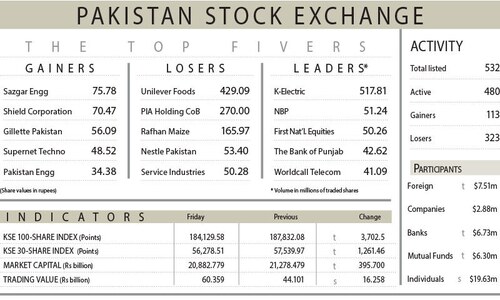
As a result, the benchmark KSE-100 index closed the week almost unchanged, shedding 45 points, or 0.02pc, to settle at 184,130. According to Arif Habib Ltd (AHL), the index remained in positive territory for most of the week but lost momentum towards the end due to unfavourable domestic and international developments.
Topline Securities Ltd noted that the market lacked meaningful triggers, resulting in a largely flat performance compared to the previous week.
Investors stay cautious as Barrick reviews Reko Diq project
On the flows front, mutual funds emerged as net buyers, purchasing equities worth $22.7 million, while local companies added $5m. In contrast, individuals, banks and foreign corporates were net sellers, collectively offloading shares valued at $31.9m.
Macroeconomic indicators released during the week presented a mixed picture. The Consumer Price Index (CPI) for January edged up to 5.80pc year-on-year, compared to 5.61pc in December 2025, indicating a mild uptick in inflationary pressures. Meanwhile, the trade deficit stood at $2.73bn, marking a 7pc decline from the same month last year and a sharp 29pc reduction compared to December 2025. Exports recorded a strong rebound, rising 35pc month-on-month to a record $3.06bn.
Petroleum offtake posted healthy growth, with sales increasing 12pc month-on-month to 1.52m tonnes in January. Analysts attributed the rise to lower petrol and high-speed diesel prices, a recovery in automobile sales and support from the government’s Green Tractor Scheme. In contrast, fertiliser sales remained subdued, reflecting weaker demand following the front-loaded Rabi season.
On the currency front, the rupee remained broadly stable, appreciating marginally by 0.02pc week-on-week to close at Rs279.71 against the US dollar. The State Bank of Pakistan’s foreign exchange reserves rose by $56m to $16.15bn.
Sector-wise performance was mixed. Cement stocks outperformed after January offtake touched a five-year high of 4.54m tonnes, up 13pc year-on-year. Other sectors, including power generation, jute, and real estate, also fared well, posting weekly gains ranging from 2.3pc to 7.1pc. However, chemicals, engineering, tobacco and oil and gas exploration and production companies came under pressure and closed the week in the red.
Looking ahead, market participants remain cautiously optimistic despite prevailing geopolitical and domestic challenges. AHL said investor sentiment in the coming weeks would largely hinge on the upcoming MSCI review and the ongoing corporate earnings season.
The KSE-100 index is currently trading at a price-to-earnings multiple of 9.3 times, with a dividend yield of around 5.3pc. AKD Securities Ltd expects the market to retain positive momentum, supported by improving macroeconomic indicators and relative political stability.
Analysts believe the government’s continued focus on structural reforms, along with expectations of foreign investment, could help bolster confidence. On this basis, some projections place the KSE-100 index at 263,800 points by December, subject to a favourable political and economic environment.
In other developments, the Federal Board of Revenue reported a 16pc year-on-year increase in tax collection for January, with receipts reaching Rs1,015bn. Separately, the United Arab Emirates extended a $2bn loan to Pakistan for one month, while the government has sought a two-year extension of its oil facility from Saudi Arabia.
Despite heightened security concerns, investors remain hopeful that stabilising domestic indicators, particularly moderating inflation and rising exports, will provide a foundation for improved market performance in the months ahead.
Published in Dawn, February 8th, 2026