New arms race looms as last US-Russia treaty set to expire
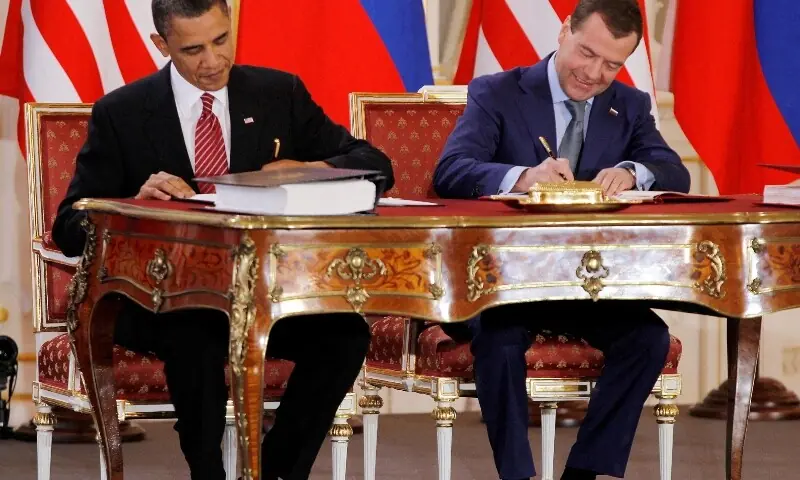

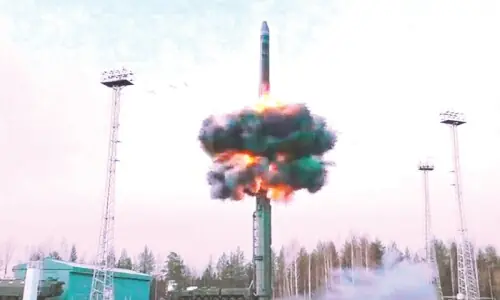
PARIS: The expiry on Thursday of the New START treaty between the United States and Russia signals the end of major bilateral nuclear-disarmament accords and a shift towards a looser nuclear order, profoundly reshaped by China’s growing diplomatic and technological power.
The web of arms control deals negotiated in the decades since the 1962 Cuban Missile Crisis, considered the closest the world ever came to intentional nuclear war, was aimed at reducing the chance of a catastrophic nuclear exchange.
Unless Washington and Moscow reach a last-minute understanding of some kind, the world’s two biggest nuclear powers will be left without any limits for the first time in more than half a century when the New START treaty expires.
News arms race
There was confusion about the exact time it would lapse, though arms control experts said they believed this would happen at 2300 GMT on Wednesday — midnight in Prague, where the treaty was signed in 2010.
As the clock ticked towards expiry, Pope Leo urged both sides not to abandon the limits set in the treaty. “I issue an urgent appeal not to let this instrument lapse,” the first US pope said at his weekly audience. “It is more urgent than ever to replace the logic of fear and distrust with a shared ethic, capable of guiding choices toward the common good.” Matt Korda, associate director for the Nuclear Information Project at the Federation of American Scientists, said that if there was no agreement to extend the treaty’s key provisions, neither Russia nor the United States would be constrained if they wanted to add yet more warheads.
“Without the treaty, each side will be free to upload hundreds of additional warheads onto their deployed missiles and heavy bombers, roughly doubling the sizes of their currently deployed arsenals in the most maximalist scenario,” he said.
Korda said it was important to recognise that the expiry of New START did not necessarily mean an arms race given the cost of nuclear weapons.
US President Donald Trump has given different signals on arms control. He said last month that if the treaty expired, he would do a better agreement.
So far, Russian officials said, there has been no response from Washington on President Vladimir Putin’s proposal to extend the limits of the treaty beyond expiry.
Death of arms control
Total inventories of nuclear warheads declined to about 12,000 warheads in 2025 from a peak of more than 70,000 in 1986, but the United States and Russia are upgrading their weapons and China has more than doubled its arsenal over the past decade.
Arms control supporters in Moscow and Washington say the expiry of the treaty would not only remove limits on warheads but also damage confidence, trust and the ability to verify nuclear intentions.
Opponents of arms control on both sides say such benefits are nebulous at best and that such treaties hinder nuclear innovation by major powers, allow cheating and essentially narrow the room for manoeuvre of great powers.
Published in Dawn, February 5th, 2026