0
0

ISLAMABAD: A transparency survey, launched jointly by Ipsos and the Federation of Pakistan Chambers of Commerce and Industry (FPCCI), has found a wide gap between “perception and reality”, reflecting a chronic trust deficit between citizens and public institutions.
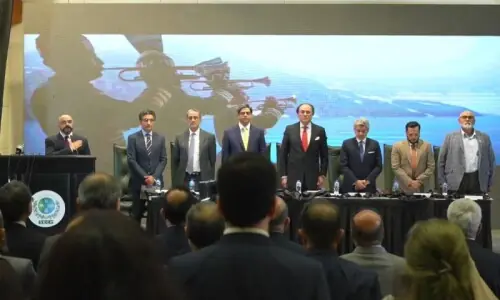
The Index of Transparency and Accountability in Pakistan (iTAP), launched at an event in Islamabad on Tuesday, showed that government departments generally suffer from a bad public image compared to the experiences reported by those who have interacted with them.
The iTAP initiative was conceived in May 2025 as an effort by the FPCCI to develop an indigenous, recurring benchmark to measure transparency and accountability in Pakistan. The organisers said the survey aimed to provide an objective assessment of public trust in government and institutions, based on fieldwork conducted during Dec 2025 and Jan 2026.
According to the survey, more than 6,000 respondents, both men and women, were interviewed across 82 urban and rural districts and over 195 tehsils. A smaller sample of 300 respondents was drawn from within government institutions.
Joint Ipsos-FPCCI study shows how bribery is seen as widespread, but far fewer people report directly experiencing it in day-to-day lives
The findings showed that 68 per cent of respondents believed bribery was common in public institutions, while 27pc said they had personally faced a situation in which they were asked for a bribe.
Abdul Sattar Babar, managing director of Ipsos Pakistan, said the survey suggested that perceptions of corruption were higher than reported personal experience.
“Corruption levels are still high, but the perception is very strong and the gap is too large,” he said, adding that the image of public sector hospitals was improving across the country. He said the trust deficit could be reduced through greater use of technology and by minimising human interaction.
He urged departments to develop and roll out mobile applications, stressing that this would also increase accountability for government employees.
The survey found that the largest share of respondents, ie around 53pc, had interacted with healthcare institutions and government hospitals over the past 12 months.
Respondents were asked 36 questions covering awareness and interaction with public offices, perceptions of malpractices such as bribery, nepotism and illicit enrichment, awareness of anti-corruption institutions, perceptions of anti-corruption measures and levels of satisfaction with those measures.
The survey placed Nadra at the top in overall satisfaction, which it attributed largely to high levels of digitisation. It also said perceptions of the traffic police had improved, citing the digitisation of challans for violations across much of the country.
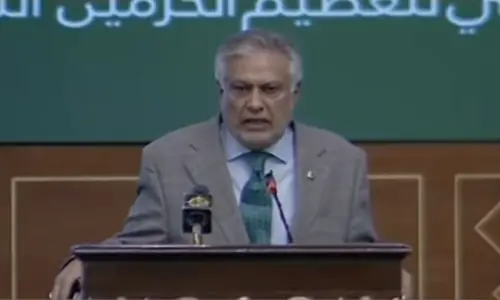
Planning Minister Ahsan Iqbal, who was the chief guest on the occasion, said transparency and accountability were the foundations of good governance and were essential for citizen satisfaction, a business-enabling environment, investor confidence and sustainable national development. He warned that negative perceptions, if left unaddressed, could undermine progress and distort realities and called for efforts to bridge the perception-reality gap.
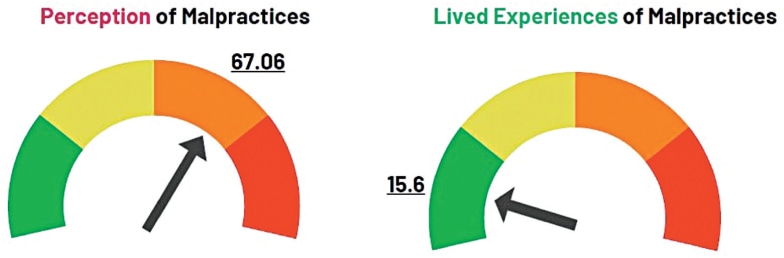
On nepotism, 56pc of respondents said they believed it was common in public institutions, while 24pc said they had observed nepotism undermining merit. The survey said overall perceptions of malpractices stood at more than 67pc, while reported experience was 15.6pc.
Similarly, 59pc said they believed public servants became rich through illegal means, while only 5pc said they had personally observed a public servant who had illicitly amassed wealth.
The survey identified bribery, nepotism and illicit enrichment as the three core forms of corruption linked to government departments.
Asked about the most corrupt institutions, respondents cited FBR’s Customs department, the offices of deputy and assistant commissioners (DC and AC), the police, FBR’s Inland Revenue and the courts as the top five.
However, the survey noted limited public interaction with some of these bodies over the past 12 months: 1pc reported interaction with the FBR (both Inland Revenue and Customs), 2pc with DC and AC offices, 4pc with the judiciary and 12pc with the police.
Published in Dawn, February 4th, 2026