4 Punjab districts allowed to manufacture kite-flying material to meet Basant demand


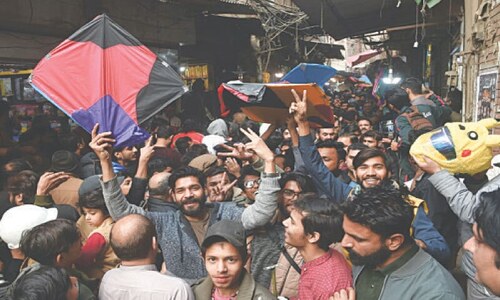
LAHORE: The Punjab government on Monday gave approval for the manufacture of permissible kite-flying material in four more districts of the province owing to the increasing demand and soaring prices of these commodities ahead of the much-anticipated Basant festival in Lahore.
Basant will be celebrated in Lahore from February 6-8, albeit under tight curbs, following the Punjab government’s move to lift the ban on the festival after a hiatus of 18 years. Celebrations, however, will remain restricted to the provincial capital, which until now was the only district where the manufacture of permissible kite-flying material was allowed.
According to a February 1 letter by the Punjab Home Department to deputy commissioners (DC) concerned, the provincial cabinet has given approval for manufacturing the kite-flying material in Faisalabad, Kasur, Multan and Sheikhupura as well.
The letter, seen by Dawn, said that the manufacturers should register themselves with the relevant DCs and through the Punjab government’s e-Biz digital portal and manufacture only “permissible kite-flying material”.
According to the Punjab government’s instructions, only cotton string is allowed to be sold for kite-flying on Basant whereas the manufacturing of metallic string material and kites exceeding fixed sizes is strictly prohibited.
Under the code of conduct, the sizes for a 1.5 Tawa Gudda (width 40 inches, length 34 inches) and a 4.5 Guddi Kite (width 35 inches, length 30 inches) have been fixed, and the manufacturing or flying of kites larger than these will not be permitted at all.
The provincial government has also imposed a ban on the manufacturing of kites bearing images of any person, holy scripture, religious place, country’s flag or that of a political party.
The Home Department’s letter also said that registered manufacturers in Faisalabad, Kasur, Multan and Sheikhupura should only sell their products to sellers and traders registered with the Lahore DC “for use in the district of Lahore on Feb 6, 7 and 8, 2026 […] and not in any other district”.
“Sale of permissible kite-flying material by registered manufacturers of these four districts to any person or entity, other than the registered traders and sellers in Lahore, shall be strictly prohibited,” the letter read.
Punjab Home Secretary Dr Ahmad Javed Qazi told Dawn that the provincial cabinet gave the approval in light of soaring prices and to bridge the demand-supply gap.
In addition to manufacturing, traders and sellers in Lahore had also been allowed to procure “permissible” kite flying material from other provinces, he further said, adding that material was already being procured from Peshawar, Haripur and Abbottabad.
The traders and sellers, however, are required to get permission from the Lahore DC to procure these items from other provinces.
In a post on X, Punjab Chief Minister Maryam Nawaz said every pinna (twine ball) would be QR-coded, “allowing it to be tracked from the manufacturer to the seller, and ultimately to the buyer”.
“All manufacturers are registered with the government and are fully compliant with approved safety regulations and specifications. In view of the increased demand for kites and strings, supplies from outside Punjab have been permitted strictly for products that meet the prescribed safety standards,” she said.
Ban around Lahore Airport
Qazi also told Dawn that the provincial cabinet had approved the exclusion of several areas, identified by the Pakistan Airports Authority (PAA), from kite-flying during Basant.
He added that the Lahore DC would notify Section 144 for those areas under Section 6(1) of the Punjab Regulation of Kite Flying Act 2025.
The PAA had written a letter to the Punjab additional chief secretary last month, requesting that a complete ban on kite-flying be imposed in certain areas during Basant for the safety of flight operations.
The PAA had requested that the Nadrabad, Gulshan Ali Colony, Nishat, Bhatta Chowk and DHA’s R, S, P and Q blocks be declared no kite-flying zones, as they fall in the aircraft approach path at the Allama Iqbal International Airport.
Similarly, the PAA had sought a ban on kite-flying in Al-Faisal Town, Joray Pul, Canal Bank Road and Tajpura, located along the aircraft take-off path.
The PAA further requested, “Impose Section 144 in the identified areas to ban kite flying on the rooftops of houses, as kites and kite-strings can be ingested into aircraft engines or strike critical aircraft surfaces, leading to potentially catastrophic consequences”.