Jamaat power show calls for end to ‘systemic exploitation of Karachi’


 0
0
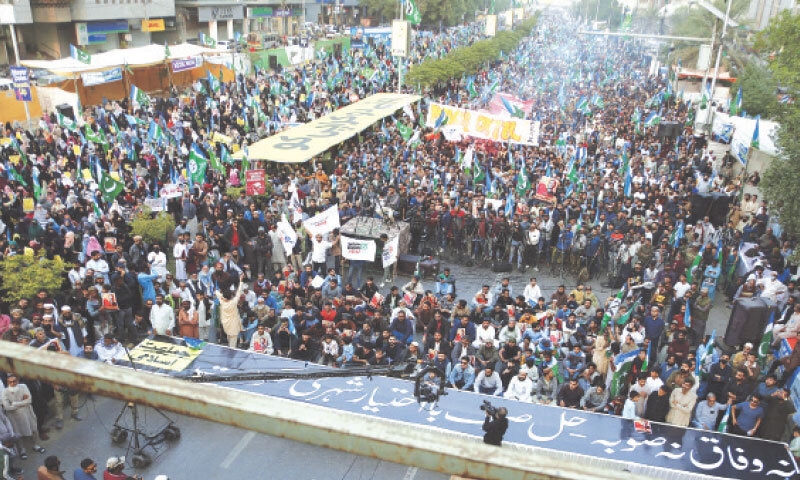

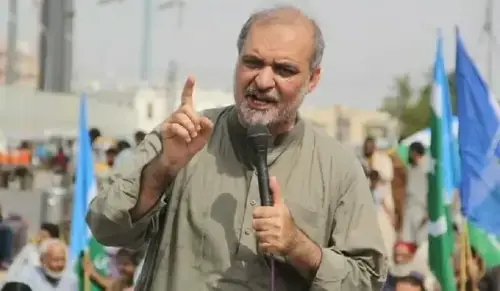
KARACHI: The Jamaat-i-Islami (JI) on Sunday staged a power show in the metropolis and warned the federal and Sindh governments that the city’s long-neglected issues could no longer be ignored.
Several small rallies from different parts of Karachi converged near the Nursery bus stop on Sharea Faisal to participate in the JI’s “Let Karachi Live” march.
The participants, including women and children, carried party flags and placards and, chanting slogans against the PPP government and city administration over the Gul Plaza tragedy.
Both tracks of Sharea Faisal were filled with people even before the start of the speech by JI chief Hafiz Naeem ur Rehman. One track was reserved for women and another for male participants of the rally.
Hafiz Naeem announces sit-in outside Sindh Assembly on 14th; demands empowered LG system, justice for Gul Plaza victims
The march led by JI-Karachi chief Monem Zafar began from Baloch Colony flyover and reached Nursery bus stop.
Addressing a huge gathering of supporters, the JI chief announced a sit-in outside the Sindh Assembly building on February 14 to demand empowered local governments, justice for victims of the Gul Plaza tragedy, and an end to what he described as systemic exploitation of the metropolis.
Describing Karachi as “mini Pakistan,” Hafiz Naeem said the city belonged to the people of all ethnicities, languages and sects, not to any single political party. He said Karachi’s citizens were not asking for privileges but for their basic right to live with dignity and security.
“The people of Karachi want to move forward, but they are being held hostage by criminal negligence, corruption, and a feudal political system,” he said.
Referring to the deadly Gul Plaza fire, he said people were burning alive while state institutions remained absent. He criticised the federal leadership for failing to visit the victims’ families, calling it tragic that the city generating the country’s largest revenue was treated with such indifference.
The JI leader claimed that Karachi contributes around 42 per cent of Pakistan’s income tax and over 50pc of national revenue, yet remains deprived of basic services. He blamed both the ruling Pakistan Peoples Party (PPP) and the Muttahida Qaumi Movement-Pakistan (MQM-P) for promoting ethnic politics while enjoying power and privileges.
He alleged that key city institutions had been taken over through political collusion and demanded the establishment of an empowered local government system in line with the Constitution. “Town and union council chairmen have no authority, while feudal lords and influential elites control all powers,” he said.
The JI chief also raised concerns over the deteriorating law and order situation, traffic fatalities involving dumpers and water tankers, rampant street crime, and the collapse of urban infrastructure. He said Karachi’s population of over 35 million lacked a respectable public transport system, adding that projects such as the Green Line and Red Line had further damaged the city instead of resolving its problems.
Hafiz Naeem also accused the “tanker mafia” of operating with political patronage and alleged that extortion money reached influential political centers. He reiterated that the people of Karachi had elected a JI mayor, but their mandate was undermined through what he termed “undemocratic interference.”
Warning the Sindh chief minister and what he called the “imposed mayor” of Karachi, the JI leader said the era of occupation and control over the city was coming to an end.
“Dignity lies in letting Karachi breathe. Otherwise, the youth will force change,” he warned.
Announcing the February 14 sit-in, Hafiz Naeem said JI’s earlier 29-day protest had succeeded in getting some demands accepted, but this time the movement would continue until powers were transferred to local governments. He said the protest could be expanded nationwide if authorities attempted to suppress it.
Among JI’s key demands is a judicial inquiry into the Gul Plaza tragedy under the supervision of the Chief Justice. He rejected what he termed “token inquiries” and questioned the role of the Sindh Building Control Authority (SBCA), asking how illegal constructions flourished despite its presence.
He also criticised dynastic politics, calling major parties “inherited properties” run through fear rather than democracy. He also condemned terrorism while arguing that outdated political and economic systems were breeding extremism.
Published in Dawn, February 2nd, 2026