ISLAMABAD: Islamabad Capital Territory (ICT) Police have submitted a comprehensive report to the Islamabad High Court (IHC), outlining recoveries made from drug peddlers over the past year and detailing extensive enforcement, surveillance, and preventive measures to curb the use and sale of narcotics, particularly in and around educational institutions.
The report, submitted by Assistant Inspector General Tahir Kazim in compliance with directions issued in Writ Petition filed by M/S Lakki Foundation Limited through its counsel Kashif Ali Malik, stated that the IHC had directed the inspector general of police (IGP) Islamabad to present a practical and actionable strategy to prevent narcotics on or near campuses
According to the document, ICT Police have intensified anti-narcotics operations and launched a multi-layered enforcement plan involving awareness campaigns, specialised investigation units, inter-agency coordination, intelligence-based operations, and digital surveillance.
The report provides a comparative overview of cases registered in 2025 and January 2026 (up to January 24). During 2025, Islamabad police registered 27 drug-related cases, arrested 30 accused and recovered 19,660 grams of charas, 3,390 grams of heroin, 4,073 grams of crystal methamphetamine (Ice), and 120 narcotic pills.
In January 2026 alone, despite the short timeframe, ICT Police registered 21 cases, arrested 21 suspects and recovered 1,530 grams of hashish, 4,641 grams of heroin, and 2,226 grams of Ice.
The report emphasised that the large heroin and Ice recoveries within less than a month reflect focused intelligence-led operations aimed at disrupting supply chains near educational institutions
Zone-wise data indicated active enforcement across City, Saddar, Industrial Area, and Rural Zones, with Saddar and Industrial Area recording particularly high recovery figures.
The report highlighted the launch of a social media awareness campaign titled “Nasha Ab Nahi”, initiated on April 26, 2024, targeting students and parents through videos, infographics, and public safety messages. Islamabad police also organised anti-drug awareness walks in multiple sectors, including I-9, F-10 Markaz, Cust University, Comsats University, Air University, D-12, and Golra.
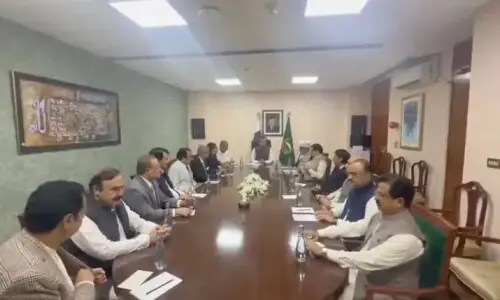
To strengthen prevention at the institutional level, ICT Police conducted high-level meetings at the Central Police Office (CPO) with representatives of the Higher Education Commission (HEC), Private Educational Institutions Regulatory Authority (Peira), Anti-Narcotics Force (ANF), universities and colleges. These meetings, chaired by the inspector general of police and deputy inspector general, focused on coordinated campus security, monitoring mechanisms, and rapid reporting systems
Additionally, police officials held zonal-level seminars and lectures at universities and schools such as Iqra University, Numl University, Cust University, Federal Urdu University (FUUAST), Imperial International School, Care Public School Golra Sharif, Sunbean School & College and other institutions. Due to winter vacations and examinations, some sessions were postponed, with assurances from institutions to reschedule.
The ICT Police have established Narcotics Investigation Units (NIUs) at police station level to ensure professional handling of drug cases, improved evidence collection, and stronger prosecution outcomes.
These units are tasked with minimising procedural gaps and enhancing conviction rates.
The report also noted ongoing capacity-building and refresher training programs at the Capital Police College, focusing on investigation techniques, chain of custody, crime scene management, legal updates and coordination with prosecutors to improve operational effectiveness.
To track and deter drug peddlers, ICT Police are conducting digital surveillance through Safe City cameras, deploying dedicated monitoring teams to identify suspicious activity around educational institutions.
The police have also dismantled several narcotics gangs since 2024, acting on disclosures made by suspects arrested in Islamabad, Rawalpindi, Attock, Peshawar and Faisalabad. Intelligence gathered from rehabilitation centers is being used to trace supply networks and identify drug dealers.
Furthermore, ICT Police have strengthened coordination with the Anti-Narcotics Force (ANF) and adjoining district police, including Rawalpindi and Attock, to curb cross-district trafficking and share actionable intelligence Recently, the court warned that school administrations and principals could face criminal liability if narcotics are found on campus, stressing that awareness alone is insufficient without strict monitoring, enforcement, and accountability.
Justice Raja Inaam Ameen Minhas has directed authorities to intensify inspections, question arrested suspects about school-related drug supply, and ensure compliance with drug-free campus policies.
Published in Dawn, February 1st, 2026