Much delayed exploration at Rohri Hills finally gets underway
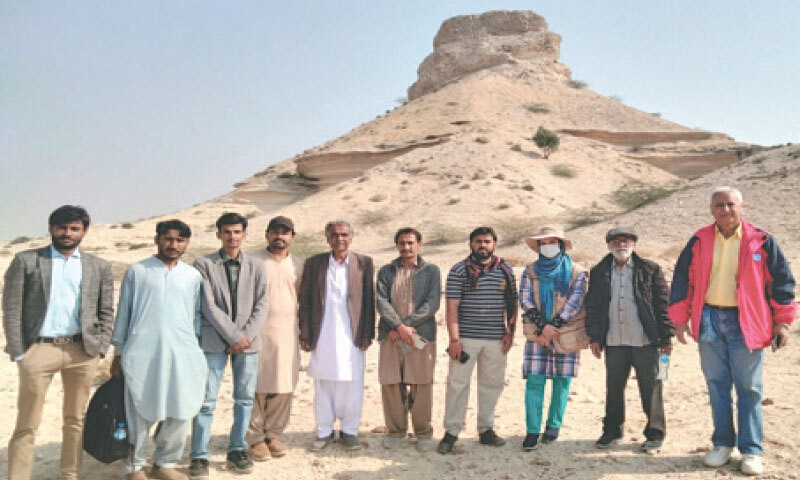


SUKKUR: A month-long project for the discovery of more artifacts from Rohri Hills — a major archaeological site in Sindh — has been undertaken under the supervision of foreign experts’ team, it was revealed on Tuesday.
The fresh initiative, under the directions of Mr Abdul Fatah Shaikh, had been in the planning stage through the last year but was delayed due to budget constraints.
According to the Sindh Culture Department’s Directorate General of Antiquities & Archaeology, the excavation is underway at four different sites since it was started in Nov last year. Upon completion of the Rohri Hills project, “an exciting underwater heritage excavation is set to commence, a statement issued by the department said.
The month-long project is led by Zahida Quadri, the head of the excavation and explorations.
Underwater excavation soon, says Directorate General of Antiquities & Archaeology
The work is being supervised by Dr Paolo Biagi from Italy, who had begun a research on the Rohri Hills in 1988. The other members of the experts’ team are Dr Maarco Madella from the University of Barcelona, Dr Ghulam Mustafa Sher, Dr Tasleem Abro (head of the Archaeology Department at the Shah Abdul Latif University) and Mohammad Amin Chandio from the Aror University, Sukkur.
Prof Shah Mohammad Luhrani, the Dean Faculty of Commerce and Business Administration at SALU, Khairpur, Dr Zaheeruddin Sher, and Faiz Ali Katohar have also joined the fieldwork.
The team has explored Ziyarat Pir Subhan Hill, Rohri Bypass, Pir Shadi Shareef Hill and Pir Adam Sultan Hill to document several stone tools factories that might have been operational around 80,000 years ago.
“Some sites on the hilltops remain so intact that it seems as if the workers have just stepped away and will return soon,” the statement observed, and noted that it is hard to believe that these sites had remained untouched for thousands of years. The tools, including axes, scrapers, flakes, cores, blades and raw materials, are scattered over a vast area.
It said that some hills appeared significantly disturbed by human activity. Local authorities have even used grenades to destroy parts of these hills to establish a cement factory and extract stone for construction.
The destruction is sheer injustice to the precious Sindh heritage, which still vividly illustrates the craftsmanship of the Stone Age people.
The Directorate General has protected these sites under the Antiquities Act, 1975 and did not issue any NOC for the establishment of a cement factory or for any activity that could cause damage to these historical sites.
Despite a ban ordered by the Sindh chief minister, stone crushing is still going on at the Kalkan Mata Temple within the area, the statement noted.
Published in Dawn, January 28th, 2026