In landmark ruling, Federal Constitutional Court upholds super tax
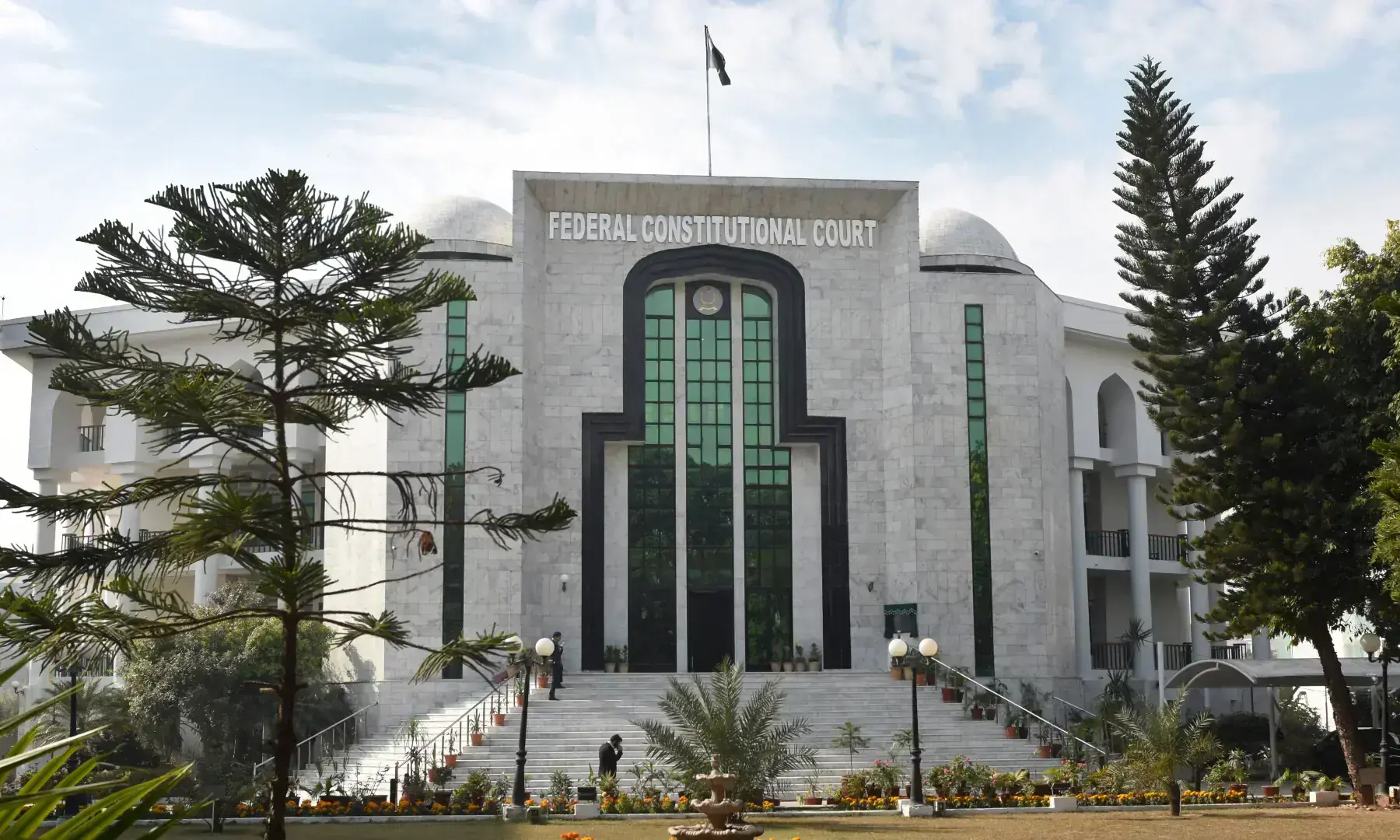

ISLAMABAD: Accepting the authority of Parliament to legislate on imposing taxes, the Federal Constitution Court (FCC) on Tuesday — in a landmark ruling with far-reaching constitutional and fiscal implications — upheld the vires of the super tax.
This means that means Section 4-B and the 4-C of the Income Tax Ordinance (ITO), 2001 will be applicable from the dates these were levied as per the prescribed rates.
A three-member bench, headed by FCC Chief Justice Aminuddin Khan and also including Justice Syed Hasan Azhar Rizvi and Justice Syed Arshad Hussain Shah, announced the much-anticipated short order.
The short order was announced in the afternoon after a brief hearing in the morning, when the FCC reserved its ruling with an observation that the verdict would be issued today. The detailed judgment will follow later.
Senior counsel Hafiz Ahsaan Ahmad Khokhar, who was representing the Revenue Division secretary, said the FCC decided over 2,200 long-pending tax cases concerning Sections 4-B and 4-C of the ITO, thus safeguarding an estimated Rs310 billion in public revenue.
These cases were transferred to the FCC after the passage of the 27th Constitutional Amendment. Different appeals were instituted against the judgments of the Sindh, Lahore and Islamabad high courts regarding the levy of super tax through Section 4-B and 4-C of the ordinance.
Different businesspersons, banks, and companies had challenged the imposition of the super tax in high courts, arguing against its retrospective imposition, saying it amounted to double taxation.
The tax was initially imposed by the PML-N government in 2015 as a one-time measure under a money bill, with the stated purpose of rehabilitating areas affected during Operation Zarb-i-Azb against terrorists.
Previously, an additional 5pc super tax was levied on annual profits exceeding Rs300m. But in 2022, the super tax was applied to individuals earning over Rs150m annually, with a maximum rate of 10pc.
It levies a tax rate of 4pc on the income of banking companies and 3pc on other sectors, aimed at funding the rehabilitation of temporarily displaced persons.
The cases arose from tax levies under Sections 4-B (super tax for rehabilitation of temporarily displaced persons) and 4-C (super tax on high-earning persons). While Section 4-B had largely been upheld, Section 4-C had been read down or struck down in some high court rulings on grounds of alleged retrospectivity, discrimination, irrationality of tax slabs, double taxation, and inequity.
Following the 27th Constitutional Amendment, the case was transferred to the FCC after 71 hearings in the Supreme Court.
On Tuesday, the FCC declared the provisions intra vires the Constitution, reaffirmed Parliament’s exclusive legislative competence in taxation, and set aside the judgments of the Islamabad, Lahore, and Sindh high courts, which were found to have exceeded their jurisdiction.
The FCC held that courts cannot redetermine tax slabs, rates, thresholds, or fiscal policy, and that the high courts committed judicial overreach, violating the doctrine of separation of powers. All appeals filed by the Federal Board of Revenue (FBR) secretary and Inland Revenue commissioner were confirmed as maintainable.
The FCC said the super taxes were valid, with specific exclusions for benevolent funds. It also allowed oil and gas exploration companies to approach the relevant tax commissioner individually for tax exemptions that should be assessed individually as per the 1948 concession regime.
It said Sections 4-B and 4-C were intra vires of the Constitution, the Parliament had the exclusive authority to determine taxation under Sections 4-B and 4-C and that the courts’ role was limited to interpretation.
The FCC also stated that the high courts’ judgments striking down or reading down Section 4-C were constitutionally invalid and set aside.
Separately, the FBR issued a press release saying the decision was expected to fetch revenue “to the tune of Rs300bn to the public exchequer”.