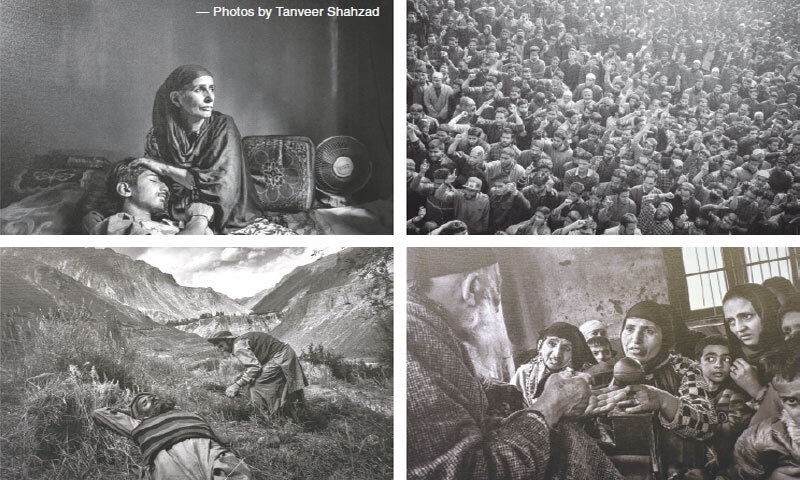

ISLAMABAD: The pain and complexities of Kashmir, a bitter paradise, came into focus at the Pakistan National Council of Arts (PNCA) as internationally acclaimed Belgian photographer and filmmaker Cedric Gerbehaye unveiled his long-term photographic project, Kashmir Wait & See, on Monday.
Mr Gerbehaye pondered on the miseries across the border, saying, “Suffering is suffering, and there’s not a greater suffering than another.”
The photo exhibition and book launch was organised by Pakistan Photo Festival (PPF) in collaboration with the Pakistan National Council of the Arts (PNCA) and the Kashmir Council EU. The event was curated by Shah Zaman Baloch, founder of PPF.
Mr Gerbehaye reflected on his photographic journey, explaining that his photography begins with a will “to know and to understand, whether he is in Palestine, Kurdistan, Africa, or Europe. Photography, for me, is a tool of understanding the world. It’s a way to communicate with people and to create a link.”
Mr Gerbehaye, while sharing his journey to Kashmir, said, “You can imagine that in very tense situations, we have lived and shared very emotional moments when I was working in the Kashmir Valley. Same with people along the LOC, in villages that are being hit. When people share their stories with me, I feel very humbled to have the opportunity to listen to their suffering.”
The project, spanning nearly a decade of engagement, offers a deeply personal visual narrative of Kashmir, tracing its social landscapes, architecture and the intimate rhythms of daily life even in conflict. Since his first visit to Srinagar in 2017, Gerbehaye has travelled across both sides of the Line of Control, documenting lives shaped by geopolitical tension while highlighting moments of resilience and humanity.
He contrasted the intensity of conflict zones along LoC with the serene yet imposing landscapes of Gilgit-Baltistan. “Gilgit-Baltistan is a place where you are obliged to understand and feel how little you are, to submerge and emerge inside these amazing landscapes, and the beauty of the culture, and the beauty of what people are sharing with you,” he said.
Shah Zaman Baloch highlighted the significance of Mr Gerbehaye’s approach saying that “all of Cedric’s work is very personal. Usually, in conflict areas, photographers produce dramatic scenes of violence, but here you will see a great sense of intimacy”.
He said this project contains many personal stories and long-term engagement, which is why it was very important to bring this exhibition to the Pakistani people.
The book, Kashmir Wait & See, complements the exhibition, combining narrative and photographs to create a lasting archive of the region’s complexities.
Following the Islamabad show which will be open till January 28, the exhibition will travel to Muzaffarabad, Mirpur, and the National College of Arts (NCA) in Lahore for Kashmir Day on February 5.
Published in Dawn, January 27th, 2026