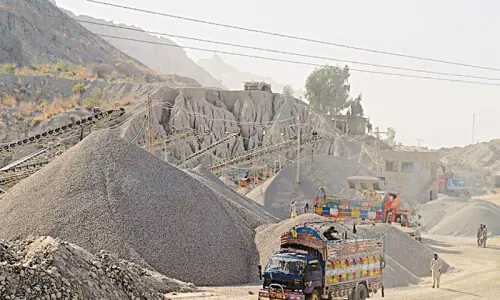
PAKISTAN’s first shipment of critical minerals to America in October last year, following a $500m agreement between a US company and the Frontier Works Organisation, was a milestone in an otherwise underdeveloped sector. However, the feat also indicates how much work remains to be done before mineral wealth can contribute meaningfully to economic growth in the country.
In a recent policy note, ICMAP, the accountant body in Pakistan, reminds us that the export of raw critical minerals is not success in itself but merely the first step towards integrating Pakistan into higher-value, compliant global supply chains. It points out that the export of raw or semi-processed minerals will do little to ease balance-of-payments pressures or broaden Pakistan’s narrow industrial base. The real test — and reward — lies in moving beyond extraction towards building an integrated domestic value chain that spans exploration, processing, and refining.
Dependence on raw exports tends to trap developing economies in low margins, price volatility and limited job creation. Through critical minerals, Pakistan can avoid that outcome by investing in downstream processing and diversifying into manufacturing industries that rely on rare earths and other strategic inputs — from e-vehicles and renewable energy equipment to advanced defence technologies.
However, such a transformation will not be smooth. Fragmented governance, shifting regulations, weak environmental and social oversight, the near complete absence of processing capacity, and inadequate infrastructure continue to deter serious investment. Security concerns and a shortage of skilled labour have compounded the problem. As a result, a sector sitting on an estimated $8tr in mineral resources still contributes less than 3pc to the national economic output.
Unless these structural constraints are addressed, much of this wealth will either remain buried or be exported cheaply to developed economies. Since rare earths are critical to modern economies, required for everything from smartphones and wind turbines to e-vehicles and military systems, including fighter jets, missiles and satellites, the emerging global geopolitics complicates the challenge.
Washington’s renewed engagement with Pakistan reflects its efforts to diversify supply chains and reduce its dependence on China, which accounts for more than 60pc of global rare earth mining and around 92pc of processing capacity. Pakistan’s potential role in an alternative supply chain may not sit comfortably with Beijing.
Handled prudently, this sector can become an important pillar of industrial and export diversification and balance-of-payments stability. Mishandled, it can lock the economy into a familiar rut of low growth without structural transformation. The choice before the government is a familiar one.
Published in Dawn, January 26th, 2026