Pakistan’s critical minerals need value addition to boost exports
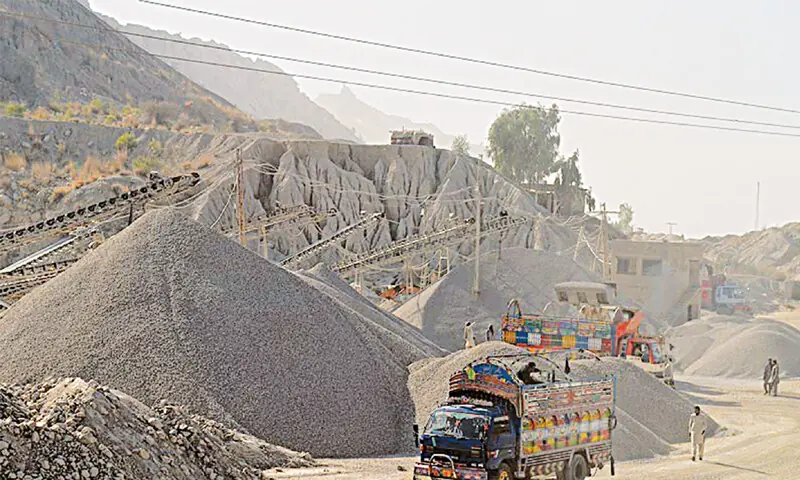

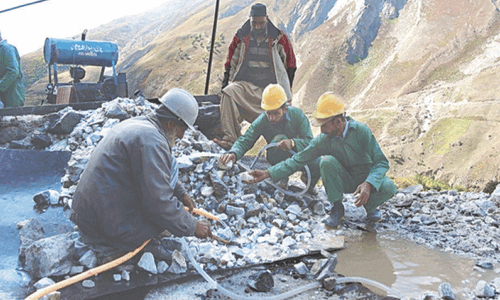
ISLAMABAD: To boost foreign exchange and drive sustainable economic growth, Pakistan must focus on transforming its raw minerals into processed and value-added products that meet global Environmental, Social, and Governance (ESG) standards, rather than merely exporting raw critical minerals.
In a policy note following Pakistan’s first shipment of critical minerals to the United States in October last year, Institute of Cost and Management Accountants of Pakistan (ICMA) said the export of critical minerals marked a historic milestone but its research emphasised that “the real opportunity lies in turning raw minerals into processed, ESG-compliant products”.
“Achieving this transformation requires the government to tackle fragmented governance, unclear regulations, poor infrastructure, limited local processing capacity, security and political risks, weak environmental and social oversight, and a shortage of skilled mining workers”, it said, adding that addressing these issues was essential to build investor confidence and fully unlock Pakistan’s vast mineral wealth.
It said the mineral exports alone cannot drive economic transformation. Pakistan must move decisively from raw extraction to integrated, ESG-compliant value chains. Harmonised national mineral policy, transparent regulation, technology-enabled oversight, and strategic international partnerships are essential to convert the country’s mineral wealth into sustainable economic growth, industrial diversification, and strengthened foreign exchange earnings.
ICMA says $8tr wealth can drive sustainable economic growth
Against this backdrop, Pakistan formally entered the global critical minerals market by dispatching its first shipment of enriched rare earth elements and critical minerals to Missouri-based US Strategic Metals (USSM) under a $500 million agreement. The consignment sent on Oct 2, 2025, signalled Pakistan’s evolution from a resource-rich yet underutilised economy into an emerging player in strategic global supply chains.
The shipment included antimony, copper concentrate, and rare earth elements such as neodymium and praseodymium, marking the start of a long-term collaboration between USSM and Pakistan’s Frontier Works Organisation. Signed in September 2025, the deal envisioned an integrated domestic value chain spanning exploration, processing, and refining, designed to maximise local value addition.
Despite vast deposits of copper, gold, chromite, and rare earth elements, Pakistan’s mining sector has historically contributed less than 3pc to GDP. ICMA research notes that the policy shift toward value-added mineral exports reflects a strategic reorientation, though tangible economic impact is expected to unfold gradually — over a 2-3-year demonstration phase, followed by 5-7 years of moderate scaling, with full impact expected in 10 plus years. “Full value addition in mineral exports could significantly increase Pakistan’s industrial output and foreign exchange earnings over the next decade”, it added.
Pakistan’s mineral wealth is estimated at $8 trillion, spread across 600,000 square kilometres and comprising 92 identified minerals, 52 of which are commercially extracted. At the heart of this potential is the Reko Diq copper-gold project, one of the world’s largest untapped reserves, with production slated to begin in 2028, and capacity expansion planned through 2034, the ICMA study noted.
The ICMA said that initiatives such as the Pakistan Mineral Investment Forum and the National Mineral Harmonisation Framework, alongside growing international engagement under the China-Pakistan Economic Corridor (CPEC) and interest from Saudi Arabia, were drawing global attention. “To fully seize this opportunity, Pakistan must ensure policy consistency, institutional coordination, and sustainable mineral governance”.
It emphasised that the emerging partnership with the United States offered a robust framework for responsible exploration, processing, and refining, leveraging technical expertise and market access. By focusing on strategically critical minerals and embedding ESG principles across the value chain, Pakistan can strengthen bilateral cooperation, enhance investor confidence, and position itself as a responsible contributor to global critical mineral supply chains and the clean energy transition.
In late October, a leading delegation of the US government-funded Critical Mineral Forum (CMF) visited Pakistan to lobby for building “a secure and transparent mineral supply chain for American industry” amid Washington’s growing concerns over China’s upper hand in global rare earth materials.
The delegation had engagements with finance minister Muhammad Aurangzeb and other stakeholders and ‘discussed avenues of cooperation in the minerals and mining sector, strengthening supply-chain security, and encouraging responsible and sustainable investment in Pakistan’s critical minerals landscape’.
Published in Dawn, January 24th, 2026