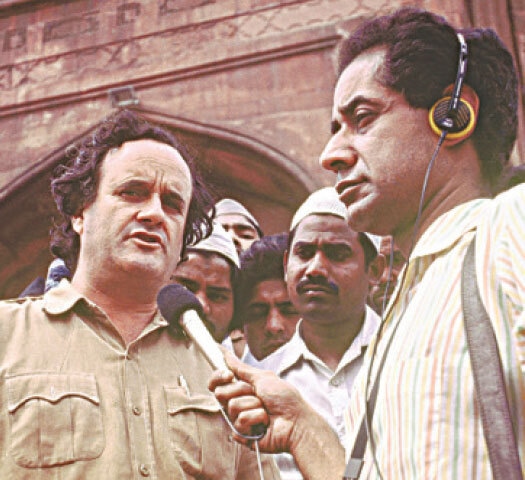
Mark Tully who died at a private hospital in New Delhi on Sunday was a sensation and a legend in radio journalism, much of it in his avatar as the BBC’s iconic bureau chief in India. Tully was 90 and had been battling esophageal cancer in recent years.
“Tully Saab” was what his favourite cabbies of the black and yellow Ambassador taxi era called him. And Tully Saab was also the envy of foreign journalists covering India and Pakistan as they struggled to break out of his daunting shadow. Mark Fineman of the LA Times was a typical victim. He was traveling by car to a village in Mathura where bitter caste rivalry had led to a Jat mob burning a Jat girl and her two Dalit male friends alive. Fineman had acquired the habit of many Indian journalists of dodging the tiny road tax by declaring themselves the press. At the village toll, Fineman decided not to pay the two-rupee tax and proclaimed himself a foreign correspondent. “Oh! Are you Mark Tully, sir?” the toll collector asked excitedly. “Damn Mark Tully. Take your two rupees and give me the receipt,” growled the American journalist with a mixture of anger and secret admiration for his British peer. Tully was appointed BBC correspondent in New Delhi in 1971, and named bureau chief a few years later, responsible for covering the South Asia region – which included India, Pakistan, Bangladesh and Sri Lanka. It was a post he held for twenty years, until his retirement in 1994.
His work with the broadcaster was underlined by coverage of historic episodes in post-Independence South Asian history. From the Bangladesh war of 1971 to the Emergency of 1975-77, the execution of Zulfikar Ali Bhutto in 1979, the Army assault on the Golden Temple, the assassination of Indira Gandhi, and the anti-Sikh riots in 1984, the assassination of Rajiv Gandhi in 1991, and the demolition of Babri Masjid in 1992.
Operation Blue Star and the Punjab problem were the subjects of Tully’s first book, “Amritsar: Mrs Gandhi’s Last Battle” (1985), co-written with BBC journalist Satish Jacob. Mark Tully’s cult figure has hinged on his high calibre professionalism as a journalist, but it owed in no small measure also to his run-in with Mrs Gandhi over her declaration of the emergency. She expelled him in 1975 but he was welcomed back by the next government. Tully’s bete noir that she was, Mrs Gandhi must have cursed the irony of being the founder of the transistor revolution in India, the very medium that made Tully the trusted radio reporter for millions across South Asia. BBC’s broadcast in a range of languages including Urdu, Hindi and Bangla were a force multiplier in his popularity.
Tully was born in Calcutta (now Kolkata) on October 24, 1935. His father was the director of a railroad and a partner in a holding company that owned a bank, an insurance firm, and tea plantations. After the Second World War, his parents sent him to boarding school in the United Kingdom. He later took theology courses at Cambridge University and then entered a seminary.
Returning to London in 1969, Tully headed the Hindi service and then the West Asia service – for which he covered the India-Pakistan war that led to the creation of Bangladesh in 1971.
Tully’s first major book on his years in India came in 1988 in the form of “No Full Stops in India”, condensing his more than two decades of work in the country in a collection of 10 journalistic essays covering some of the prominent news events, including Operation Blue Star, Roop Kanwar Sati case, Ramanand Sagar’s “Ramayan”, and the Kumbh Mela that he witnessed in 1977.
“The stories I tell in this book will, I hope, serve to illustrate the way in which Western thinking has distorted and still distorts Indian life — I might almost say they are parables. They provide no answers to India’s poverty, but I believe they do suggest where we should begin to look for those answers — in India itself,” he wrote in the book’s introduction.
An acclaimed author, Tully was also the presenter of the BBC Radio 4 programme ‘Something Understood’. He was knighted in 2002 and received the Padma Bhushan from the government of India in 2005.
Published in Dawn, January 26th, 2026