Low snowfall leaves Gilgit-Baltistan mountains bare
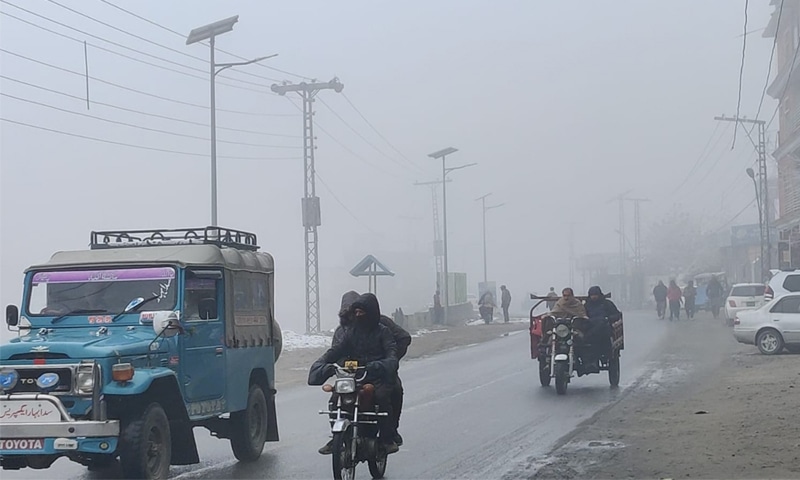


GILGIT: Climate change impacts are becoming increasingly visible in Gilgit-Baltistan, where below-normal snowfall has left much of the region unusually dry this winter.
Light snowfall was recorded in parts of Skardu, Kharmang, Shigar, Ghanche, Astore and Ghizer on Friday and Saturday. The Pakistan Meteorological Department (PMD) has forecast further rain and snowfall in several areas until Jan 23.
Officials said Skardu received about two to three inches of snow on Saturday, while parts of Ghizer saw intermittent snowfall over the past two days.
Light snow was also reported in Hunza, Nagar and other areas last week, but residents said most valleys remained dry, with mountains largely bare and rocky.
Experts warn ‘snow drought’ could worsen flood risk downstream
Muhammad Ali Alam, a resident of Skardu, said the region typically received heavy snowfall by mid-January. “The mountains should be snow-clad by now, but the first snow of the season in Skardu and adjoining areas only fell on Friday,” he told Dawn. He said residents had observed later and lower snowfall over the past two years.
Karim Hayat, a resident of Hussaini village in Upper Hunza’s Gojal valley, said snowfall usually began in late November.
“It is alarming that we are facing a snow drought till January,” he said, adding that the light snow on surrounding peaks would melt quickly in the sun. He also said temperatures remained unusually high until the end of December.
Saeed Farooqi from the Tirashig area of Astore said the district would normally be blanketed in snow by this time. “This year, the area remained dry through January,” he said.
Experts said a shift in winter patterns had been observed across GB in recent years, with snowfall starting later, the areas receiving less snow and temperatures remaining higher than usual.
Gilgit-Baltistan Environmental Protection Agency (GBEPA) Director Khadim Hussain told Dawn the region’s fragile ecosystem was being disturbed by climate change and environmental degradation.
He said snowfall had increasingly shifted to mid-January and February, reducing the chance of snow compacting and turning into ice on mountains and glaciers.
“Late snowfall does not compact and can melt rapidly when the summer season starts, which increases the risk of floods downstream,” he said.
Mr Hussain said climate change was a major driver of the shift, but local factors were also contributing. He cited deforestation, unplanned construction of roads and other infrastructure, the influx of tourism and increasing human activity near glaciers.
“Greenhouse emissions, increasing traffic discharge emissions in the fragile environment, human settlements near glaciers, burning of tyres, animal dung and cutting of forests for firewood impacted glaciated areas,” he said.
He said uncontrolled population and increasing human activities in environmentally sensitive areas also contributed to the weather pattern change in the area.
Citing data collected by GBEPA, he said the average temperature in GB rose by about 0.6 degrees Celsius between 1987 and 2013. He said the region had faced a rise in flash floods, accelerated glacial melt and other climate-linked hazards in recent years.
Published in Dawn, January 18th, 2026