JCP recommends making 4 ad hoc high court judges permanent
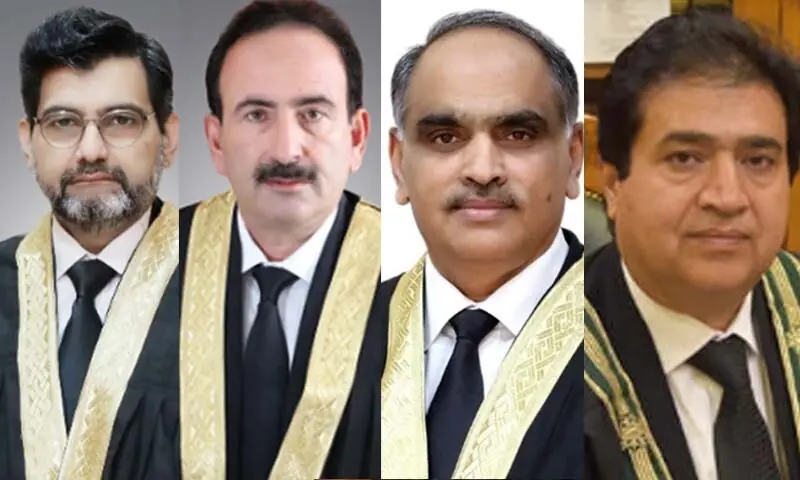

ISLAMABAD: The Judicial Commission of Pakistan (JCP) recommended on Monday that three ad hoc judges of the Islamabad High Court (IHC) and one of the Balochistan High Court (BHC) be made permanent.
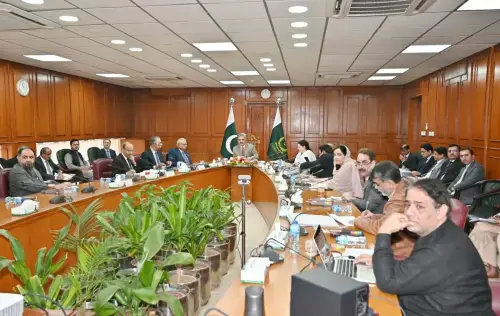
The decision was taken during a meeting of the JCP — the key judicial body responsible for appointing judges to the superior judiciary — chaired by Chief Justice of Pakistan Yahya Afridi.
A press release issued by the Supreme Court of Pakistan after the meeting said: “The commission also recommended, by majority, the confirmation of the following additional judges as judges of the Islamabad High Court … after due consideration of the relevant data form, antecedents and evaluation of material placed before it.”
The commission has recommended the confirmation of Additional Judges Muhammad Azam Khan, Muhammad Asif and Inaam Ameen Minhas of the IHC.
“Similarly, the commission also recommended, by consensus of the present members, the confirmation of Justice Najamuddin Mengal, additional judge, as judge of the High Court of Balochistan,” the press release added.
The JCP, however, did not recommend, by majority, the confirmation of Additional Judge Ayub Khan of the BHC, the press release said.
The five ad hoc judges approved by the JCP will become permanent after the president’s assent.
Among the IHC judges, Justice Azam and Justice Minhas were appointed as additional judges to the IHC, whereas Justice Asif was appointed as a judge in the BHC before he was transferred to Islamabad through a presidential order that also brought incumbent IHC CJ Mohammad Sarfaraz Dogar to the high court in federal capital.
These transfers and the subsequent elevation of Justice Dogar as chief justice witnessed unprecedented internal discord within the IHC. Several judges appeared as litigants before the Supreme Court, while two judges attended proceedings before the Sindh High Court as private petitioners in the case relating to Justice Tariq Mehmood Jahangiri’s degree.
In 2025, the IHC decided at least 16,000 cases. Official data shows that Justice Minhas recorded the highest number of disposals, deciding 2,039 cases in his single bench and more than 500 cases in division benches. Justice Mohammad Azam Khan decided 1,841 cases in single benches and around 600 in division benches, while Justice Mohammad Asif disposed of 1,338 cases.
It may be noted that Justice Asif is also facing a complaint before the Supreme Judicial Council (SJC), in which it has been alleged that he misused his authority to influence proceedings in a hit-and-run case involving his son.
According to the complaint, dated December 25 and submitted by Advocate Inamul Rahim, the incident occurred on December 2 last year near the Pakistan National Council of Arts, where a speeding SUV allegedly driven by Justice Asif’s son struck a scooter, killing two girls on the spot. A judicial magistrate later granted bail to the accused on December 6 after the victims’ families pardoned him in court.
Sources told Dawn that during deliberation on making ad hoc judges permanent in the JCP meeting, IHC‘s Justice Mohsin Akhtar Kayani and IHC CJ Dogar appreciated that Justice Asif did not use his official position to influence the victims’ families soon after the incident. They also acknowledged that the judge visited the bereaved families to apologise.
However, during voting, Justice Kayani and SC Judge Munib Akhtar opposed making Justice Asif permanent.
Deliberation on key institutional, policy matters
The SC press release also said that key institutional and policy matters were deliberated on during the JCP meeting
“The core commission constituted under Article 175A (2) of the Constitution, considered issues relating to the criteria for nomination of judges to Constitutional Benches of the high courts, the procedure for interviews of candidates for judicial appointments, and amendment to the Judicial Commission of Pakistan (Appointment of Judges) Rules, 2024, concerning appointments to the Federal Constitutional Court of Pakistan,” the press release said.
It added: “Following deliberations, the commission authorised the committee to examine these matters in detail and to place recommendations before it regarding procedure for interview, and amendments to the rules, ensuring effective and transparent implementation of the constitutional framework.”