ONE of the most remarkable narrative shifts of recent times is the almost complete disappearance of the ‘global middle class’ from public discourse. It was only a few years ago that Pakistan was being celebrated, alongside other non-Western societies, as home to a rapidly growing and highly prosperous middle class with globalised tastes and aspiration. What seemed like an irresistible historical force has turned out largely to be a myth. The rather more familiar tale of the rich getting richer and the poor getting poorer is back. Many who might still self-identify as middle class have, in fact, fallen rapidly back down the class ladder.
Let us recount the original claim about the global middle class. It was birthed in the early 2000s, when the Musharraf dictatorship was at its zenith. Its primary drivers were a cheap credit boom fuelled by recently privatised commercial banks, and a wave of remittances in the post 9/11 period. The result was a consumption boom that suggested significant social mobility.
For the lucky — or what neoliberal ideologues would call the more enterprising — enhanced class and status position were consolidated through investment in land or other financial assets, success in upgrading small businesses, or educational certification that bumped families into white-collar professional brackets.
But most who benefited from the initial consumption boom never managed to secure permanent and regular income flows. Indeed, the more common story is one of growing indebtedness, increasingly limited returns on educational investments and multiple family members seeking informal, temporary work to make ends meet.
The system ensures that most middle-class aspirants don’t make it.
Today, even donors like the World Bank and IMF who told tales of ‘structural reform’ in the 2000s and 2010s opine that consumption booms never produce sustained social mobility. They shed crocodile tears about increases in poverty and inequality, and insist on ‘inclusive growth’ to accompany ‘macroeconomic stability’. The big words mean nothing to most working people who are sold the proverbial dream of middle-class mobility only to discover that you can be very enterprising but only a limited few are lucky enough to rise consistently up the class ladder.
The non-Western ‘global middle class’ subject that eats out regularly, can buy a corner plot in a gated housing scheme and the newest sedan, and go on holiday twice a year is largely a figment of the neoliberal ideological imagination. The fact that a few live out this life in metropolitan centres tells us only that most of Pakistan’s 250 million people are increasingly immiserated.
The bursting of the ‘global middle-class’ bubble is even more stark in neighbouring India. The BJP once coined the phrase ‘India shining’ to lend weight to the myth that 300m Indians had graduated into the middle class. Today, many well-educated Indian youth feel economically suffocated and politically disenfranchised enough to be running political campaigns like the Cockroach Janta Party that expose the myth of a highly prosperous country.
This is not a doom-and-gloom narrative. It is an empirically informed analysis of recent history. Postcolonial capitalism in Pakistan, India and many other parts of the non-Western world, especially regions that experience massive youth bulges, produces inequality by design. Most young working people are indoctrinated to believe in the myth of individual mobility even though wealth accumulates at the top whilst nameless masses are dispossessed of their limited means.
The notion that anyone who works hard enough can become ‘middle class’ is certainly a very powerful ideology, and can be hegemonic in particular historical circumstances. Take the European and North American heartlands of the capitalist world-system after the end of World War II, where a wide cross-section of society enjoyed meaningful class mobility during the so-called Golden Age of Western societies. The ‘rich’ countries were, of course, feeding off imperialist transfers of wealth from the rest of the world. Yet they, too, have now suffered sustained stagnation which means that young generations of even the educated ‘middle class’ can no longer expect their lives to be more prosperous than their parents.
Briefly, the rich stay rich because they have power and control economic resources. They sell the myth that the poor remain poor because they are at best not enterprising enough and at worst lazy. Some middle-class aspirants ‘from below’ do make it, and become ideological poster-children for the system. But the system ensures most do not make it; they become cannon fodder for hateful politics, mostly pivoting around a virulent state nationalism that vilifies the ‘other’ within. The slide into barbarism quickens with each iteration of the story.
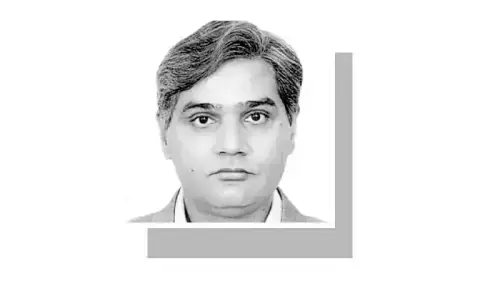
The writer teaches at Quaid-i-Azam University, Islamabad.
Published in Dawn, July 3rd, 2026