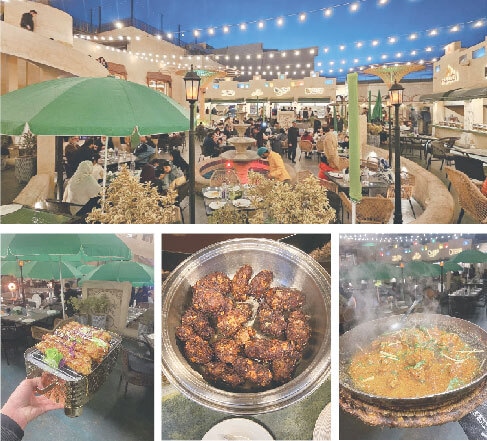
ISLAMABAD: There is something quietly ambitious about Basti in E-11. Not ambitious in the way of molecular gastronomy or imported concepts, but in scale — the audacity of attempting to gather Pakistan’s diverse, deeply regional food habits into one open, busy space and letting them coexist without hierarchy.
Marketed as The Food Street, Basti is less a restaurant and more a stitched-together village of kitchens. On most evenings, especially after sunset, it fills quickly with families, office groups and friends lingering well beyond the mechanics of eating. The appeal is immediate: smoke curling from live grills, dough slapped into shape at the naan counter, oil crackling under jalebis — all visible, all audible, all insistently present.
What distinguishes Basti from the themed dining spaces Islamabad has grown used to is that the kitchens are not hidden behind glass or stylised into performance. They are simply there — live, unabashed, unfiltered. Hygiene is not theatrically advertised; instead, it is demonstrated through confidence and routine. Meat is cut, marinated, skewered and cooked in full view, without apology or concealment.
The layout is organised into pavilions, each representing a familiar eating culture rather than a rigid menu category. At the heart of it is the Qasai Adda, where the scale of meat on offer becomes apparent. Cuts of beef, mutton and chicken are displayed plainly, signalling abundance rather than indulgence. For diners wary of red meat, there is reassurance here: chicken dominates the menu, appearing in more variations than beef or mutton — tikka, boti, karahi, handi and grilled options that are lighter, less fatty and often more forgiving on the palate.
From here, the smoke draws you inevitably toward the Koila Ghar, Basti’s charcoal barbecue station. Chicken tikka and boti are cooked over glowing coals, acquiring a restrained smokiness that enhances rather than overwhelms the marinade. The angeethi section leans slightly richer — meats grilled over coal in enclosed pits, absorbing heat slowly and emerging tender, glossy and deeply flavoured. Malai boti here is particularly notable: cream-based but not cloying, with green chilli and garlic cutting through the richness.
Adjacent to this is the Butt Karahi and Tikka pavilion, where karahis are cooked in traditional iron woks over high flame. The chicken karahi is tomato-forward, sharp with ginger and green chillies, finished with a sheen of oil rather than submerged in it. It is the sort of karahi that works best eaten immediately, scooped up with naan while the sauce is still clinging to the meat rather than separating into layers.
The Chapli Kabab station draws a steady crowd. These are coarse-textured, generously sized patties, studded with crushed coriander seed, pomegranate and green chilli. They arrive crisp at the edges, soft within, and noticeably lighter than their roadside counterparts — less grease, more balance.
Nearby, Kaka Dil Gurda offers a more acquired taste: chicken hearts and livers cooked quickly over high heat, seasoned assertively, best eaten hot and without pause.
One of the more interesting sections is Bab-e-Khyber, which leans into Pakhtun flavours — simpler seasoning, emphasis on meat quality, minimal intervention. This restraint provides contrast in a space otherwise rich with spice and smoke.
Bread is given due respect at the Naan Bai, where dough is stretched, slapped onto the tandoor wall and retrieved blistered and fragrant. The naan is soft without being doughy, with enough char to hold its own against heavier dishes.
The Quetta Waal is perhaps the most quietly comforting corner of Basti. Here, tea is treated not as an afterthought but as a meal companion. Strong, milky chai arrives in steady cups, paired with parathas — plain, aloo-stuffed and variations layered generously with ghee.
For children, the Humpty Dumpty section keeps expectations modest. Mini burgers and fries dominate the offering — nothing inventive, but sufficient.
The Chinese pavilion offers an unexpected pause from desi heaviness. Piping hot soups arrive steaming, broths clear and peppery. Gravies lean Indo-Chinese rather than strictly regional — glossy sauces, vegetables retaining crunch, noodles cooked just short of softness. These dishes are not meant to compete with specialist Chinese kitchens, but they serve as effective palate resets mid-meal.
Dessert is impossible to ignore. The Thanda Meeta section offers cooling finishes — kheer, falooda, and chilled sweets — while the Halwai does brisk business frying jalebis to order.
Basti does not chase refinement. It chases togetherness. In doing so, it offers Islamabad something increasingly rare: a place where eating is not rushed, kitchens are visible, and the meal belongs as much to the table as it does to the plate.
Published in Dawn, January 11th, 2026