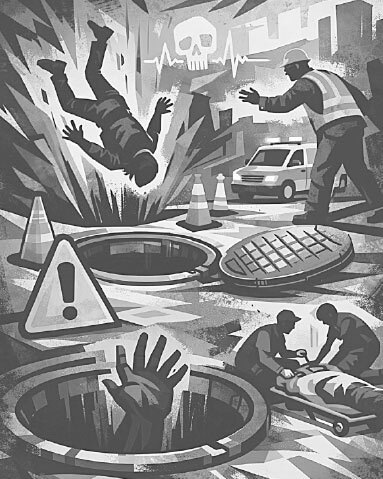
KARACHI last year lost 24 lives to the city’s neglected sewers, manholes and drains. Eleven people died after falling into open drains and nullahs, seven fell into uncovered manholes, and six sanitation workers were effectively killed by a system that forced them to enter and clean toxic, clogged raw sewage gutters with their bare hands.
It ought to be difficult, if not impossible, for all of us who live in this country to identify ourselves as human beings while silently watching these orchestrated and exploited deaths of fellow humans — with such utter cruelty and inhumanity. We could, however, reform this dilapidated and brutal governance system by taking at least three immediate steps.
There should be a survey to count and digitise every storm-water and sewage gutter and manhole across the city, and allocate a unique identity code that identifies location, type (storm-water, wastewater, combined sewer), depth, size, pipe connections, material, installation date and the owner department.
Before the Sindh government senses another opportunity for ‘tragedy capitalism’ to obtain and blow up a fresh $50 million World Bank loan under the pretext of streamlining the system, it may be appropriate to publicly state that open- source geographic information system (GIS) desktop softwares, such as QGIS and Map Window GIS, are available for free, for anyone to use for the management of manholes, storm drains, sewerage pipes and gutters. The Sindh government should enact legislation banning all forms of manual scavenging, and prohibiting workers from entering hazardous sewage gutters.
The current practices are inhumane, violate fundamental human rights, and need to be replaced by modern systems.
Naeem Sadiq
Karachi
Published in Dawn, January 10th, 2026